EN
EN


Vegetable Dicer Machine: How to Define the Right Cut Size
Choosing a vegetable dicer machine is not simply a matter of selecting the smallest or largest cube available. In a commercial kitchen or food-processing line, the right cut size must fit the finished product, the raw vegetable, and every operation that follows. A cube that looks acceptable at the discharge point can still cause uneven cooking, poor pack appearance, excess fines, or trouble on a weighing line.
For processors, caterers, central kitchens, and prepared-food producers, a useful rule is to define the finished specification first and choose the cutting system second. This approach turns a vegetable dicer machine from a general-purpose cutter into a controlled part of the process.
Start with the finished product specification
Ask what the diced vegetables will become: a frozen mix, soup ingredient, salad component, filling, sauce base, roasted side dish, or dehydrated product. Each application has a different tolerance for cube size and shape. A small dice may distribute evenly in a sauce or filling, while a larger cube may be needed to remain visible after blanching, cooking, or retorting.
Write the target in practical terms: nominal cube dimension, permitted variation, acceptable amount of fines, and the appearance required in the final pack. For example, the goal is not merely “8 mm dice.” It may be “an 8 mm nominal dice that cooks at the same rate as the other ingredients and remains recognizable after freezing and reheating.” That statement gives operators and equipment suppliers a far clearer target.
Match cut size to downstream cooking and handling
Smaller cuts generally expose more surface area. They may heat, cool, dry, or season faster, but they can also be more vulnerable to breakage. Larger cuts can give a stronger visual presence and may better tolerate handling, yet they may need longer and more uniform thermal processing. The correct choice depends on the downstream process rather than a universal preferred size.
- Blanching or cooking: choose a size that reaches the desired texture consistently without overprocessing the outside.
- Freezing: confirm that the shape separates well enough for the intended frozen format and does not create excessive broken pieces.
- Drying or dehydration: evaluate how thickness and cube geometry affect drying time and finished texture.
- Filling and depositing: make sure the dice flows through hoppers, pumps, or depositors without bridging or crushing.
- Retail presentation: use a size that remains visually clear after the final cooking method.
Commercial machines often provide several cut sets rather than one fixed result. One indexed product example lists sizes from 4 mm to 15 mm; that is useful as an illustration of available options, not as a universal standard. The important question is which size your process can repeatedly accept.
Consider the vegetable before selecting the grid
A vegetable dicer machine handles firm potatoes, crisp carrots, onions, peppers, tomatoes, and leafy materials differently. Texture, moisture, fiber direction, maturity, and temperature all influence how cleanly a product passes through the cutting assembly. A size that performs well with chilled, firm carrots may not produce the same edge quality on softer onions or ripe tomatoes.
Pre-processing matters too. Washing, peeling, trimming, coring, and pre-cutting should provide a stable feed condition. Many machines have specific inlet or maximum product-diameter limits; an indexed specification for one model cites an 80 mm material limit. Treat such figures as model-specific, then verify the actual feed limits with the machine documentation and a product trial.
Look beyond the nominal cube size during trials. Inspect edge definition, broken pieces, tails, slices, and product loss. If the material is too soft or irregular for a small grid, moving to a larger dice—or adjusting preparation and feed—can be more effective than forcing a finer cut.
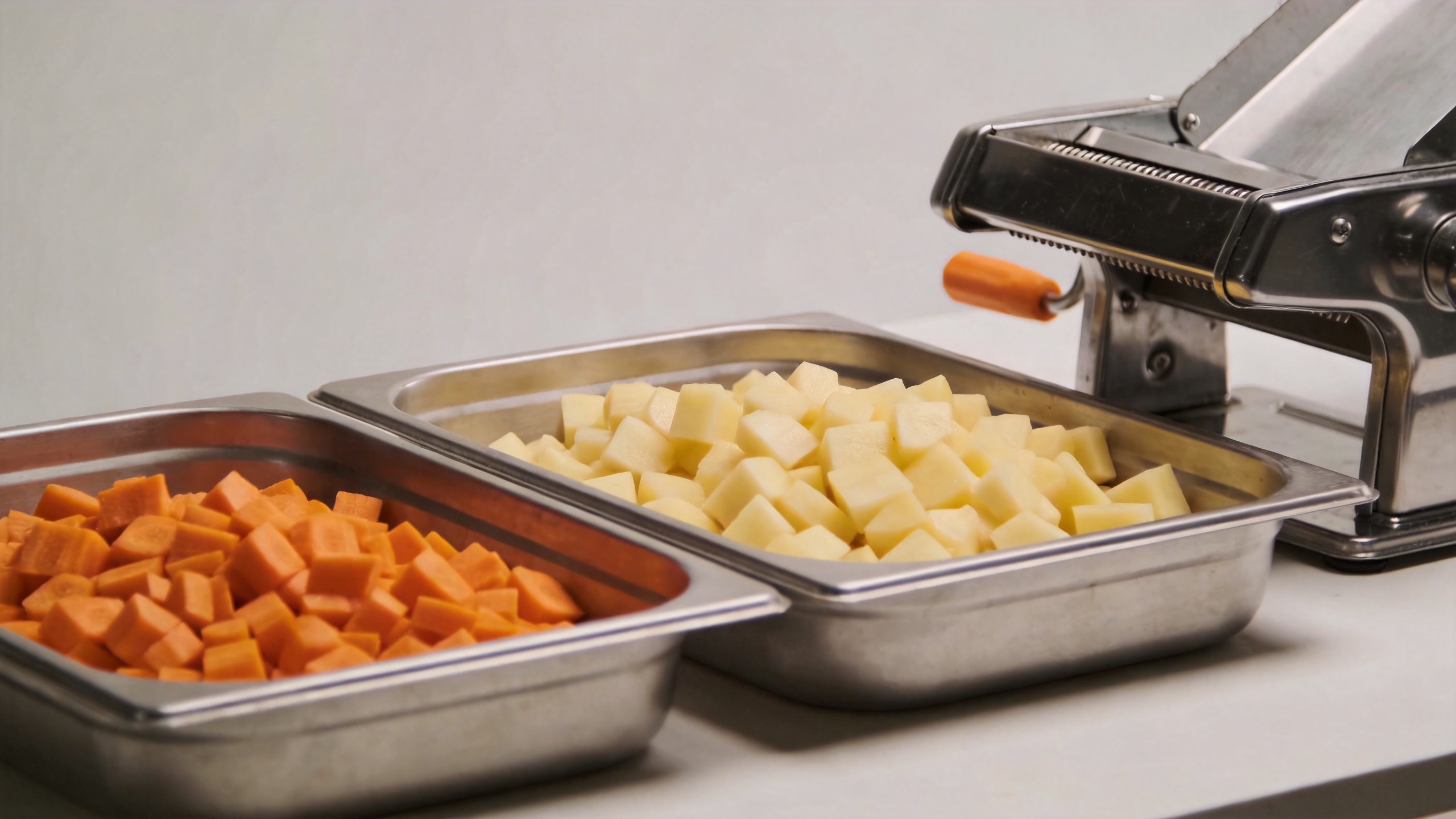
Use the veg dicer machine as a process decision, not a stand-alone purchase
A veg dicer machine should be reviewed together with line capacity, labor flow, cleaning time, and changeover frequency. A search result for commercial dicing equipment described adjustable cut sizes alongside a 300–800 kg/h capacity range, showing why size selection and throughput should be evaluated together. At higher output, even a small increase in fines or variation can create a significant sorting or yield issue.
Before buying or changing a cut set, map the entire route from receiving to packing. Note where vegetables are cooled, how they are fed, where samples are taken, and whether the next machine has a size-sensitive inlet. If multiple products run on the same line, list the required size ranges and the time needed to clean or change cutting components between them.
A practical trial plan for defining the right dice
- Set the final-use target. Define the product application, desired visual effect, and acceptable tolerance.
- Choose two or three candidate sizes. Avoid jumping directly to a single grid size when the final result is uncertain.
- Prepare representative raw material. Use the actual varieties, temperatures, and pre-treatment conditions expected in production.
- Run a controlled trial. Record output weight, fines, damaged pieces, cube consistency, and cutting behavior for each setting.
- Process the samples downstream. Cook, freeze, dry, or package them as they will be handled commercially.
- Approve the result against the final specification. Select the setting that provides a suitable balance of appearance, yield, throughput, and repeatability.
Do not judge the trial only at the cutter. A cube that looks uniform immediately after dicing may react differently after a blancher, freezer, fryer, or packing system. The final product is the real test.
Make the vegetable dicer machine setting easy to verify
Once a target size is selected, document the vegetable dicer machine setup in a short operating standard. Record the cutting set, product temperature, feed preparation, expected cube appearance, sample frequency, and accept/reject limits. This gives production teams a repeatable reference when the same vegetable dicer machine runs a different shift or a different raw-material lot.
Use a retained sample board or a simple sieve-and-visual check to compare the output of the vegetable dicer machine with the approved result. The aim is not to chase one mathematical dimension at every moment. It is to identify a drift before too much material moves downstream. If the vegetable dicer machine begins producing extra fines, crushed pieces, or elongated cuts, check raw-material condition and feed preparation before assuming that the grid itself is at fault.
A veg dicer machine trial should also include normal changeover conditions. Ask an operator to clean, reassemble, and set the vegetable dicer machine using the written standard. If the intended size depends on steps that are difficult to repeat, the chosen configuration may create avoidable variation during routine production.
Build flexibility into your vegetable dicer machine selection
When a product range includes several recipes or seasonal vegetables, flexibility is often more valuable than optimizing for one size alone. Confirm which cutting components are available, how changes are made, and how operators can verify the selected configuration. Also consider access for sanitation, because residue around cutting parts can affect both hygiene and cutting quality.
For teams evaluating a commercial option, the Commercial Industrial Electric Vegetable Cutter Dicing Machine for Potato, Fruit & Green Onion can be discussed with the supplier using your own raw material and finished-product specification. Request a trial plan that focuses on your required cube quality, feed condition, and downstream process rather than relying on a nominal size alone.
Conclusion: choose the size that works after the cut
The right vegetable dicer machine cut size is the one that supports the complete production process. Start with the finished product, account for cooking and handling, test the actual vegetables, and validate the results after downstream processing. By using a structured trial instead of selecting a grid by appearance alone, buyers can make a more reliable decision on both cut size and equipment configuration.