EN


Bubble Washer vs. Vortex Washer: Which Fruit Washing Method Fits Your Line?
Choosing a fruit washer machine is not simply a choice between two tank designs. For a processor, the right washing action has to match the crop, the incoming soil load, the desired product appearance, and the way the washer connects to trimming, cutting, drying, or packing. Bubble and vortex systems both use water as the cleaning medium, but they move produce differently. That difference can affect cleaning consistency, product damage, labor needs, and downstream flow.
This comparison is designed for line planners evaluating fruit and vegetable washing equipment. Rather than treating one method as universally better, start with the material and the production objective: remove loose soil from robust produce, protect delicate leaves, or create a stable wash stage for mixed raw-material intake.
How bubble washing works on a fruit washing line
A bubble-style fruit washer machine introduces air into the wash water. Rising bubbles agitate the water and gently turn produce over, helping loosen dirt, sand, and light debris from surfaces and crevices. The action is usually broad across the tank, so it can be useful when product arrives with variable soil loading or when a line needs a forgiving first wash before inspection.
For potatoes, carrots, radishes, and other more robust products, the combination of soaking and bubble agitation can provide useful contact without relying solely on brushes. It can also suit apples, citrus, or other firm fruit when the conveying and discharge arrangement are set up to avoid impact points. The actual result depends on dwell time, water condition, product loading, and how the machine is adjusted—not on the bubble feature alone.
The engineering question is whether the agitation is enough to release field debris while remaining calm enough for the product. Overloading a tank can reduce water movement around each piece; running a very fragile crop through an overly energetic zone can create bruising or leaf breakage. A sample run with the real crop is more valuable than choosing from a category name.
How vortex washing changes the cleaning action
A vortex fruit washer machine uses directed water flow to create a circulating washing pattern. Instead of relying mainly on rising air bubbles, the water current moves product through a controlled swirl or rolling path. This can be particularly helpful where a line must keep lighter material moving evenly and prevent it from sitting in a dead zone.
Leafy vegetables, cut vegetables, and lighter produce often need a cleaning motion that separates leaves or exposes surfaces without aggressive mechanical contact. A vortex approach can offer that water-led movement. It may also make sense when product flow consistency is as important as soil release, for example before dewatering or optical sorting. However, a vortex is not automatically gentler or stronger: pump flow, nozzle arrangement, water depth, and the crop itself determine the effective force.
For processors comparing equipment, the important distinction is practical. Bubble washing emphasizes air-assisted turbulence throughout the water bath. Vortex washing emphasizes a directed circulation pattern. Both methods need a well-designed intake, overflow or debris removal, and a discharge that transfers product without piling it up.
Bubble washer vs. vortex washer: a production comparison
| Decision point | Bubble washing approach | Vortex washing approach |
|---|---|---|
| Primary cleaning motion | Air bubbles and water agitation lift and loosen debris. | Directed water flow circulates and moves product through the wash zone. |
| Typical starting fit | Firm fruit, root vegetables, and variable incoming soil loads. | Leafy, lighter, or irregular products that benefit from controlled water movement. |
| Key setup focus | Air volume, tank loading, soak time, and debris separation. | Flow direction, circulation intensity, product retention, and discharge stability. |
| Main validation risk | Insufficient contact at high loading or excessive agitation for fragile product. | Uneven circulation, product clustering, or flow that is too energetic for the crop. |
| Line role | Often a versatile primary or pre-wash stage. | Often selected where gentle movement and controlled conveying are central. |
These are starting points, not fixed rules. A firm leafy product and a soft root crop can each change the decision. A reliable comparison uses a documented trial with the same incoming material, water quality, loading rate, and downstream acceptance criteria.
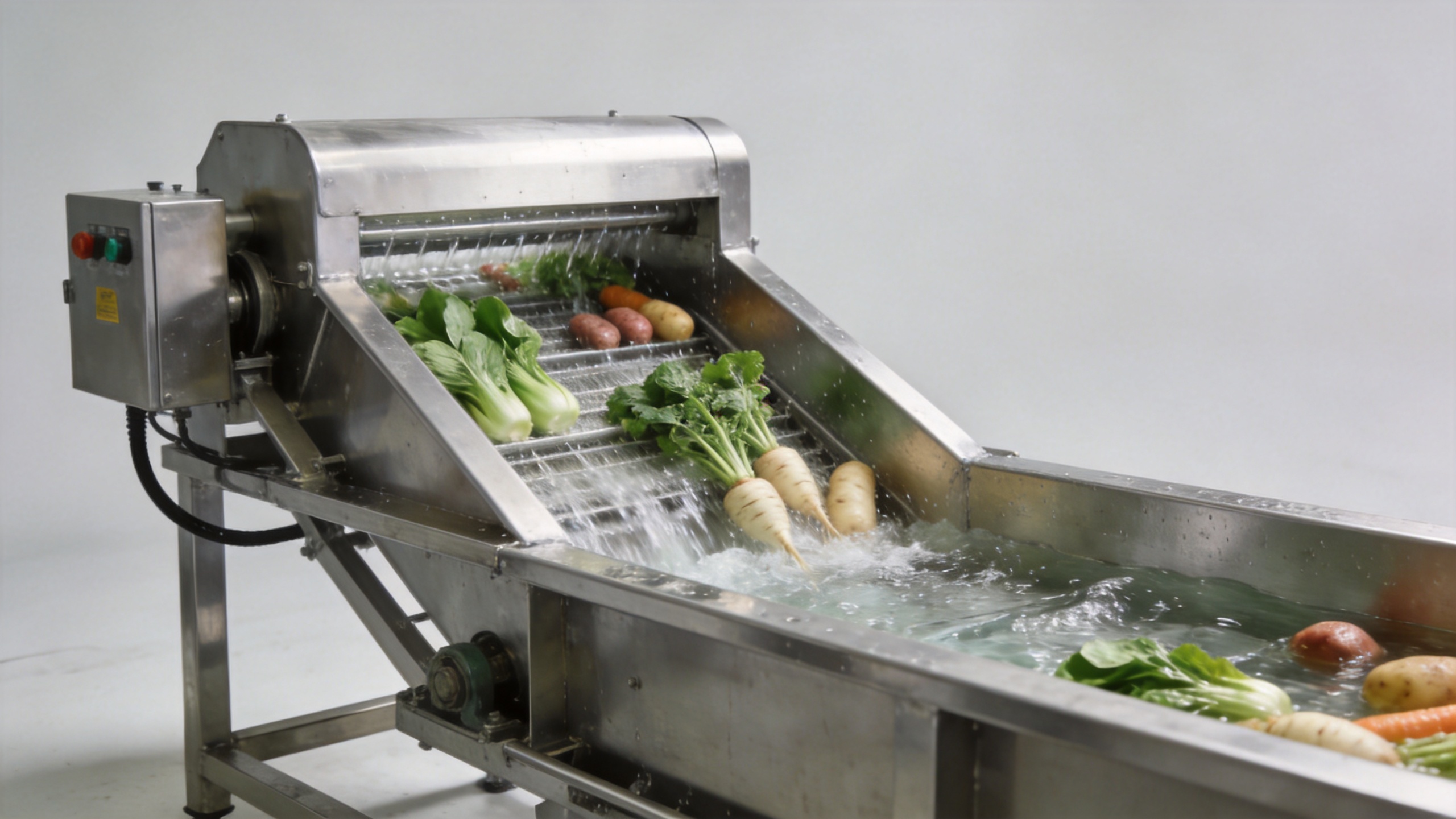
Match the washer to your produce and contamination profile
Root vegetables and soil-bearing crops
When soil, sand, and field debris are the dominant problem, a bubble system can be an effective first candidate because soaking and distributed agitation help release loose contamination. Check whether sediment can be removed continuously and whether the product reaches a rinse stage before it travels to cutting or packing. For heavily soiled crops, a washer should be evaluated as one part of a sequence, not as the only cleaning barrier.
Leafy vegetables and light materials
For lettuce, herbs, leafy greens, and similar produce, protect the usable yield. A vortex configuration may provide a more controlled path through water, but the trial must inspect leaf separation, trapped debris, breakage, and the condition of the product at the dewatering stage. If the product floats, confirm that the line’s guides and discharge design maintain even residence time.
Firm fruit and mixed-product programs
Firm fruit can work with either approach when the handling path is smooth. In mixed-product operations, flexibility may matter more than a single preferred washing action. Ask how readily water movement, belt speed, and product retention can be adjusted between production runs. A line that produces clean product on one crop but requires excessive manual correction on the next is not truly flexible.
Look beyond the wash tank: five line-integration checks
- Infeed control: Can the upstream elevator or feed table prevent surges that overload the wash zone?
- Debris management: Where do soil, floating leaves, and heavy particles go, and can operators clean those points safely?
- Water management: Define filtration, replenishment, drainage, and sanitation procedures around the actual crop and local requirements. A recirculation concept only works when water quality is actively managed.
- Product transfer: Inspect every handoff to a spray rinse, elevator, dewatering unit, or cutter. Product damage often occurs at a transfer point rather than in the washing action itself.
- Trial criteria: Measure visible soil, damaged product, operator intervention, water condition, and downstream throughput before making a purchase decision.
For buyers who need a vortex-focused option, review the available commercial stainless-steel vortex fruit washing machine as a starting point for discussing line layout. Confirm the final configuration, material suitability, and operating parameters with the supplier before selection.
A practical selection process for your fruit washer machine
Begin with a short product matrix: crop name, size range, firmness, floating behavior, soil type, target hourly output, and the next process step. Then run representative samples through each proposed cleaning action. Review the product at the washer exit and again after dewatering or cutting, because a small amount of damage may become more visible later in the line.
Choose bubble washing when broad air-assisted agitation and soaking align with your product and contamination load. Choose vortex washing when controlled water circulation and product movement better serve delicate or light materials. In many projects, the final answer is not “bubble or vortex” in isolation; it is the wash method that produces stable quality with the least handling stress and the cleanest integration into the complete fruit and vegetable processing line.
Fruit washer machine evaluation checklist
Use this checklist when comparing each proposed fruit washer machine configuration. It keeps the fruit washer machine discussion tied to measurable line conditions rather than brochure language.
- Does the fruit washer machine clean the actual crop at the planned feed rate?
- Can the fruit washer machine maintain even product movement during a short surge?
- Does the fruit washer machine release soil without increasing damaged or broken product?
- Can operators set the fruit washer machine for both a delicate crop and a firmer crop?
- Does the fruit washer machine provide practical access for debris removal and routine cleaning?
- Is the fruit washer machine water-management plan compatible with the site’s filtration and sanitation routine?
- Does the fruit washer machine discharge product cleanly to the next conveyor or dewatering stage?
- Can the fruit washer machine be integrated without creating a manual bottleneck?
- Is the fruit washer machine trial assessed after downstream handling, not only at the tank exit?
- Does the proposed fruit washer machine layout leave room for safe inspection and maintenance?
Document results under the same incoming conditions so the comparison is defensible across engineering, quality, and operations teams.
Conclusion
A well-matched fruit washer machine supports more than appearance. The right fruit washer machine helps protect yield, stabilize downstream operations, and give operators a repeatable process. Use the crop, the contamination profile, and a real production trial to compare bubble and vortex washing. With the right data from your own line, the fruit washer machine selection becomes an engineering decision rather than a guess.