EN


Cashew Processing Plant Cost Factors: Automation, Labor and Capacity
A kaju processing plant is rarely priced as one fixed machine. It is a connected production system, and its budget changes with process scope, automation level, labor design, capacity target, utilities, and commissioning requirements. For a buyer preparing a quotation request, the useful question is not simply “What does a plant cost?” It is “What configuration can deliver the required kernel output and quality with a labor model we can operate?”
From a procurement perspective, the equipment price is only the starting point. A line that appears inexpensive can become costly if it creates a bottleneck at shelling, relies on a labor pool that is unavailable during peak season, or requires upgrades soon after commissioning. This guide helps buyers frame a kaju processing plant inquiry around total operating fit rather than a headline number. A practical kaju processing plant budget starts with the operating model, not a catalog price.
Start with the process scope, not the final price
Cashew processing normally moves through receiving and grading, conditioning or steaming, shelling, drying, peeling, grading, and packing. Not every kaju processing plant includes every module. Some projects begin with raw cashew nuts and require a broader line; others purchase kernels at an intermediate stage and only need drying, peeling, grading, or packing. That boundary has a direct effect on capital cost in every kaju processing plant proposal.
Ask suppliers to itemize the quotation by process section. For a kaju processing plant, this makes it easier to compare what is included: conveyors and buffers, conditioning equipment, shelling machines, kernel separation, dryers, peelers, graders, metal detection, packing, controls, and auxiliary systems. Also identify whether foundations, installation supervision, spare parts, and operator training are included. A lower quote is not necessarily a lower project cost if these items sit outside the initial scope.
Automation level changes both investment and operating risk
The biggest cost choice in a kaju processing plant is usually the degree of automation. A manual or semi-automatic line can reduce initial equipment investment and give operators flexibility in smaller operations. However, shelling and peeling are labor-intensive stages, so the operating model depends heavily on worker availability, training, supervision, and consistent handling.
A more automated configuration typically adds material handling, synchronized process controls, automatic feeding, sorting, and packaging functions. It increases upfront investment, but can reduce repetitive manual touchpoints and help a plant manage a higher, more stable flow. Automation is not automatically the preferred choice for every project. If raw material supply is seasonal, the expected running hours are low, or technical support is limited, a simpler line may fit better.
| Configuration | Initial cost direction | Labor requirement | Best evaluated against |
|---|---|---|---|
| Manual / basic | Lower | High | Small volume, flexible batches, dependable labor |
| Semi-automatic | Mid-range | Moderate | Growing output with selected bottleneck automation |
| Highly automated | Higher | Lower per unit of output | Stable feedstock, higher utilization, controlled workflow |
Rather than asking for “full automatic” by default, define which stations must be automated and why. For example, a buyer may automate feeding and shelling first while retaining manual inspection where visual quality judgement remains important. That produces a more useful kaju processing plant comparison than a generic automation label. It also shows where a kaju processing plant can be upgraded in phases.
Labor cost is more than headcount
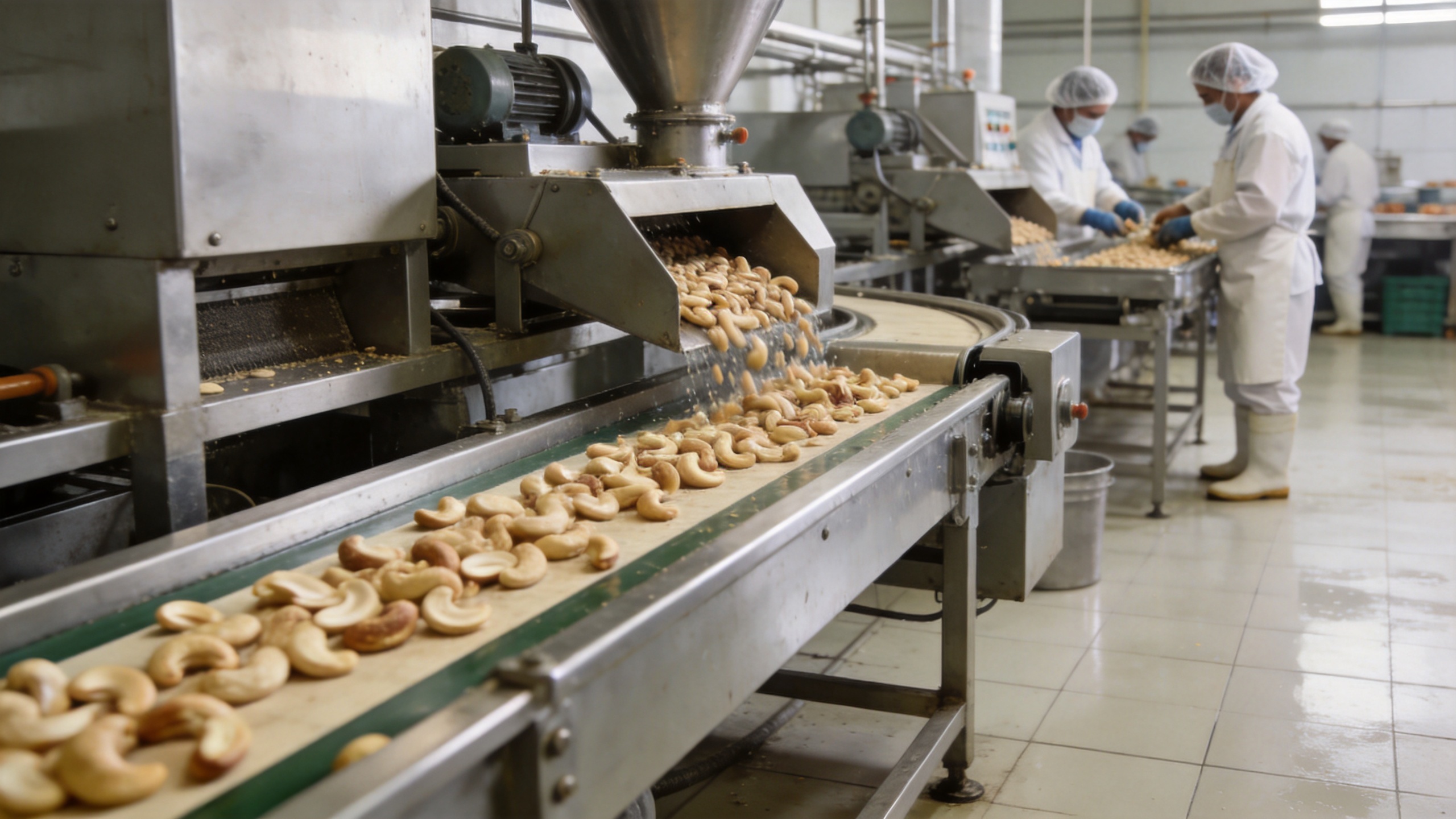
Labor planning should cover the people needed at each shift, not only the number of operators standing beside machines. Include raw-material handling, shelling and separation, peeling inspection, grading, packing, sanitation, maintenance support, quality checks, and shift supervision. The real cost also includes recruitment, turnover, training time, personal protective equipment, absenteeism, and the effect of uneven operator skill on yield and product grade.
A common mistake is to compare a low-investment line with an automated line using only monthly wages. The better comparison is cost per acceptable unit of output over the expected utilization period. If the plant cannot maintain staffing at the bottleneck stage, the nominal machine capacity will not translate into shipped kernels. Likewise, adding automation without a maintenance plan can trade one labor problem for avoidable downtime.
For cashew processing, hygiene planning must be part of this labor discussion. Cleanable equipment surfaces, sensible product flow, worker changing practices, and storage discipline all require time and layout allowance. These are operating needs, not decorative extras, and they should appear in the kaju processing plant specification.
Capacity drives machine sizing, utilities, and layout
Capacity should be defined in a way the supplier can engineer: raw nut input per hour or day, target kernel output, working shifts, expected operating days, and the desired product grades. A kaju processing plant should be sized around the slowest stable stage, not around the highest rating on one machine brochure.
Before selecting equipment, calculate a practical throughput target from annual demand and divide it by realistic operating hours. Then add a margin for cleaning, changeovers, planned maintenance, and seasonal supply variation. If your monthly volume is stable at a meaningful scale, investing in a more continuous flow may be justified. If volume fluctuates sharply, a large line may sit underused and its fixed costs become harder to absorb.
- State raw-cashew input and finished-kernel target separately.
- Specify shifts per day and expected annual operating days.
- Describe product grade mix and packing formats.
- Share available floor space, power, steam or heat source, compressed air, and drainage conditions.
- Ask where the proposed line’s actual bottleneck will be under your operating assumptions.
Do not overlook utilities, safety, and commissioning
Equipment purchase is only one part of a kaju processing plant project. Budget for electrical distribution, heat or steam generation where required, ventilation, compressed air, water, drainage, civil works, installation, and start-up support. The local availability and price of these utilities can change the economics of a proposed process route.
Safety and maintainability deserve the same attention. Cashew shell processing can involve heat, moving equipment, and material-handling risks. Review guarding, emergency stops, access for cleaning, spare-parts recommendations, and the local service plan. For the kaju processing plant, request a list of wearing parts and an initial spares package so that the first maintenance cycle does not depend on an urgent international shipment.
A practical quotation checklist for buyers
When requesting a proposal for a kaju processing plant, send a structured brief. It reduces back-and-forth and lets suppliers propose equipment around your real constraints.
- Raw material type, condition, and planned input volume.
- Required output, grades, and packaging formats.
- Operating hours, shifts, labor availability, and technical staffing.
- Preferred automation at each major process stage.
- Available utilities, building dimensions, and local installation conditions.
- Required sanitation, safety, and quality-control practices.
- Budget range and whether the project will be installed in phases.
Buyers comparing a complete solution can also review the industrial cashew nut shelling, peeling, and packing processing machine line as a confirmed product-page reference when discussing the scope of an integrated line.
Choose the configuration that matches your operating model
The right kaju processing plant is not defined by the lowest purchase price or the highest automation level. It is the one whose process modules, labor plan, throughput, utilities, and maintenance capability match the way the factory will actually run. A phased project may be sensible when demand is still developing; a more integrated line may be a stronger long-term choice when feedstock, staffing, and utilization are predictable.
Use the quotation checklist to request an itemized proposal, then compare options on total project scope and cost per sustainable output—not on equipment price alone. That approach gives your team a clearer basis for budget approval, supplier evaluation, and commissioning planning.