EN


Coconut Dryer Machine: Key Factors for Even Drying Quality
Uniform moisture is the real production target, not simply a short drying time. A well-configured coconut dryer machine helps processors turn sliced coconut meat or copra into a stable, consistent material for the next stage. For export-oriented food operations, uneven batches can mean dark edges, wet centers, extra rework, and uncertainty during packing. This guide explains what buyers should examine before selecting and commissioning a coconut drying system.
Why a coconut dryer machine can produce uneven batches
A coconut dryer machine removes water by transferring heat to the product and carrying released moisture away with moving air. The process becomes uneven when either heat or airflow takes an easier path through the chamber. Air may rush across the trays nearest the fan while passing too slowly through the middle or lower levels. At the same time, thick pieces, overloaded trays, or a mixed batch of coconut sizes dry at different rates.
That is why the practical question is not only “What temperature can the machine reach?” A coconut dryer machine needs controlled circulation, a sensible loading pattern, and a way to verify the final moisture of representative samples. Search results for commercial copra dryers commonly focus on capacity and maximum temperature; in day-to-day operation, air distribution and loading discipline are just as important.
1. Build the process around consistent raw material preparation
The most capable coconut dryer machine cannot fully correct a poorly prepared feed. Standardize slice thickness or chip size before loading. Separate very small pieces from thicker pieces when practical, and avoid combining fresh material with partially dried stock in one run. Surface water should be drained before the product enters the dryer, because puddling on trays blocks airflow and creates local wet zones.
Buyers should ask for a recommended loading depth rather than relying on a theoretical tray area figure. A shallow, even layer gives hot air access to more product surface. If production needs a deeper bed, the coconut dryer machine should be evaluated for airflow resistance and for how operators rotate or exchange trays during the cycle.
2. Match airflow design to the tray layout
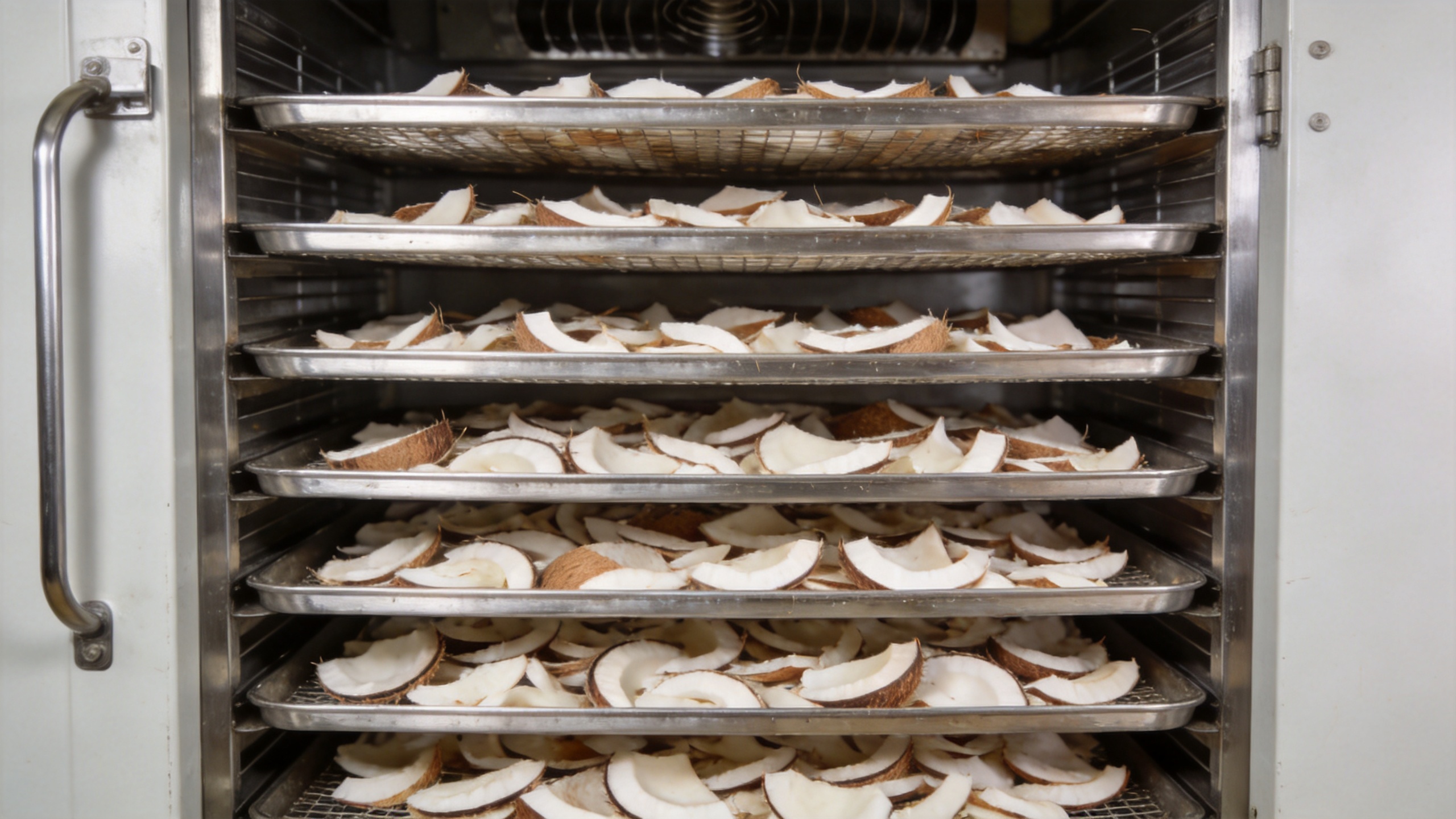
In a tray-style coconut dryer machine, even drying depends on whether each tray sees a similar volume of conditioned air. Plenum design, fan direction, adjustable dampers, and the distance between trays all influence this result. In a belt or continuous system, belt loading and air direction need the same attention. A supplier demonstration should show more than a temperature screen: it should show temperature and moisture checks at multiple locations in the load.
- Air volume: Enough flow must cross the product to remove humid boundary air.
- Air direction: Reversing or balanced circulation can reduce the difference between inlet and outlet zones.
- Tray spacing: Spacing must leave a clear path for air rather than compressing product layers together.
- Sealing: Uncontrolled leaks can bypass the product and weaken the designed air path.
When comparing a coconut dryer machine, request a layout drawing that identifies fan locations, air inlets, return paths, and the expected tray-loading method. This makes it easier to compare designs on a process basis rather than on chamber size alone.
3. Control temperature gently, then verify the product
Higher heat can accelerate evaporation, but it does not automatically make a coconut dryer machine more uniform. Excessive surface heating may dry the outside quickly while the interior moisture moves more slowly. The suitable setpoint depends on the coconut format, initial moisture, product specification, and intended use. One retrieved study summary on copra reported a 90°C condition associated with a 7% moisture endpoint; it should be treated as an application-specific reference, not a universal recipe.
A reliable operating method uses staged settings: an early phase to remove free moisture, a controlled middle phase for internal moisture migration, and a finishing phase followed by conditioning. During commissioning, sample several trays or positions instead of taking one sample near the door. This approach gives the coconut dryer machine operator evidence of the batch spread, not just an average number.
4. Use sensors, sampling, and feedback together
Temperature sensors are necessary, but they do not replace product measurement. A coconut dryer machine should provide clear control of chamber temperature, time, and fan operation. For more demanding operations, humidity or exhaust-air monitoring can help the team see when moisture removal is slowing. Whatever the automation level, a simple sampling plan remains valuable.
- Define sampling points: fan side, center, far side, upper and lower trays.
- Measure moisture or use a validated weight-loss check at the same points.
- Record the spread, not only the average.
- Adjust loading, fan timing, temperature stages, or tray rotation based on the spread.
These records help buyers establish repeatable recipes for each coconut cut. They also make it easier to identify whether a problem comes from raw material variation or from the coconut dryer machine itself.
5. Specify capacity as usable capacity, not just chamber volume
Capacity claims should be linked to product form, starting moisture, target moisture, layer thickness, and cycle time. A coconut dryer machine that is overloaded to meet a headline capacity may deliver a less consistent result and require a longer correction cycle. During supplier discussions, provide a real sample description and request a test plan with defined acceptance criteria: moisture range across the load, visual quality, cycle time, and energy use per batch.
For buyers considering a multipurpose food dehydrator, Industrial Drying Vegetable Dryer Fruit Drier Machine Dehydrator Automatic is a relevant product category to discuss with the supplier. Confirm the actual coconut process configuration and test results before making a purchasing decision.
A practical buyer checklist for a coconut dryer machine
- Can the supplier explain the full airflow path and fan-control logic?
- What slice thickness, tray loading depth, and batch size were used for the stated capacity?
- How will the coconut dryer machine be tested at multiple tray positions?
- Are temperature, time, and fan settings recorded for repeatable recipes?
- Is tray rotation or airflow reversal recommended for the intended coconut format?
- What moisture range defines acceptance for the buyer’s final product?
Even drying is achieved through a system, not a single feature. The right coconut dryer machine combines suitable product preparation, balanced airflow, controlled heating, and disciplined verification. By asking for these details before purchase and validating them during commissioning, processors can build a drying operation that is easier to control as volumes grow.