EN


Commercial Nut Grinder: How to Plan a Flexible Nut Butter Line
A flexible nut butter line is more than a commercial nut grinder placed between a hopper and a filling machine. It is a coordinated system that must handle ingredient variability, sanitation, changeovers, buffering, and packaging without turning every new SKU into a disruption. For processors considering several nut types or recipes, the right question is not “Which commercial nut grinder is sized for the full line?” It is “Which line layout lets the whole process run predictably at the product mix we actually plan to sell?”
As a technical adviser evaluating food-processing equipment, I start with the production flow and the operating conditions, then compare machine specifications, and only then discuss configuration. That sequence matters because a commercial nut grinder can appear suitable on paper while the line around it creates the real bottleneck.
Start With the Product Family, Not the Grinder
Before choosing a commercial nut grinder, group products by the things that change process behavior: raw versus roasted inputs, particle-size expectations, oil separation tolerance, inclusions, allergens, and cleaning requirements. Peanut butter, almond butter, sesame paste, and mixed-nut spreads can share some equipment, but they do not necessarily share the same practical changeover routine.
Define three production families: frequent-run products, occasional products, and restricted products that require a more rigorous allergen or sanitation break. This simple map determines whether you need a shared line with planned campaigns or dedicated downstream paths. It also prevents a common mistake: treating every recipe as though it has the same flow characteristics.
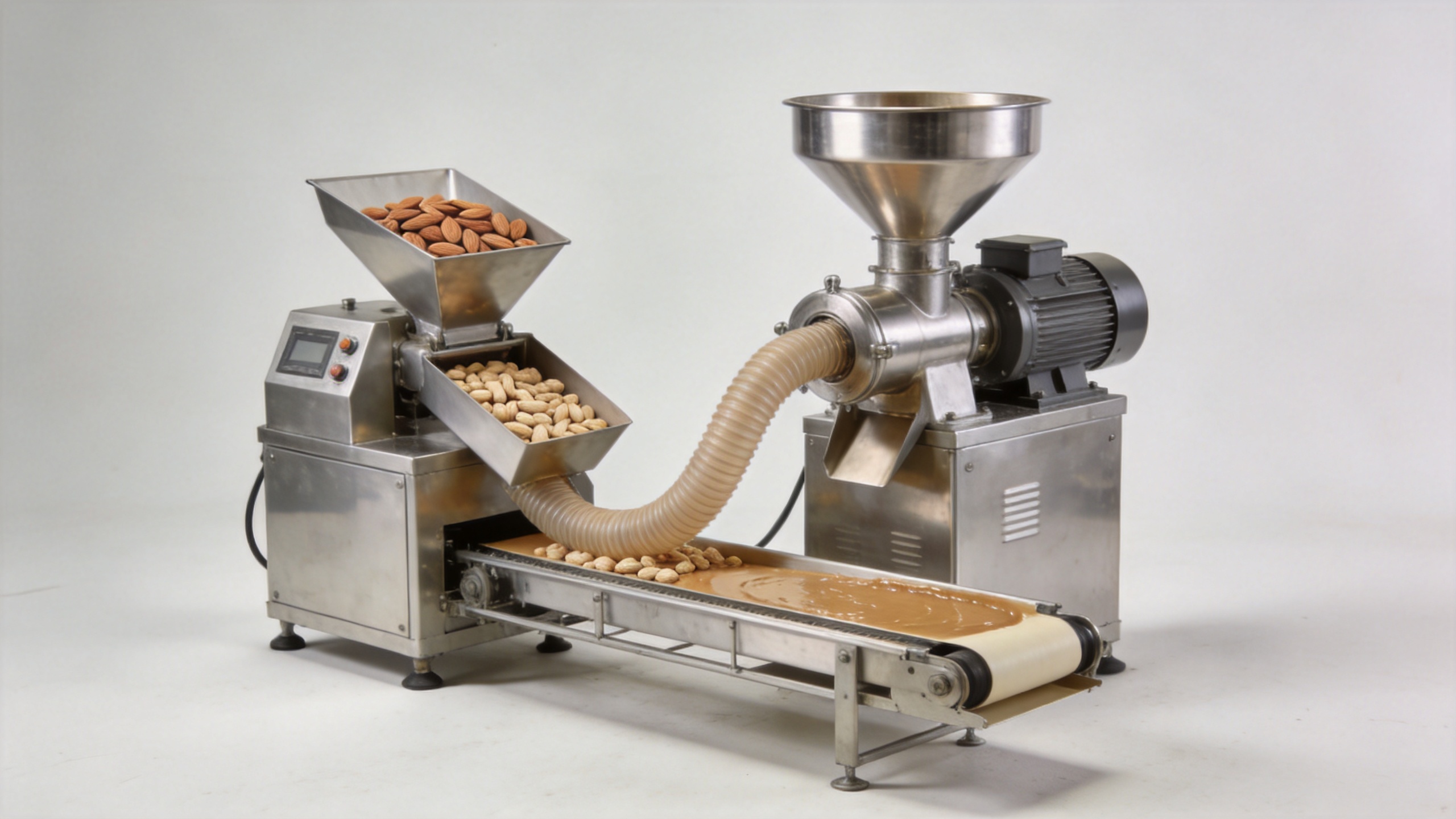
For an established product family, a peanut butter production machine for nut factories can be reviewed as part of the grinding and packing workflow. The confirmed product record lists a 200 kg/h rating; whether that rating fits your operation still depends on recipe, feeding continuity, planned cleaning time, and the capacity of downstream packing.
Build the Line Around Stable Material Flow
A flexible line usually follows a sequence: receiving and inspection, optional roasting, cooling, sorting, feeding, grinding, optional mixing or deaeration, buffering, filling, and packing. Each stage should be evaluated as an interface, not as an isolated machine.
| Line stage | Planning question | Why it affects flexibility |
|---|---|---|
| Pre-processing | Will all nut types enter at the same temperature and moisture condition? | Different incoming conditions change grinding behavior and consistency. |
| Feeding | Can the feed system maintain a steady, controllable flow? | Interrupted feeding can create uneven load and inconsistent texture. |
| Grinding | Can the commercial nut grinder be set and cleaned for the intended product families? | Grinding is central, but it cannot compensate for unstable upstream material. |
| Buffering | Is there enough controlled holding volume between processing and filling? | A buffer absorbs small speed differences without forcing the grinder to stop repeatedly. |
| Filling | Does packaging speed match the actual—not merely nominal—output? | A slow filler can turn a well-sized grinder into an underused asset. |
Many buyers initially focus on the rated output of the commercial nut grinder, then overlook feeder, buffer, and filler constraints. A better approach is to estimate usable output after normal pauses: ingredient replenishment, formula checks, changeovers, and cleaning. If the filler or buffer cannot absorb those rhythms, increasing grinder capacity alone will not create a flexible line.
Choose Modular Capacity Instead of One Oversized Bottleneck
For consideration-stage decisions, compare two models: a tightly integrated line sized for one stable recipe, and a modular line that can accept future changes. Integrated systems can simplify installation; modular systems usually make it easier to add a feeder, a buffer, a mixing section, or a second packaging route later. Neither is automatically better. The right choice depends on how stable your product range will be.
Buying a commercial nut grinder far above current needs may appear to create room for growth. However, if demand growth is uncertain, idle capacity can increase capital tied up in equipment, utilities, and maintenance. Conversely, selecting only for today may force an expensive retrofit when a new SKU requires a different feeding or packing rhythm. A sensible plan reserves physical space, utility connection points, and control-system expansion options even if every module is not purchased on day one.
- Set a realistic base case for normal weekly volume rather than using the high-case forecast.
- Identify one likely expansion path, such as another filling head or an additional buffer tank.
- Confirm how product contact parts, pipework, and controls would connect to that future module.
- Keep access space for cleaning, inspection, and replacement parts; compact layouts that block service access are rarely flexible in practice.
Make Changeover Time a Design Requirement
The commercial nut grinder is one part of a changeover. In a shared line, product residue can remain in hoppers, feed screws, transfer paths, buffer vessels, and filler components. The practical design target is not “fastest possible cleaning” in isolation; it is a documented, repeatable procedure that protects product quality and fits the production schedule.
Think through changeovers before layout approval. Which parts can be opened safely? Where can material collect? Can operators visually verify cleaning? Are dedicated tools or removable contact parts needed for restricted product families? These questions are especially important when the product mix includes allergen-management requirements.
There is also a trade-off between automation and operating capability. More automated nut butter machines may reduce repetitive handling, but they can require stronger controls troubleshooting and maintenance discipline. For a site without dedicated technical support, a clearly accessible, well-documented semi-automated configuration may deliver more reliable flexibility than a highly complex system.
Balance Texture Control, Heat, and Downstream Packing
Texture expectations should be written as process targets, not left as subjective descriptions. Specify what “smooth,” “coarse,” or “with inclusions” means for your product team, then confirm how the line will manage the associated process steps. A commercial nut grinder influences particle reduction, and the full line must support that result, but ingredient condition, recirculation logic, mixing, and temperature control can all affect the final result.
Be careful with assumptions about continuous running. Actual output can differ from a quoted rating when the formula changes, when operators pause to inspect product, or when the packaging side needs attention. Instead of promising a universal loss factor, include a short trial plan: run representative materials, observe product temperature and texture, verify the handoff to the filler, and record the time required for a normal changeover.
That trial should use the recipes most likely to challenge the line, not only the easiest one. The goal is to find the operational limits before final acceptance, when changes to feed control, buffering, or cleaning access are still manageable.
A Practical Evaluation Checklist for Nut Butter Machines
- Product scope: List every nut, seed, recipe, and inclusion expected in the first production year.
- Production rhythm: Define campaign size, planned runs per week, sanitation windows, and packaging formats.
- Interface capacity: Compare feeder, commercial nut grinder, buffer, and filler capacities as one system.
- Changeover design: Review product-contact paths, cleaning access, and allergen-control requirements.
- Utility and space plan: Confirm power, ventilation, floor loading, operator circulation, and future expansion points.
- Acceptance plan: Agree on representative-material trials and continuous-operation checks before final sign-off.
- Service readiness: Clarify training, manuals, spare-parts planning, and remote technical support arrangements.
Plan for Flexibility You Can Actually Operate
A commercial nut grinder is a critical choice for a flexible line, but the most flexible nut butter line is built through interfaces: stable feeding, manageable cleaning, sensible buffering, matched packing, and room to grow. A line that looks efficient in a simplified flow diagram can become difficult to run if operators cannot clean it quickly, diagnose an interruption, or change a product family without losing the day.
Start with the product family and production rhythm, then use the checklist to compare complete line concepts. For buyers planning a new or expanded nut butter operation, a supplier discussion is most productive when it includes representative materials, expected package formats, layout constraints, and the expansion route—not just a target capacity for a commercial nut grinder and its connected equipment.