EN


Commercial Peanut Butter Machine Price: What Should Food Factories Compare?
A commercial peanut butter machine quote is rarely a simple equipment price. For a food factory, the useful comparison is the total production scope behind the quote: what material enters the line, what leaves it, which utilities are required, and which services remain after shipment. This matters especially when two offers appear similar but describe different capacities, automation levels, packing arrangements, or acceptance terms.
As a practical procurement exercise, ask every supplier to quote the same process boundary. A commercial peanut butter machine may be supplied as a single grinding unit, a small processing set, or part of a larger line with handling and packing equipment. Comparing a low headline number with a broader turnkey offer does not show which option fits the factory.
1. Start with the production scope, not the commercial peanut butter machine price alone
Before discussing price, write down the intended process: roasted peanuts or raw peanuts; plain paste or a recipe with sugar, salt, stabilizers, or inclusions; bulk filling or retail packaging. Then ask the supplier to identify every included machine and every excluded interface. This gives the commercial peanut butter machine quote a clear boundary.
- Ingredient receiving, sorting, roasting, cooling, peeling, or grinding
- Mixing, buffering, transfer pumps, and product-contact piping
- Metal detection, filling, capping, vacuum or other packaging functions
- Electrical controls, installation materials, commissioning, and training
If an item is optional, keep it as a separate line rather than assuming it is included. This approach makes it easier to compare a peanut butter making machine package with a phased expansion plan.
2. Normalize capacity claims before comparing offers
Capacity is often the biggest driver of a commercial peanut butter machine price, but “kg/h” is meaningful only when the test conditions are stated. Request the product recipe, peanut preparation state, target fineness, operating hours, and whether the figure is a peak value or a sustained output. Ask whether cleaning, changeovers, and packaging stops are excluded.
For example, the verified product record for Hongle Machinery describes an automatic peanut butter production machine with a stated 200 kg/h capacity, vacuum packing, and an oil-free design. Buyers should treat that figure as a starting point for a discussion of production conditions, not as a substitute for a documented acceptance test. A commercial peanut butter machine that reaches the required output consistently can be more valuable than a lower-priced unit rated only under ideal conditions.
| Comparison item | Question for the supplier | Why it affects cost |
|---|---|---|
| Rated output | At which recipe and fineness is capacity measured? | Grinding load and line size may change. |
| Operating time | Is output continuous, average, or peak? | It changes the number of shifts and buffers needed. |
| Yield and loss | How are startup and transfer losses handled? | It affects usable product per batch. |
| Future capacity | Can the line be expanded without replacing core equipment? | It affects the long-term commercial peanut butter machine investment. |
3. Compare the configuration behind each commercial peanut butter machine
Equipment specifications should be reviewed as a system. Product-contact materials, sealing parts, motor and drive selection, control components, safety guards, and cleanability all influence operating reliability and the final quote. Instead of requesting “an appropriate configuration,” specify the factory’s product, sanitation routine, local power supply, and expected working schedule.
Ask suppliers to separate standard configuration from upgrades. Useful questions include whether the grinding stage is designed for the requested texture, whether the transfer path can be cleaned efficiently, and whether controls provide the information operators need during normal production. For a commercial peanut butter machine, the cost of an option should be compared with its effect on labor, cleaning time, product consistency, and maintenance access.
4. Include packaging and downstream interfaces in the comparison
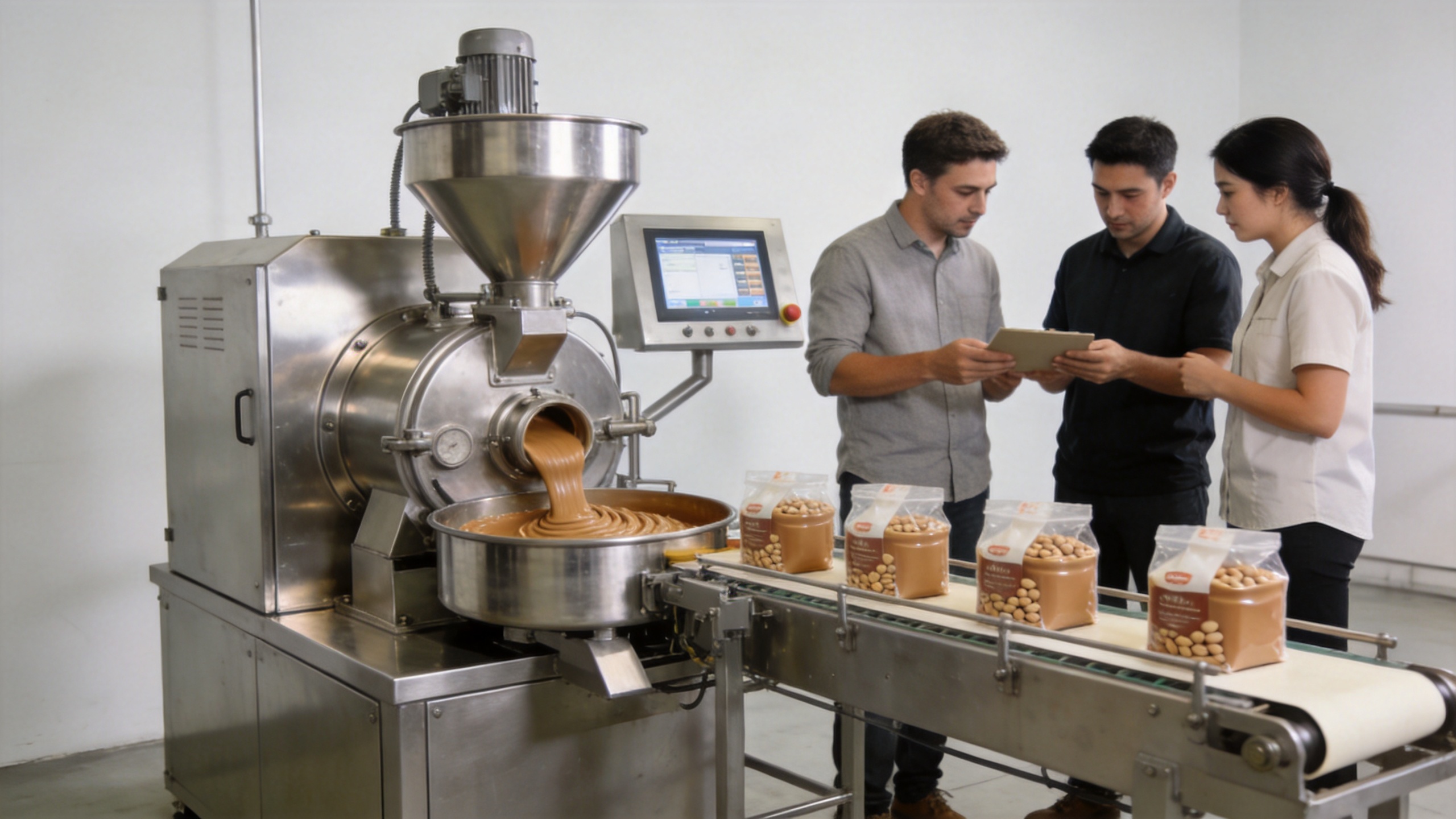
A factory can produce good paste and still lose time at filling. If retail jars, pouches, or vacuum-packed formats are part of the project, clarify whether the commercial peanut butter machine quotation includes product holding, feeding to the filler, filling equipment, caps or sealing, coding, and conveyors. The product record linked below is one example of a package described with vacuum packing; its exact scope should be confirmed in the supplier quotation.
Review the Automatic Peanut Butter Production Machine for Nut Factories when preparing a specification checklist. Do not assume that an included packaging phrase covers all jars, films, utilities, or integration work.
5. Put delivery, commissioning, and service terms beside the equipment price
A decision-stage comparison should show the landed and supported cost, not only the ex-works machine value. Request a written breakdown for lead time, packing method, shipping responsibility, installation support, commissioning, operator training, warranty scope, recommended spares, and response channels. Confirm who supplies foundation work, cables, compressed air, and product trials.
For overseas food factories, remote support can be meaningful if it is defined. Hongle Machinery’s current profile describes remote video technical guidance, operating manuals, and spare-parts support. Ask what documents, languages, response times, and commissioning steps are actually included in your commercial peanut butter machine offer. This converts a general service statement into a comparison item.
6. Use one quote sheet for every commercial peanut butter machine supplier
Create a side-by-side sheet with the same columns: process scope, documented capacity conditions, configuration, packaging scope, utilities, layout inputs, delivery term, commissioning, warranty, spare parts, exclusions, and total price. Attach the supplier’s drawing and clarification list to each version. A commercial peanut butter machine proposal is easier to approve when purchasing, production, engineering, and quality teams can review the same assumptions.
The most suitable offer is not automatically the lowest one. It is the commercial peanut butter machine proposal that clearly matches the factory’s required output, product format, operating capability, and support plan—with fewest unpriced assumptions. Send suppliers your completed checklist, request revisions on the same basis, and compare the final commercial scope before placing an order.