EN


Commercial Vegetable Washing Machine Price: What Affects a Supplier Quote?
A quote for a vegetable washing machine commercial application is rarely just a number attached to a standard machine. For a food processor, central kitchen, produce packer, or export-oriented operation, the useful question is: what exactly is included in the quoted scope, and will it fit the product, throughput, hygiene routine, and downstream line?
From a B2B procurement perspective, two machines can look similar in a catalog while carrying very different commercial vegetable washer quotes. One may be a basic batch unit; the other may include a larger wash tank, food-contact stainless steel specification, a blower system, controls, conveying, or provisions for integration. Comparing only the headline amount can therefore create a costly gap between the expected machine and the delivered line.
Start With the Quote Scope, Not a Standalone Price
Ask every supplier to identify the equipment boundary in writing. Is the offer for the washer only? Does it include pumps, air blowers, electrical controls, a discharge conveyor, installation guidance, spare parts, packaging, or commissioning support? These details shape the commercial vegetable washer quote just as much as the main frame does.
It also helps to distinguish between an indicative price and a configured quotation. An indicative figure may assume a simple standard build. A configured quotation should reflect the product to be washed, expected output, site utilities, operator workflow, and any adjacent equipment. The first number is useful for budgeting; the second is the basis for a defensible purchasing decision.
Capacity and Product Type Change the Machine Design
Throughput is one of the clearest price variables for a vegetable washing machine commercial project. Suppliers may describe capacity in kilograms per hour, but that figure is meaningful only when the product and loading method are stated. Leafy vegetables, root vegetables, cut produce, and delicate fruit do not move through water in the same way. Soil load, piece size, crop variety, and the required wash result can all change practical output.
Commercial listings illustrate the range of configurations: one relevant listing describes a batch bubble washer at 200 kg/hr, while other supplier material presents bubble-washing systems from several hundred kilograms per hour into larger customized capacities. Those examples are not universal specifications, and they should not be treated as a price benchmark. They do show why capacity cannot be compared without a test condition.
For a meaningful quotation, provide the supplier with:
- the product mix and the most difficult product to wash;
- target throughput per hour and expected operating hours;
- the desired incoming and outgoing handling method;
- acceptable product damage and water-use expectations; and
- space, drainage, voltage, and water-quality constraints.
A correctly sized commercial vegetable washer may cost more than a minimal unit, but undersizing can create labor bottlenecks, repeated handling, and unstable throughput later.
Material, Hygiene Design, and Water Management Affect the Build
In food equipment, material specification is not a cosmetic detail. The grade and thickness of stainless steel, weld finish, accessibility of the wash zone, drainage design, and food-contact components all influence fabrication effort and long-term cleanability. Supplier descriptions often reference food-grade stainless steel, but buyers should ask which areas use which material and how the design is cleaned between production runs.
Water handling is another quote variable. A basic washer may use a straightforward recirculation arrangement, while a more defined solution can include filtration, overflow management, fresh-water rinse sections, or provisions for sanitation modules. Optional ozone, UV, secondary rinse, or similar features should be quoted separately and evaluated against the process requirement rather than assumed as standard. A higher quote can reflect a more complete hygiene or water-management scope; it does not automatically mean better performance for every product.
Automation and Controls Are a Trade-Off, Not a Checklist Item
Automation can affect both the initial commercial vegetable washer quotation and the daily operating model. A manually loaded batch machine may suit a smaller or varied operation. Conveyor feeding, timed sequences, speed control, automatic discharge, or connected controls may make more sense where production is repetitive and labor availability is a constraint.
The practical question is not simply “Is it automatic?” Instead, ask which tasks are automated, who performs cleaning and changeover, and what happens when product flow changes. Higher automation can reduce handling steps, but it may also require more careful commissioning, training, electrical documentation, and service support. Request a controls list and clarify whether the quoted panel, sensors, motors, and safety devices match the planned operating environment.
Line Integration Can Turn a Washer Into a Larger Project
A standalone washer and an integrated washing section are different quotation scopes. If the machine must accept product from a lift, feed a dewatering unit, connect to sorting, or synchronize with cutting and packaging equipment, the supplier may need to change conveyor height, interface dimensions, controls, or discharge design. These decisions can influence engineering time, fabrication, and installation work.
Where an integrated solution is relevant, request a simple layout and a responsibility matrix. Identify who provides upstream and downstream interfaces, utilities, guards, and site acceptance criteria. This prevents a common procurement mistake: comparing a washer-only offer with another supplier’s partially integrated line as if the two quotes cover the same deliverable.
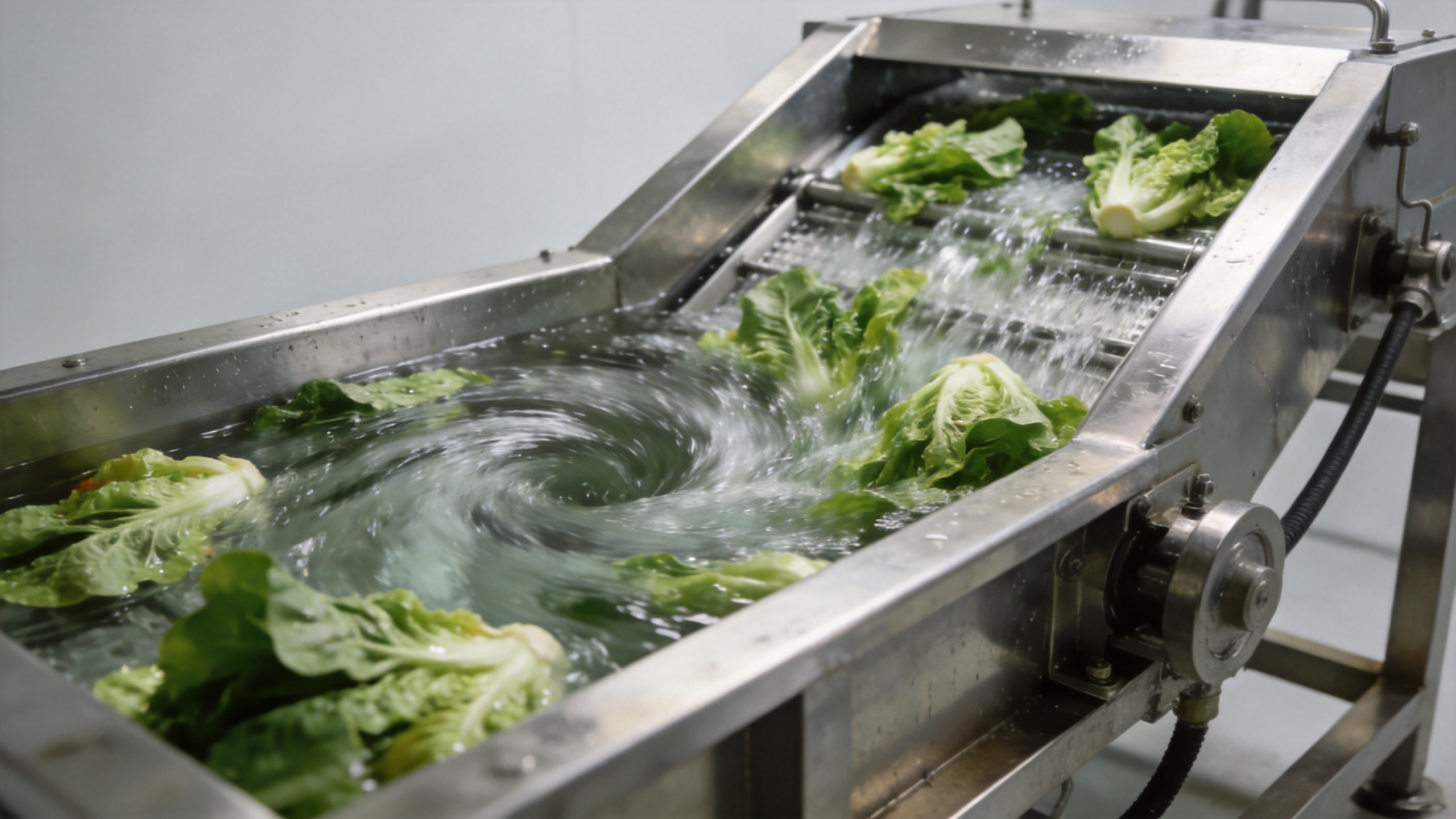
For buyers exploring a vortex-style configuration, the available product reference is Vegetable and Fruit High Efficiency Commercial Stainless Steel Disinfection Vortex Fruit Washing Machine. Treat the product page as a starting point for a configuration discussion, not as proof that every option is included in a particular supplier quote.
Customization, Documentation, and Delivery Terms Need Their Own Lines
Customization is often where a commercial vegetable washer quote becomes hard to compare. Changes to tank dimensions, conveyor width, electrical standards, language on the control panel, guards, packaging, or spare-parts kits can each alter the scope. Ask suppliers to separate standard items, selected options, and custom engineering so that changes remain visible.
For export purchases, also clarify the delivery basis, packaging method, lead time, documentation, and after-sales response process. A low equipment figure may exclude export crating, freight-related preparation, commissioning support, or recommended wear parts. None of those items should be assumed. They should appear as included, optional, or excluded.
A Practical Supplier Quote Comparison Checklist
Before selecting a vegetable washing machine commercial solution, place supplier offers in one comparison sheet. Use the same rows for every supplier:
- Process: product type, cleaning method, target throughput, and acceptance criteria.
- Machine scope: tank, blower, pump, conveyors, control system, and safety components.
- Materials: food-contact material, thickness where specified, and cleanability details.
- Options: filtration, rinse, sanitation provisions, dewatering, and line interfaces.
- Services: drawings, factory test expectations, installation guidance, training, and spare parts.
- Commercial terms: delivery basis, packaging, lead time, payment milestones, warranty, and exclusions.
Finally, send the same requirement sheet to each supplier. That small discipline usually produces more useful commercial vegetable washer quotations than asking for “a headline price.” It makes differences in capacity, material, automation, and integration visible before the purchase order is issued.
Make the Quote Support the Production Decision
The right commercial vegetable washer is not necessarily the lowest quoted machine. It is the configuration that can wash the intended product at an agreed operating condition, fit the hygiene process, connect realistically to the line, and come with clear commercial boundaries. When suppliers quote against the same process brief, buyers can evaluate value rather than guess at hidden differences.
Use the checklist above to prepare your inquiry, then ask for a configuration-based proposal. A transparent quote gives the procurement team a better basis for technical review, budget approval, and a smoother transition from trial to production.