EN


Cutting Vegetable Machine: Choosing a Model for Food Production
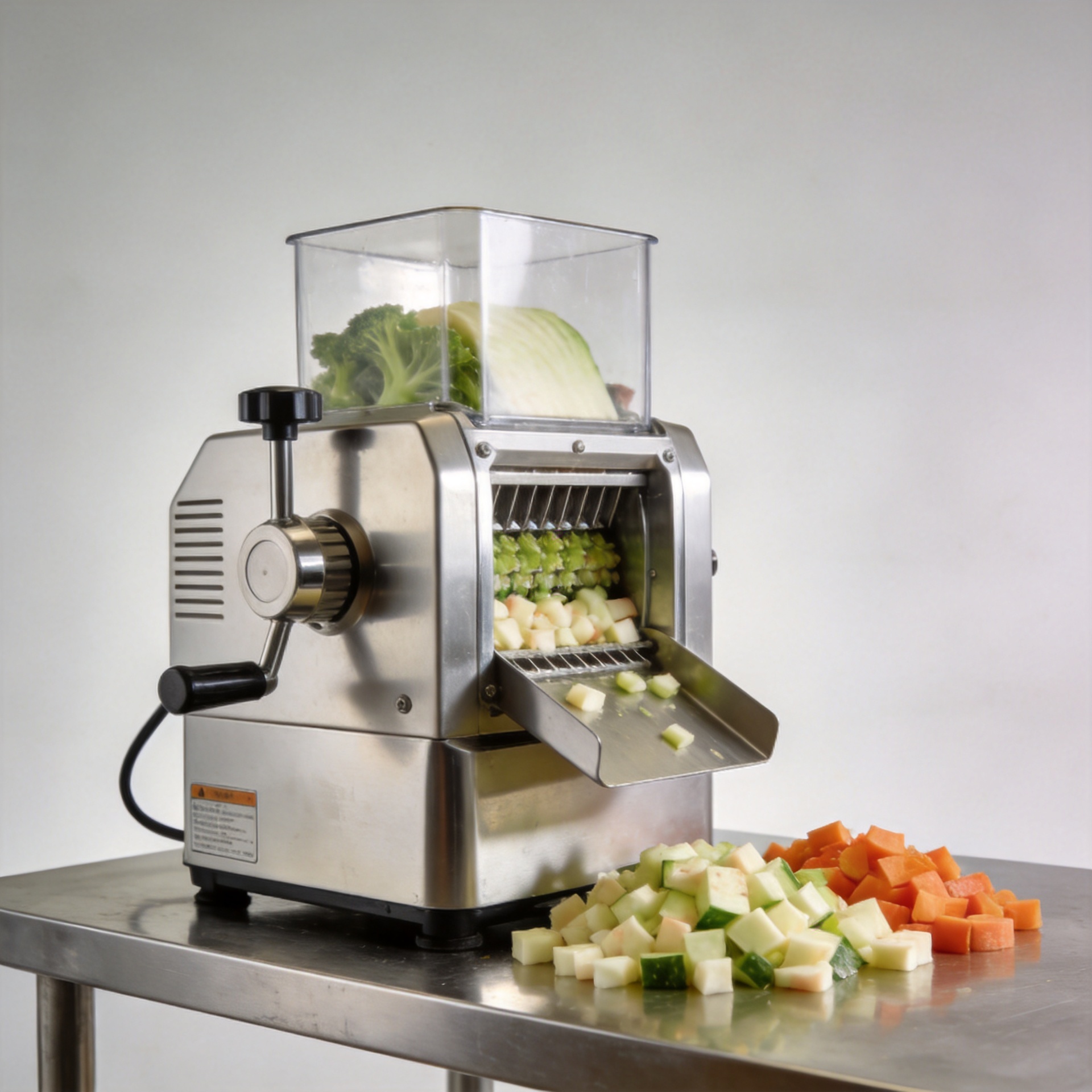
A cutting vegetable machine is not simply a faster knife. In a food-production setting, it is a process decision that affects cut consistency, labor planning, sanitation routines, yield control, and the pace of downstream washing, blanching, packing, or cooking. The right cutting vegetable machine should fit the ingredients and workflow you run today while leaving a practical path for changes in volume or product mix.
As a technical adviser for industrial equipment selection, I start with the line rather than a catalog. A cutter that looks productive on paper may still create bottlenecks if its discharge, cut format, cleaning time, or safety arrangement does not match the rest of the operation. This guide gives food producers a clear way to compare a cutting vegetable machine without assuming that the largest or most complex model is not automatically the right choice.
Start With the Food Process, Not the Machine
Before requesting quotations for a cutting vegetable machine, map the actual job. List each raw material, its condition at loading, the desired final cut, the hourly demand, and the next processing step. Potatoes, firm roots, leafy vegetables, onions, and soft fruit can behave very differently during feeding and cutting. A cutter suited to firm dice work may not be the most efficient answer for delicate leaf products.
It helps to define the process in five questions:
- Which products will go through the cutting vegetable machine, and how variable are their sizes?
- Do you need slices, strips, cubes, shreds, or more than one format?
- What is the required output during a normal shift, not only the peak day?
- Will material feed directly into washing, mixing, blanching, drying, or packaging equipment?
- What cleaning window and operator skill level are realistic for each changeover?
This step may sound basic, but it prevents a common mistake: buying around a headline capacity rather than the production conditions that determine usable output.
Match Cut Quality and Blade Options to Your Product Range
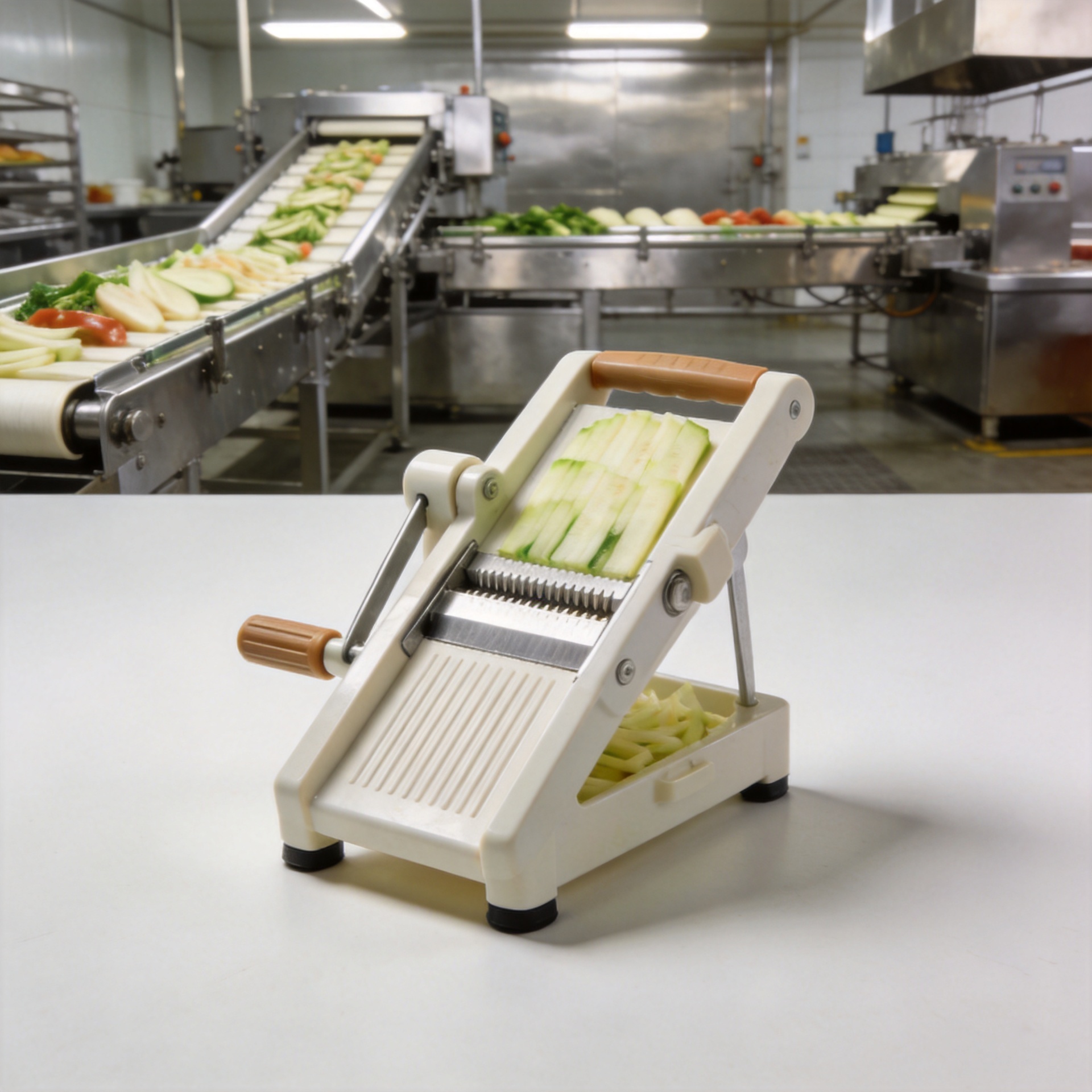
The value of a cutting vegetable machine usually comes from repeatable geometry. Uniform slices and dices can support more predictable cooking, drying, seasoning, and pack presentation. Ask the supplier to describe the available cutting assemblies, the intended produce types, and the procedure for changing blades or discs. Do not treat every advertised cut style as interchangeable; the feed condition, firmness, and orientation of the material still matter.
A practical test is to prepare a small matrix of your priority products and cut formats. For each one, confirm the target dimensions, acceptable variation, expected breakage, and trimming or waste concerns. If you plan to add new SKUs later, verify whether the selected cutting vegetable machine can accept the needed tooling rather than assuming accessories will be available.
Buyers often think a higher capacity rating is necessarily better. A more accurate view is that real output depends on produce preparation, feeding consistency, blade condition, and the time required to switch formats. The specification is useful, but it is not a guarantee of line performance.
Size the Cutting Vegetable Machine for the Whole Line
Capacity must be considered alongside upstream supply and downstream handling. If washing delivers product irregularly, a high-speed cutting vegetable machine may spend time waiting. If the next conveyor or packaging station cannot accept the discharge rate, the cutter can create accumulation and additional handling. For a stable line, compare nominal capacity with the slowest practical step in the process.
| Decision point | What to confirm | Why it matters |
|---|---|---|
| Feed preparation | Produce size, pre-cutting, moisture, and loading method | These conditions influence consistent feeding. |
| Output rate | Normal hourly requirement and peak requirement | Helps avoid oversized equipment with poor utilization. |
| Discharge interface | Height, direction, conveyor handoff, and collection method | Reduces unnecessary transfer and congestion. |
| Changeover time | Blade changes and sanitation between products | Protects actual shift capacity. |
If your production varies greatly by season or order mix, a modular cutting vegetable machine with manageable changeovers can be more useful than a narrowly optimized high-throughput unit.
Make Cleanability and Safety Part of the Specification
For food production, a cutting vegetable machine must be evaluated as a hygienic work station. Review food-contact surfaces, access to product zones, removable parts, drainage, and the cleaning sequence. Commercial food-preparation guidance consistently highlights hygiene, cleanability, and safety systems as core evaluation points. Your own sanitation program should define what must be opened, removed, inspected, and dried between runs.
Safety deserves the same level of detail. Confirm the guarding arrangement, interlocks, emergency-stop location, start-up procedure, and cleaning lockout practice. Ask who will train operators and how blade handling is managed. The safest purchasing decision is one that considers normal operation, clearing a jam, tool change, and cleaning—not only the demonstration run.
Verify Utilities, Service, and Acceptance Before Ordering
A cutting vegetable machine should arrive with a clear installation and acceptance plan. Confirm power requirements, footprint, delivery access, operating manuals, spare-parts recommendations, and the information needed for integration. When an imported machine is involved, English technical documents and remote commissioning support can reduce uncertainty for the receiving team.
Before finalizing an order, request a written acceptance checklist based on your priority materials. It should cover cut format, product handling, safety functions, cleaning access, delivery scope, and the documentation supplied with the equipment. A factory run test is valuable, but it should reflect realistic ingredients and operating conditions whenever possible.
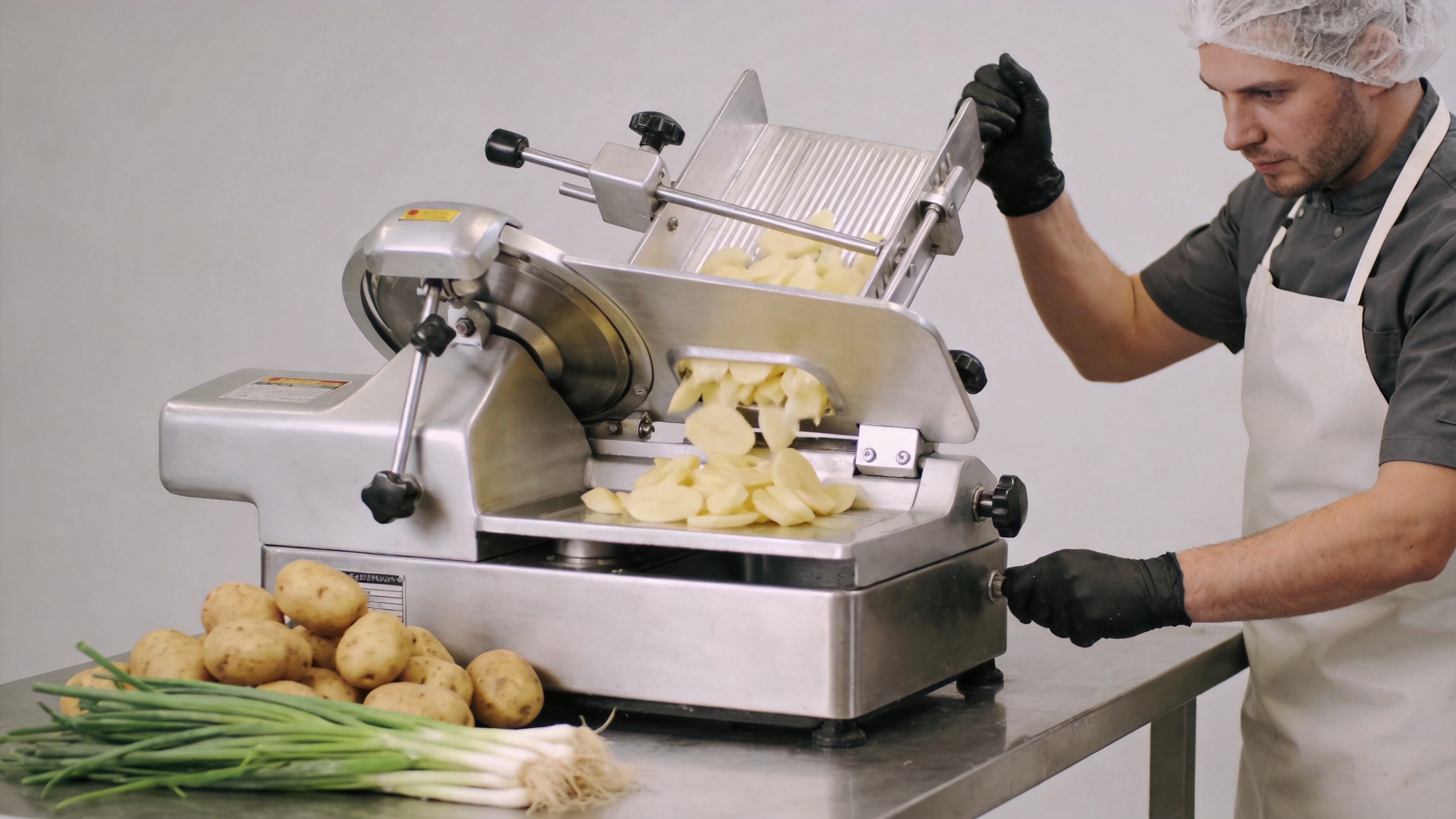
For buyers comparing an electric dicing option for potato, fruit, and green onion preparation, review the confirmed product page for the Commercial Industrial Electric Vegetable Cutter Dicing Machine for Potato, Fruit & Green Onion. Treat the discussion with the supplier as an opportunity to validate your own feed material, target cut, and line interface rather than as a substitute for that validation.
A Short Procurement Checklist
- Define materials, cut formats, and normal hourly output.
- Check blade or disc availability for every priority format.
- Compare the cutting vegetable machine with upstream and downstream line capacity.
- Inspect cleanability, guarding, interlocks, and emergency controls.
- Confirm utilities, installation space, documents, training, and spare support.
- Agree on an acceptance test that reflects your products and process.
A suitable cutting vegetable machine is one that produces the required cut consistently, can be cleaned and operated safely, and fits the rhythm of the entire food-production line. Begin with process facts, verify them with the supplier, and use an acceptance checklist to turn a broad equipment search into a controlled purchasing decision.