EN
EN


Electric Garlic Peeler Machine: How Dry Pneumatic Peeling Technology Works for Food Factories
Walk through a mid-scale garlic processing line and you will notice one bottleneck almost every operator has learned to work around: the peeling station. Manual workers can strip garlic all day, but the output is inconsistent, labor costs compound over time, and the moment demand spikes, the whole line slows down. That is where the electric garlic peeler—specifically one built around dry pneumatic technology—changes how the math works.
What follows covers how dry pneumatic peeling actually works, why food factories have shifted to it, and what it means in practice compared to older methods.
What Is Dry Pneumatic Peeling Technology?
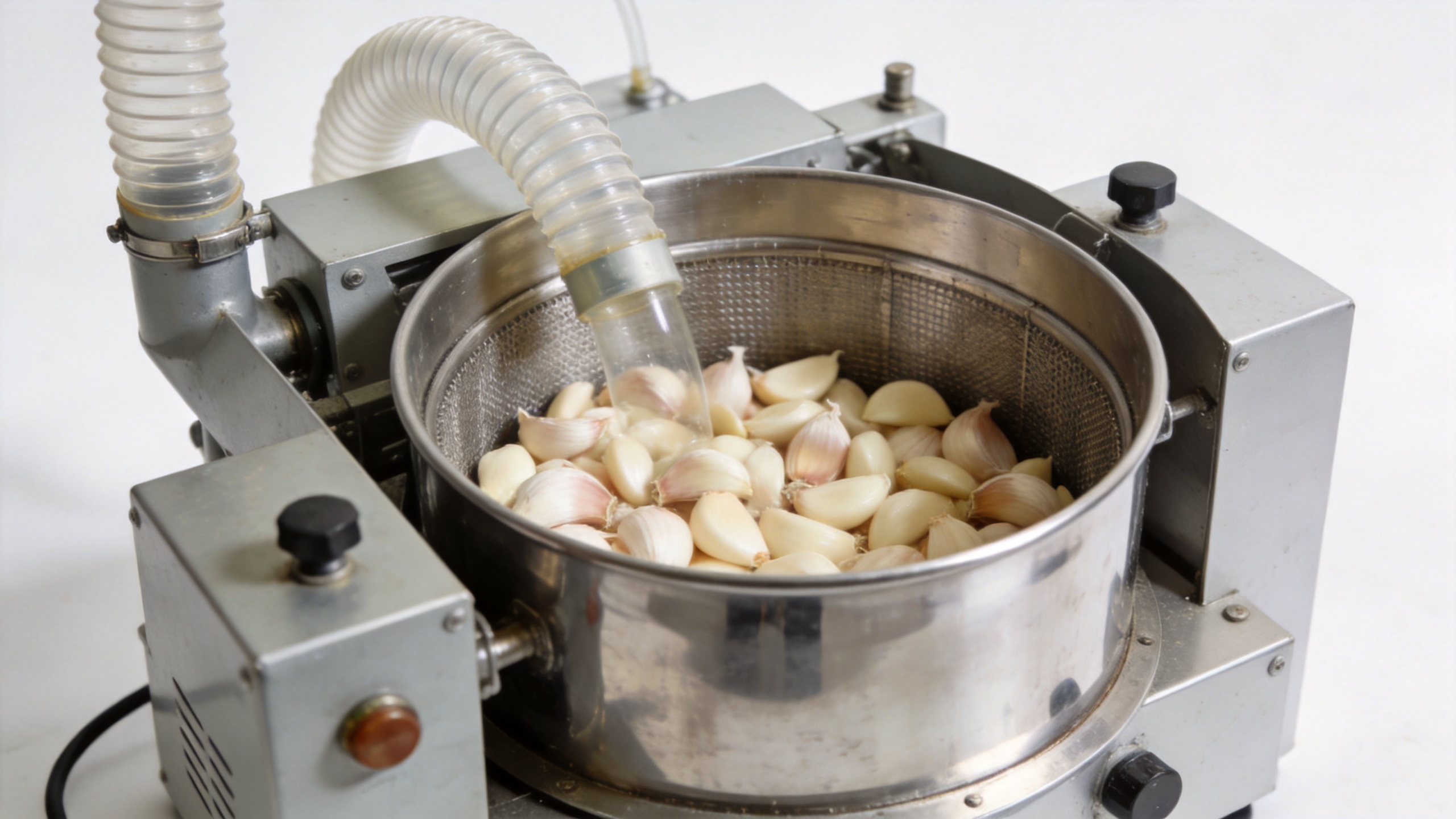
A dry pneumatic garlic peeler uses high-velocity compressed air to separate the thin papery skin from each garlic clove. The defining feature is that it's dry: no water enters the peeling chamber at any point. Garlic cloves are fed into a rotating drum or tubular channel where repeated air pulses create friction between cloves, loosening and ejecting the skin without cutting, soaking, or bruising the flesh.
Compared to earlier mechanical designs—where rubber rollers or abrasive surfaces did the stripping work—the air-based approach is gentler. Cloves tumble against each other and against controlled airflow rather than against hard surfaces. For food factories where whole-clove integrity affects both product shelf life and downstream processing quality, this distinction matters more than it might appear on a spec sheet.
How the Dry Pneumatic Peeling Process Works: Step by Step
A closer look at the full sequence helps clarify whether a given machine's configuration actually fits the production environment and downstream line requirements.
- Clove separation and feeding: Whole garlic heads are first split into individual cloves—either manually or via a dedicated splitting machine. The separated cloves enter the electric garlic peeler through a hopper or conveyor intake at a controlled feed rate.
- Compressed air injection: Inside the peeling chamber, a regulated air compressor feeds pressurized air through precisely angled nozzles. The resulting turbulence causes cloves to rotate rapidly and collide gently with each other, working the skin loose from the surface.
- Skin ejection: The loose papery skins, being lighter than the cloves, are carried by the airflow through a separation outlet—typically a mesh screen or air curtain—while the peeled cloves continue forward through the process channel.
- Collection and secondary sorting: Peeled cloves exit through a discharge port into a collection tray or directly onto a conveyor feeding the next processing stage. Most industrial electric garlic peeler machines include a secondary air blower to remove any residual skin fragments still clinging to cloves after the main cycle.
The entire cycle operates continuously in high-capacity industrial models. Commercial dry pneumatic electric garlic peeler machines designed for food factory environments consistently achieve a peeling rate of 95% or higher—meaning fewer than one in twenty cloves leaves the machine with significant skin intact under normal operating conditions.
Dry vs. Wet vs. Manual Peeling: Key Differences for Food Factories
Most food factory operators evaluating an electric garlic peeler for the first time are coming from one of two places: a manual workflow or an older wet-process machine. Here is how the three methods stack up:
| Method | Water Use | Labor Input | Clove Surface Condition | Hygiene Risk in Chamber |
|---|---|---|---|---|
| Manual peeling | None | High | Variable; damage rate depends on operator skill | Moderate (direct hand contact) |
| Wet pneumatic machine | High | Low | Surface moisture shortens downstream shelf life | Elevated (standing water promotes bacterial growth) |
| Dry pneumatic electric garlic peeler | None | Very low | Intact, dry surface ready for immediate packaging | Low (no water accumulation in chamber) |
Wet-process machines were once widely adopted because soaking softened the skin and made removal easier. The trade-off, however, is that moisture introduced at the peeling stage shortens garlic's post-processing shelf life, creates conditions where bacteria can accumulate in the machine chamber, and adds a drying step before packaging or cold storage. Factories supplying chilled or ambient-storage retail lines have increasingly moved away from this approach.
Research on pneumatic garlic peeling machine performance documents approximately 99.6% labor savings compared to manual processing at equivalent output volumes—a figure that becomes substantial when factored across a full production shift, not just hourly wage cost but also consistency and the contamination risks associated with sustained hand contact.
Capacity and Throughput: Matching Machine Scale to Your Production Needs
One of the first practical decisions when specifying an electric garlic peeler for a food factory is output volume. Industrial-grade dry pneumatic machines span a wide capacity range depending on chamber size, air pressure configuration, and feeding system design:
- Small-scale production: Around 200 kg/h—suitable for operations with limited floor space or variable daily garlic volumes where full-time machine dedication is not justified.
- Medium-scale production: 400 kg/h—the common midpoint for factories processing garlic as one of several ingredients alongside other peeling or processing lines.
- Large-scale and dedicated production: 600 kg/h and above, with high-capacity models reaching 1,000 kg/h or more for operations where garlic is a primary processed output.
The rated capacity on a machine data sheet reflects performance under ideal conditions—uniform clove size, optimal clove moisture content, and continuous feeding. Factories processing garlic sourced from multiple origins or with varied clove sizes typically plan actual throughput at 15–20% below the rated figure. This is worth confirming with suppliers before committing, particularly for lines where downstream packaging equipment operates at a fixed throughput speed.
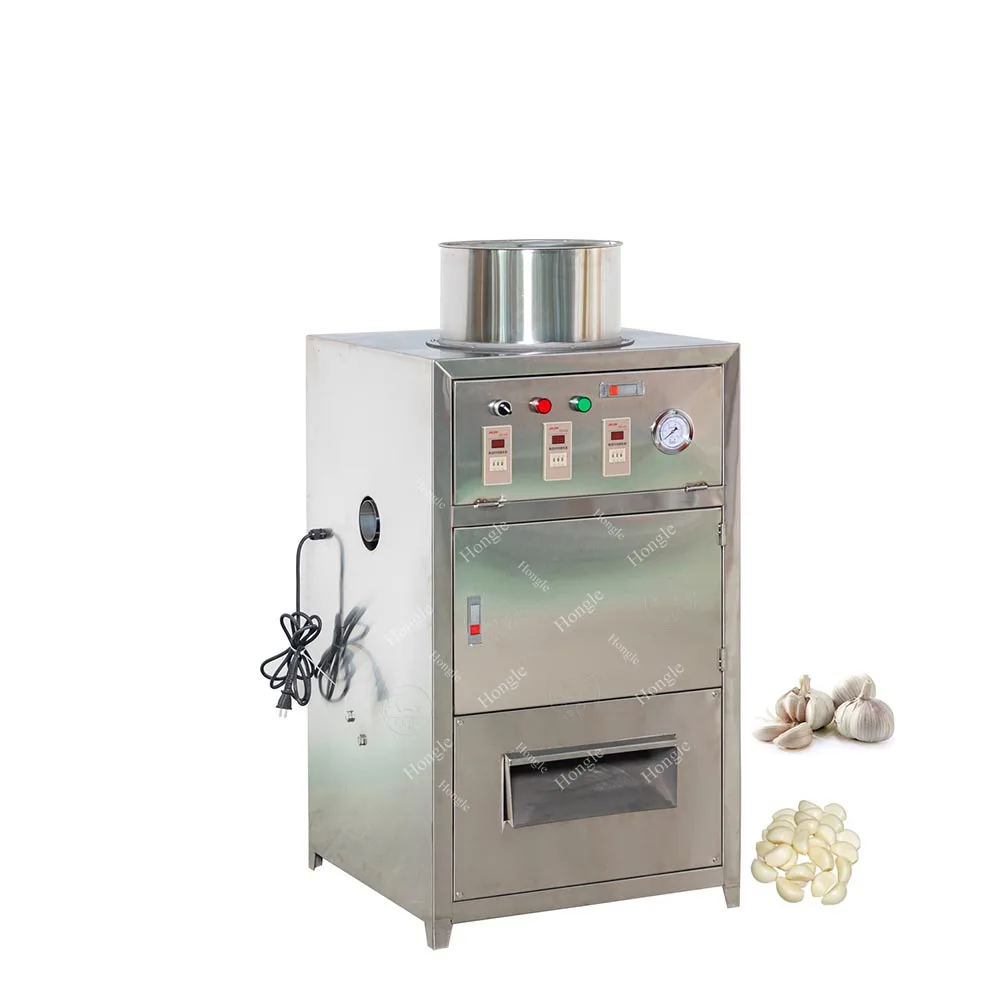
For food processors sourcing full-automatic commercial equipment at industrial scale, HongLe Machinery offers a 1,000 kg/h commercial garlic and ginger peeling machine designed for continuous high-volume food factory operation.
Why Food Factories Are Switching to Dry-Type Electric Garlic Peelers
Beyond the technical performance of dry pneumatic peeling, the operational case for adoption in food factories comes down to several recurring patterns across different production environments.
Standardization of output quality. Manual peeling produces variable results—some cloves emerge fully intact, others are nicked or partially skinned depending on operator technique and fatigue. An electric garlic peeler running at a calibrated air pressure setting delivers repeatable output across an entire production batch. For factories supplying retail packaged garlic or garlic-based condiments where visual consistency affects shelf acceptance, this standardization has a direct commercial impact.
Line integration without major capital changes. Modern dry pneumatic machines are engineered with inlet and outlet dimensions that align with standard food processing conveyors. Upgrading from a manual peeling station to a machine-based one typically does not require structural changes to the processing floor—an important consideration for factories retrofitting existing lines rather than building new facilities.
Reduced cleaning cycle time. Because dry pneumatic peeling introduces no water into the machine chamber, the interior does not accumulate moisture-dependent residues at the same rate as wet-process equipment. Most food factory operators report that daily cleaning of a dry-type electric garlic peeler is faster and requires fewer sanitation inputs than equivalent maintenance on wet-process machines—relevant for operations running multiple shifts where cleaning windows are constrained.
The shift from manual to machine-based garlic peeling tends to follow the same arc seen across most high-volume ingredient processing upgrades: the initial driver is labor cost reduction, but the sustained value comes from output consistency, hygiene control, and the ability to scale throughput without proportionally scaling the workforce. Dry pneumatic technology addresses all three within a single system that fits into the physical footprint of an existing food processing line.