EN


Electric Garlic Peeler vs. Pneumatic Peeler for Commercial Processing
For a food processor, an electric garlic peeler is often the first machine considered when manual peeling starts to restrict output. But an electric system and a pneumatic garlic peeler solve different production problems. One may fit a compact, self-contained work cell; the other may fit a dry, continuous processing line with compressed-air infrastructure already in place. The practical choice is not about declaring one technology universally better. It is about matching the peeling method to garlic condition, production rhythm, utilities, labor plan, and downstream handling.
From a B2B purchasing perspective, compare the whole process rather than only the quoted capacity. A supplier’s headline number is a starting point; actual results depend on clove size variation, skin dryness, feeding consistency, cleaning intervals, operator routines, and the way peeled cloves move to the next station.
How the Two Garlic Peeling Approaches Differ
An electric garlic peeler uses an electrically driven mechanism to create the peeling action. The exact arrangement varies by machine: it may involve rotating surfaces, friction, vibration, or a combined preparation-and-peeling sequence. This category can be attractive where buyers want a relatively direct installation path and a compact machine footprint.
A pneumatic peeler relies on controlled airflow and normally needs an appropriately sized air compressor and air-treatment arrangement. In dry-pneumatic processing, air separates skins from cloves without adding water to the product. That can be useful when the next stage—such as slicing, drying, packing, or further preparation—benefits from a dry product flow. However, airflow settings, garlic condition, and conveying design must be evaluated together. Research and commercial process descriptions both indicate that air pressure influences peeling performance, so a quoted result should be confirmed with representative garlic rather than assumed.
Compare the Drive System Before Comparing Capacity
| Decision factor | Electric garlic peeler | Pneumatic peeler |
|---|---|---|
| Primary utility | Electrical power for the machine drive | Electrical power plus a stable compressed-air supply |
| Installation question | Check voltage, controls, guarding, and floor layout | Also check compressor capacity, pressure stability, filtration, moisture control, and pipe routing |
| Process orientation | Often suited to standalone or batch-oriented work cells, depending on the design | Often suited to dry-air processing and continuous material flow, depending on the design |
| Maintenance focus | Drive components, contact surfaces, cleaning access, and electrical controls | Air system condition, valves, filters, hoses, pressure settings, plus the machine itself |
| Key purchasing question | Can the machine handle our real garlic mix at our operating rhythm? | Can our air system sustain the required flow and pressure during peak production? |
The comparison shows why a lower machine price can be misleading. If a pneumatic option requires a new compressor, new piping, or upgrades to air treatment, those items belong in the project budget. Conversely, a factory that already has reliable compressed air may find that a pneumatic arrangement fits its line more naturally. The right answer changes with the site.
Match Capacity to the Production Rhythm, Not a Single Number
Commercial buyers should translate daily demand into an hourly operating plan. Start with the number of usable peeled cloves needed per shift, then allow for receiving, separating, loading, peeling, inspection, cleaning, and changeover. A machine that reaches its headline output briefly may still become the bottleneck if operators must pause frequently to feed it or remove skins.
For an electric garlic peeler, ask whether the feed method and discharge arrangement let the machine run at the same pace as your upstream bulb separation and downstream washing, slicing, drying, or packing steps. For pneumatic equipment, add a second question: does the air supply remain stable when other equipment is drawing air? A pressure drop during the busiest part of a shift can affect process consistency even when the peeler itself is correctly sized.
A useful factory trial does not only measure a short demonstration. Use your intended garlic varieties and include smaller and larger cloves, realistic skin dryness, a sustained run, and a record of manual rework. Measure usable output, damaged cloves, remaining skin, cleaning time, and operator interventions. This turns capacity from a sales label into an operating estimate.
Consider Garlic Condition and Downstream Handling
Garlic is not a perfectly uniform raw material. Clove size, curing level, skin adhesion, moisture condition, and storage history can all influence peeling behavior. That is why a good supplier discussion begins with sample material and process details rather than a generic promise.
If your facility needs a dry product stream before slicing, dehydration, or vacuum packing, pneumatic dry-air peeling deserves close review. Its value is not simply that it uses air; it is that the process may reduce the need to introduce water before the next operation. If your workflow instead prioritizes a simpler standalone setup, an electric garlic peeler may be easier to position near an existing preparation area—provided that its actual peeling quality and cleaning routine meet your standard.
Do not treat automation as a substitute for process control. Higher automation can reduce repetitive handling, but it also raises the importance of training, spare parts planning, and a clear fault-response routine. A suitable configuration is one your operators can keep stable on an ordinary production day, not only during commissioning.
A Commercial Selection Checklist
- Define the material: document garlic variety, bulb and clove size range, curing condition, and expected seasonal variation.
- Map the line: identify how bulbs enter, how cloves are separated, where skins go, and how peeled cloves reach the next machine.
- Verify utilities: confirm voltage and electrical protection for any system; for pneumatic systems, verify compressor flow, pressure stability, filtration, and moisture management.
- Specify acceptance criteria: agree on usable output, residual skin tolerance, clove damage tolerance, sustained trial duration, and cleaning requirements.
- Budget for ownership: include consumables, wear parts, air-system upkeep, operator training, service response, and planned downtime—not only the machine purchase price.
- Plan for maintenance: ask for the recommended cleaning schedule, critical spare parts list, electrical documents, and remote-support process before placing the order.
Where a Matched Commercial Machine Fits
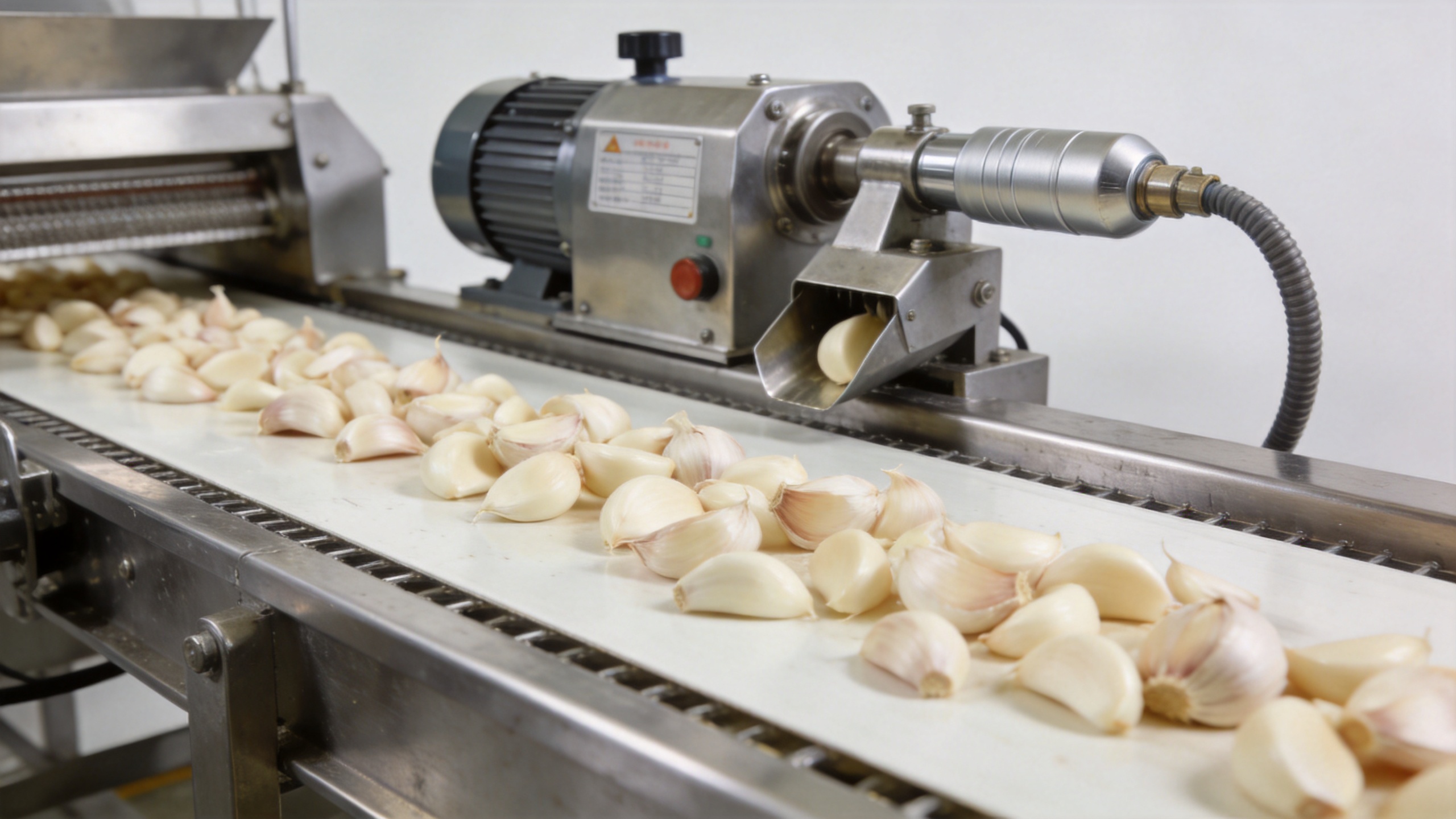
For buyers evaluating a higher-throughput option, the available commercial garlic and ginger peeling machine can be reviewed as part of a broader line assessment. The product page should be used to confirm the current configuration and discuss whether the feeding, utility requirements, trial criteria, and downstream interfaces suit your process. Product titles and photographs alone are not a substitute for a material test or a documented acceptance plan.
Which Option Should You Choose?
Choose an electric garlic peeler when a compact electrical setup, straightforward placement, and a self-contained workflow are more important than integrating with an existing compressed-air system. Choose a pneumatic peeler when dry-air processing, continuous flow, and the ability to support a stable air supply are central to the production design. For either route, request a trial using representative garlic and judge the result against your own quality and labor targets.
The most reliable decision is usually made in this order: define the finished-product requirement, map the line, confirm utilities, test the raw material, and then compare the total operating cost. That approach helps commercial processors select a garlic peeling solution that fits today’s workload while leaving room for controlled growth.
Electric Garlic Peeler Evaluation Worksheet
Use this worksheet during a supplier call. For each point, record the answer for the electric garlic peeler under review, then record the equivalent answer for the pneumatic alternative. This makes an electric garlic peeler comparison more useful than a catalog-only comparison.
| Question | What to record |
|---|---|
| Electric garlic peeler input | Record garlic condition accepted by the electric garlic peeler. |
| Electric garlic peeler output | Record usable output and manual rework after the electric garlic peeler. |
| Electric garlic peeler feed | Record who feeds the electric garlic peeler and at what interval. |
| Electric garlic peeler cleaning | Record the electric garlic peeler cleaning steps between batches. |
| Electric garlic peeler utilities | Record voltage, protection, and the electric garlic peeler load. |
| Electric garlic peeler wear parts | Record the electric garlic peeler parts that require planned replacement. |
| Electric garlic peeler integration | Record how the electric garlic peeler connects to separation and packing. |
| Electric garlic peeler trial | Record the electric garlic peeler trial duration and acceptance criteria. |
| Electric garlic peeler support | Record the electric garlic peeler documents, training, and service route. |
| Electric garlic peeler cost | Record the electric garlic peeler purchase, operating, and downtime costs. |
After the worksheet is complete, compare the electric garlic peeler and pneumatic option against the same standards. The electric garlic peeler is the better choice only when its result fits the full production system; a pneumatic alternative may be better when dry airflow and line integration carry more weight.