EN


Freeze-Dried Food Equipment vs Hot-Air Dryers for Food Processors
For a food processor, choosing between freeze-dried food equipment and a hot-air dryer is not simply a question of which machine removes more water. It is a decision about product positioning, production rhythm, utilities, packaging, and the price a market will pay for the finished food. A factory may see a crisp, high-value freeze-dried fruit snack and assume that freeze drying is automatically the better route. In practice, the right answer depends on the product and the business model.
A useful procurement rule is to define the required finished-food quality first, then compare process requirements, and only then compare machine prices. Freeze-dried food equipment can protect structure and support fast rehydration, while hot-air dryers are often a more practical route for high-volume dried ingredients, vegetable pieces, and products where a denser texture is acceptable.
How the Two Drying Processes Differ
Freeze drying begins by freezing the product. Under vacuum, ice changes directly to vapor during primary drying, a process called sublimation. The low-temperature route helps preserve a porous structure, which is one reason freeze-dried foods can rehydrate quickly and retain a shape close to the original ingredient. Industry guidance from the Institute of Food Technologists notes that primary drying removes about 95% of the water, while final freeze-dried foods commonly reach roughly 1% to 4% moisture.
Hot-air drying works differently. Heated air passes over or through prepared food, evaporating water from the surface and then drawing moisture outward from the interior. The method is mechanically simpler and usually easier to integrate into a continuous food-processing line. However, heat exposure and a longer moisture migration path can change color, shrinkage, texture, aroma, and rehydration behavior. Those changes can be acceptable trade-offs: for many dried vegetable ingredients, seasoning components, and volume-oriented snacks, they are acceptable trade-offs.
Quality, Texture, and Product Positioning
Freeze-dried food equipment is most compelling when the product sells on appearance, crisp bite, light weight, rapid rehydration, or premium ingredient quality. Fruit pieces, ready-to-eat meal components, specialty coffee or dairy inclusions, and high-value nutrition products may benefit from that profile. IFT guidance reports that freeze-dried products can show rehydration ratios four to six times those of conventional air-dried foods. That does not guarantee the same result for every recipe, because cut size, solids content, pretreatment, and packaging still matter, but it explains why the process is attractive for quality-led products.
Hot-air drying is often better suited to products where consistency, throughput, and a lower processing cost carry more weight than a highly porous structure. A processor making dried onion, vegetable flakes, seasoning ingredients, or fruit ingredients for further processing may prefer a hot-air route. The finished product can be more compact and less visually similar to fresh food, yet the line may be easier to operate at scale. The key is to define what the customer actually values instead of treating a premium texture as a universal requirement.
Capacity and Utility Requirements
The comparison changes when utility planning enters the discussion. Freeze drying needs refrigeration or deep-freezing capacity, a vacuum system, condensers, controlled heat input, and enough time for a batch cycle. The chamber must be loaded and unloaded, so scheduling, tray handling, and batch traceability deserve attention during line design. If the target output has large daily swings, equipment utilization can become a major cost issue.
A hot-air drying line typically depends on controlled heat, airflow, exhaust management, and appropriate product feeding. It may be configured for trays, belts, or other handling arrangements depending on the food and desired output. The simpler thermal route can support a more continuous workflow, but the processor still needs to manage temperature uniformity, product thickness, air distribution, and sanitation. A nominal capacity is only a starting point; real capacity depends on incoming moisture, loading density, and the required final condition.
Energy and Total Cost of Ownership
Freeze drying has a substantial energy burden because it combines freezing, vacuum operation, and condensation over a long cycle. IFT notes that the energy required for freeze drying can be close to twice that of conventional air drying. That is why a procurement review should include electricity demand, refrigeration load, vacuum-pump maintenance, labor per batch, spare parts, and the cost of holding work in process—not just the purchase price.
Hot-air dryers generally offer a lower-energy and lower-complexity route, particularly when a plant already has a suitable heat source and airflow infrastructure. Still, lower utility demand does not make every hot-air system the preferred investment. If heat damage reduces selling price, produces excessive rejects, or requires extra downstream handling, the apparent saving can shrink. The decision should compare margin per kilogram of saleable product, not only energy per kilogram of water removed.
A Practical Selection Checklist
| Decision factor | Freeze-dried food equipment | Hot-air dryer |
|---|---|---|
| Typical fit | Premium, porous, fast-rehydrating products | Volume-oriented dried foods and ingredients |
| Process route | Frozen product, vacuum, sublimation | Heated airflow and evaporation |
| Typical trade-off | Higher quality potential with higher capital and utility demands | Lower complexity with more thermal impact on the product |
| Planning priority | Batch time, vacuum/refrigeration, premium-market margin | Airflow, heat source, throughput, and moisture uniformity |
Before requesting quotations, prepare a sample brief that lists raw-material form, slice thickness, starting and target moisture, daily throughput, desired texture, packaging format, available utilities, and cleaning expectations. Ask suppliers to explain what assumptions sit behind their stated capacity. This is particularly important when comparing a freeze-drying chamber with a dryer intended for continuous operation.
Freeze Dried Food Equipment Evaluation Worksheet
Use this worksheet when comparing freeze dried food equipment proposals. First, ask each freeze dried food equipment supplier to state the tested product, loading weight, and cycle duration. Next, ask whether the freeze dried food equipment capacity is based on fresh input or finished output. These details keep a freeze dried food equipment quotation comparable with a hot-air line quotation.
- For freeze dried food equipment, document incoming moisture and target final moisture.
- For freeze dried food equipment, confirm tray area, batch loading pattern, and loading labor.
- For freeze dried food equipment, identify refrigeration demand and condenser capacity.
- For freeze dried food equipment, verify vacuum-pump configuration and routine maintenance access.
- For freeze dried food equipment, request the expected cycle profile for the actual food product.
- For freeze dried food equipment, compare product breakage after discharge and packing.
- For freeze dried food equipment, define acceptable color, flavor, and rehydration criteria.
- For freeze dried food equipment, evaluate cleaning access and food-contact materials.
- For freeze dried food equipment, include utilities, consumables, and spare parts in lifecycle cost.
- For freeze dried food equipment, check how a delayed batch affects daily output planning.
- For freeze dried food equipment, confirm local electrical compatibility before ordering.
- For freeze dried food equipment, plan barrier packaging that protects the low-moisture product.
- For freeze dried food equipment, establish pilot acceptance samples before final purchase.
- For freeze dried food equipment, compare after-sales support and commissioning scope.
This approach does not assume freeze dried food equipment is the preferred route. Instead, it turns freeze dried food equipment into a measurable option alongside hot-air drying, so a processor can assess the freeze dried food equipment investment against expected product margin. A well-defined freeze dried food equipment trial is more useful than a generic capacity claim, and a complete freeze dried food equipment cost model should include the effect of utilization, packaging, and quality yield.
Where a Food Dehydrator Fits
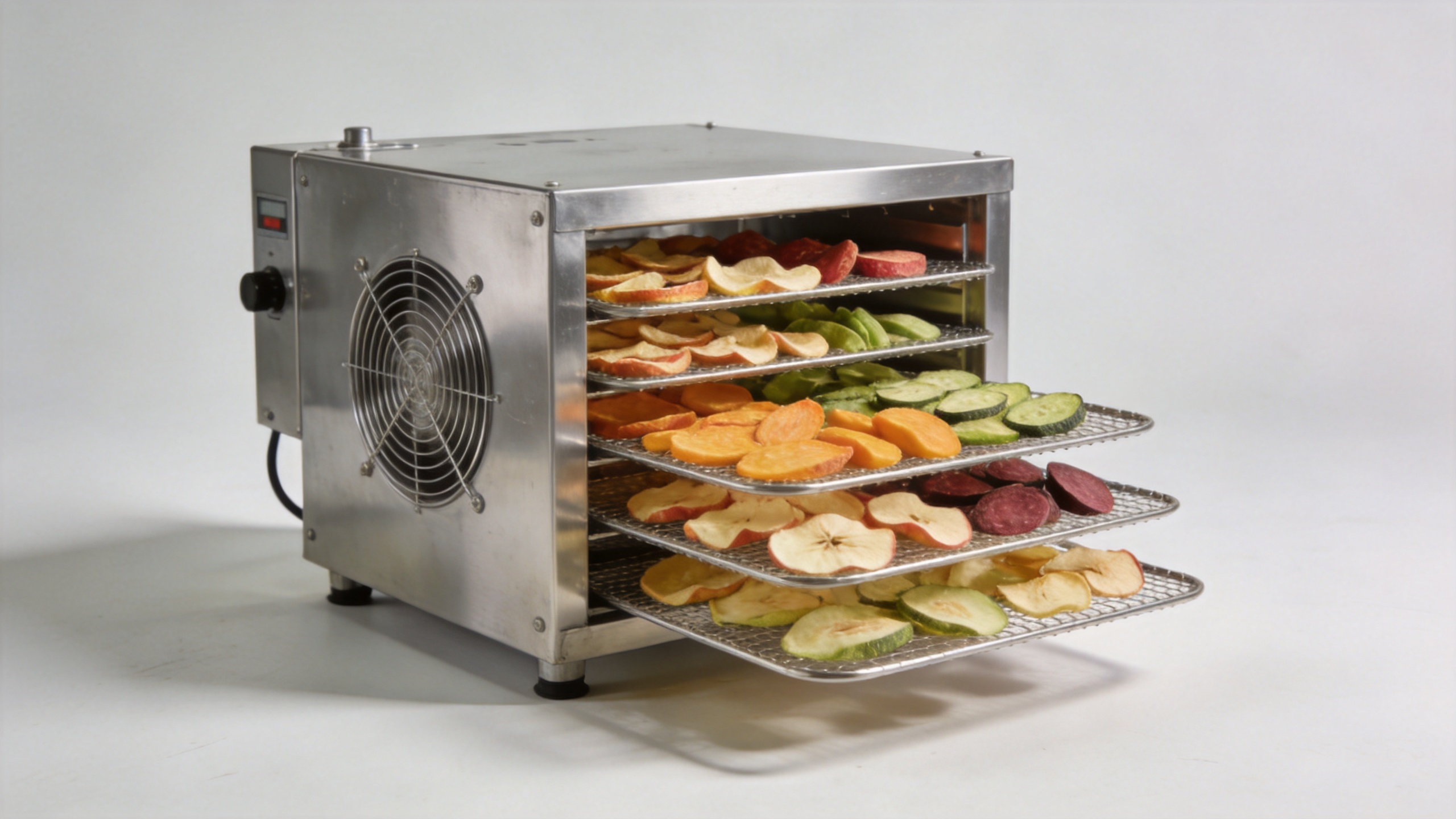
Some processors do not need to choose only between a complete freeze-drying system and a generic drying concept. For fruit and vegetable dehydration projects, an industrial drying vegetable dryer fruit drier machine dehydrator can be a relevant option to evaluate for conventional hot-air dehydration. The product page confirms the equipment category, but the final selection should still be based on verified capacity, heat source, material contact requirements, and the processor’s specific product trials.
Make the Decision Around the Finished Product
There is no universal winner. Choose freeze-dried food equipment when a premium, lightweight, porous product and strong rehydration performance can justify a more demanding process. Choose a hot-air dryer when the product can accept conventional dehydration characteristics and the business needs a practical, scalable cost structure. For either route, pilot trials with the actual raw material are more reliable than selecting from brochure specifications alone. A clear product specification, a realistic utility audit, and a margin-based comparison will make the final equipment decision much more defensible.