EN


Freeze Drying Machine: Buyer Checklist for Food Processors
Buying a freeze drying machine for a food operation is a process-design decision, not a catalogue exercise. A line that looks large enough on paper can still miss cycle-time, condenser, sanitation, utility, or service requirements once real ingredients enter the chamber. For procurement teams handling fruit, vegetables, snacks, ingredients, or ready-to-eat products, the right question is not “Which machine has the biggest chamber?” It is “Which system can repeatedly deliver the required product quality at the required throughput?”
This checklist helps food processors compare a freeze drying machine on the evidence that matters before a purchase order is issued.
1. Define the product and production target before comparing machines
Start with the product, not the equipment. Record the ingredient type, piece size, initial moisture, target final moisture, batch weight, expected daily output, packaging plan, and acceptable cycle time. Fruit slices, vegetable dices, powders, and heat-sensitive ingredients can behave very differently during freezing and sublimation. A supplier needs this information to recommend a meaningful freeze drying machine configuration.
Ask the supplier to distinguish between a stated chamber volume and a verified usable wet load. Wet load, layer thickness, loading method, and cycle duration determine output. If the seller quotes capacity only in kilograms without defining the product and cycle basis, treat that figure as a starting point for discussion rather than a production guarantee.
- What product will run first, and what products may follow later?
- How many batches are required per shift or per day?
- What final moisture and appearance standards are required?
- Will loading be manual, tray-based, or integrated with upstream handling?
2. Check the thermal and vacuum system as one process package
A food freeze drying machine depends on the interaction of freezing capacity, shelf or chamber heat transfer, vacuum performance, and vapor capture. Looking at any one component in isolation can create a false comparison. Review the refrigeration arrangement, condenser capacity, vacuum pump type, chamber sealing, and control logic together.
In practical supplier discussions, ask what happens when the product releases moisture at the highest expected rate. The supplier should explain how the condenser is sized for that load, how vacuum is controlled through the cycle, and what alarms protect the batch if a setpoint or utility drifts. Modern industrial systems commonly use PLC-based control for temperature ramps, vacuum setpoints, and alarm records; request a demonstration of the screen, trend data, and batch-history export rather than accepting a generic automation claim.
| Checkpoint | What to request | Why it matters |
|---|---|---|
| Condenser performance | Design basis for your expected moisture load | Helps prevent an under-sized vapor capture stage from extending cycles. |
| Vacuum system | Pump specification, control method, maintenance plan, and leak-test procedure | Stable vacuum supports repeatable drying conditions. |
| Refrigeration | Ambient design condition, refrigerant approach, and defrost method | Performance can change with climate and operating schedule. |
| Controls | Setpoint ranges, alarms, recipe access, and data records | Supports repeatability, troubleshooting, and buyer acceptance testing. |
3. Put hygienic design and cleanability on the procurement checklist
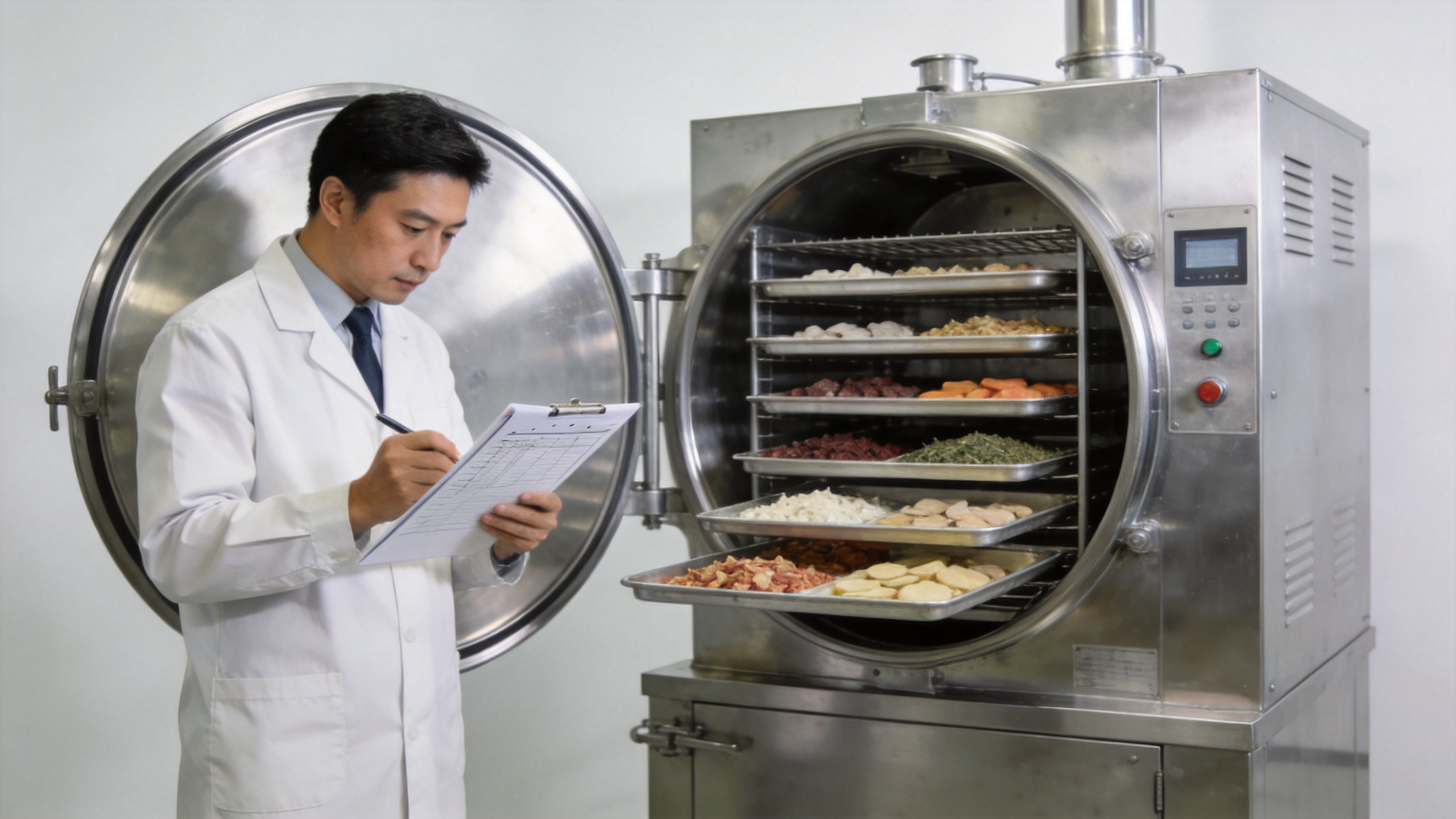
Food processing teams should inspect more than the exterior finish of a freeze drying machine. Request drawings or photographs that show food-contact surfaces, weld finishing, drain points, door seals, tray construction, and areas where product dust or condensate could accumulate. Clarify whether the proposed design supports the cleaning approach used in your plant and who is responsible for defining cleaning chemicals, rinse steps, and verification.
For every component that contacts product or may influence product hygiene, ask for material identification and maintenance instructions. If allergen control, high-care production, or frequent product changeovers are part of the plan, include them in the supplier’s process proposal. A machine that is difficult to inspect or clean can turn a small design compromise into recurring downtime.
4. Verify utilities, footprint, and integration boundaries
Before selecting a freeze drying machine, map the installation boundary: electrical supply, cooling method, water needs where applicable, compressed air, drainage, ventilation, floor loading, door clearance, and service access. The equipment footprint alone is not the installation footprint. Leave room to load trays, open doors, remove panels, service pumps, and move product safely.
Also define handoffs with freezing, preparation, packaging, and cold storage. If the freeze dryer will be part of a broader fruit or vegetable processing project, discuss product preparation and drying equipment as a line-level conversation. HongLe Machinery’s industrial drying vegetable dryer and fruit drier machine can be reviewed as a confirmed equipment reference for related drying-process planning; its listing alone should not be treated as proof of freeze-drying specifications.
5. Require a clear factory acceptance test plan
A strong procurement process converts promises into a factory acceptance test, or FAT, plan. The plan should identify the sample product or representative load, loading condition, target outcome, data to be recorded, acceptance criteria, and responsibilities for deviations. If a full product trial is not feasible before shipment, ask for the exact assumptions used in the proposal and identify the commissioning test required after installation.
- Confirm the product sample, tray loading, and batch mass.
- Agree the temperature, vacuum, and cycle records to be provided.
- Define measurable acceptance criteria for the agreed product trial.
- List documents delivered with the machine: manuals, electrical drawings, spare-parts list, and maintenance schedule.
- Record the training, remote support, installation, and commissioning scope in the contract.
6. Compare total operating risk, not just purchase price
The lowest quoted freeze drying machine may have a higher lifetime cost if it creates longer cycles, difficult cleaning, utility strain, or weak technical support. Ask each supplier to separate the equipment price from installation support, recommended spares, consumables, controls access, training, and remote troubleshooting. For export projects, confirm packaging, shipping interfaces, documentation, and communication responsibilities before shipment.
Zhengzhou HongLe Machinery Equipment Co., Ltd. serves food-processing equipment buyers across multiple export markets and provides remote technical guidance, operating materials, and spare-parts support according to its business profile. Use those capabilities as points to verify in a proposal and contract, alongside the technical evidence for the specific equipment.
Final buyer checklist
Before approving a supplier, make sure the proposal answers these questions: Is capacity based on your actual product and cycle? Are condenser, vacuum, refrigeration, and controls sized as one system? Can the design be cleaned and maintained in your plant? Are utilities and integration boundaries defined? Is there a documented FAT and commissioning plan? Are service, documentation, and spare parts included in writing?
A well-specified freeze drying machine gives a food processor a more reliable path from pilot batches to repeatable production. Use this checklist to make supplier comparisons evidence-based, then validate the final choice against your own product trial and operating conditions.
Questions to ask in every freeze drying machine quotation
Use the same questions with every supplier so the comparison stays fair. For each freeze drying machine quotation, ask for the product basis behind the stated capacity, the expected cycle duration, the condenser and vacuum design basis, and the utilities required at the installation point. Ask whether the supplier will provide a pre-shipment leak test, control demonstration, operating manual, spare-parts recommendation, and commissioning support.
It is also useful to ask what information the supplier needs from you before they finalize a proposal. A responsible freeze drying machine supplier should request product samples or product data, target throughput, plant conditions, and quality objectives. This turns the quotation from a generic machine offer into a project document that can be reviewed by production, quality, engineering, and purchasing.
Finally, keep the commercial comparison aligned with the process comparison. Payment terms and delivery dates matter, but they should not replace a documented scope for the freeze drying machine, FAT, installation, training, and after-sales response. When those items are visible before ordering, the procurement team is better positioned to control project risk.