EN


Fruit and Vegetable Sanitizer Systems: What Food Processors Need to Know
For a food processor, a fruit and vegetable sanitizer is not simply a chemical choice or an add-on after a washer. It is part of a controlled process that removes field debris, manages wash water, reduces the opportunity for cross-contamination, and delivers produce to the next step in a predictable condition. That distinction matters because searches for “sanitizer” often return hand-hygiene products, while processors need a practical way to evaluate a fruit and vegetable washing line.
This article uses fruit and vegetable sanitizer to mean the sanitation function within a commercial produce-washing process. The right arrangement depends on the commodity, incoming soil load, line capacity, water quality, downstream use, and the food-safety program that governs the facility.
Start with the process, not the sanitizer
Cleaning and sanitation do different jobs. Cleaning removes visible soil and organic matter. Sanitation is applied to clean produce or food-contact surfaces to reduce microorganisms of public-health concern. If the first job is weak, the second one becomes harder to control. In practical terms, a good fruit and vegetable sanitizer program begins with sorting, pre-rinsing, suitable agitation, and removal of debris before the product reaches its final rinse or sanitation stage.
It is tempting to assume that a higher nominal capacity or a stronger treatment setting will solve the problem. In reality, line performance depends on factors such as product loading, water turnover, dwell time, drainage, and how evenly the product travels through the wash zone. Parameters are a starting point, not a guarantee. A processor should validate the chosen process against its own product and operating conditions.
Where a sanitizer system fits in a fruit and vegetable washing line
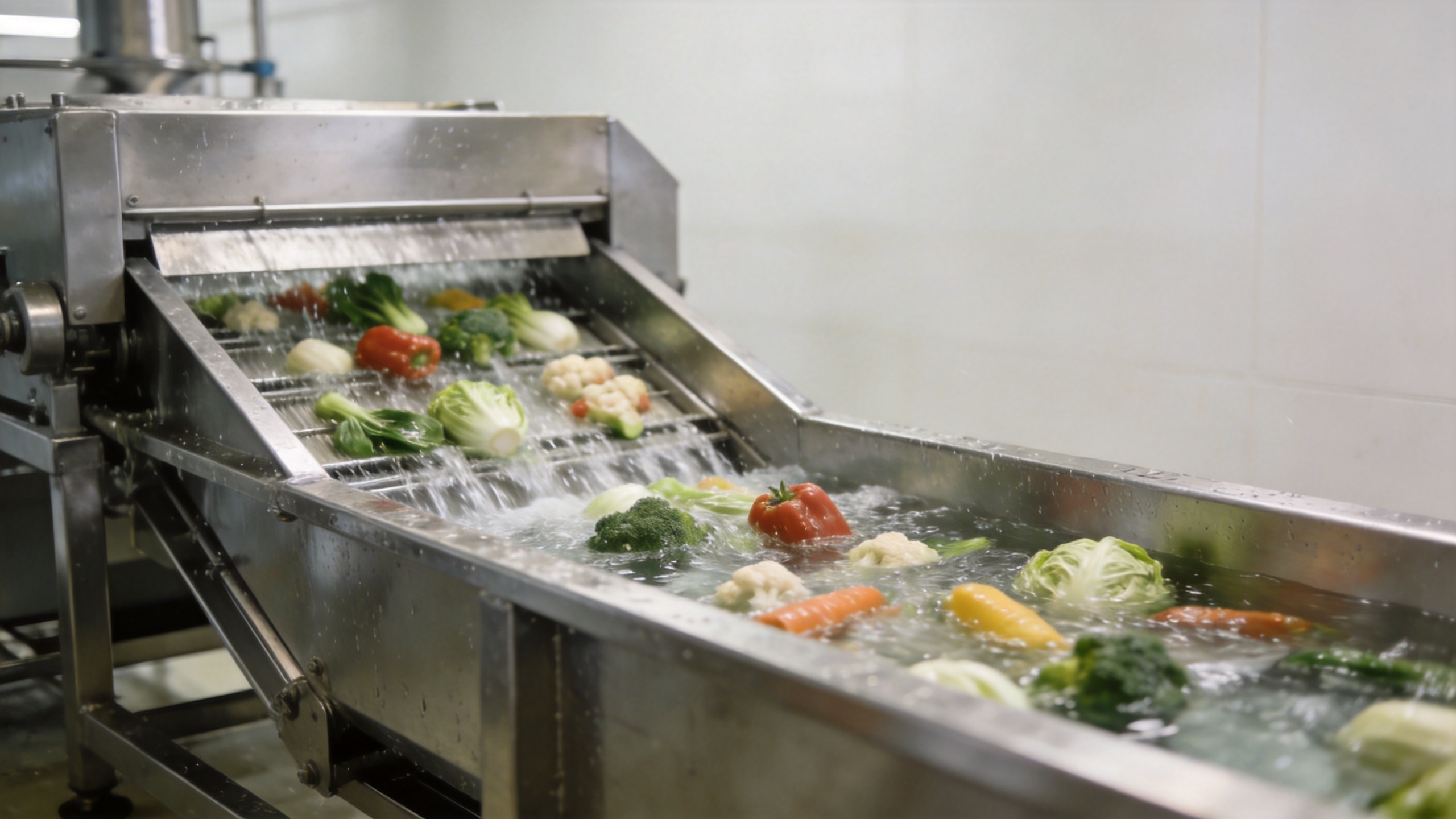
A typical line may include receiving, dry sorting, pre-wash, main wash, optional sanitation or controlled final rinse, dewatering, inspection, cutting or packing. The order changes with the crop and final product, but the hygiene principle is consistent: keep unwashed and washed product flows separated wherever possible. USDA produce-processing guidance likewise emphasizes process flow that avoids cross-contamination between unwashed and washed produce.
An industrial fruit washing machine can provide the mechanical handling and wash environment needed in this sequence. When evaluating equipment, focus on how it supports the system rather than treating the machine as a standalone sanitation claim. Ask how water enters and exits, where sediment leaves the process, whether product movement is gentle enough for the crop, and how the machine can be cleaned between runs.
For example, processors considering a vortex-style solution can review the available commercial stainless-steel fruit and vegetable washing machine as part of a broader workflow discussion. The final selection should still be based on verified product trials, capacity requirements, and the facility’s sanitation plan.
Three controls a fruit and vegetable sanitizer system must manage
1. Product cleaning and water quality
Produce brings variable loads of soil, leaves, damaged material, and organic matter into the plant. These loads affect wash water and can reduce the consistency of a fruit and vegetable sanitizer step. Build in a way to remove debris and define when water is refreshed, filtered, or otherwise managed. A line that looks clean at start-up may behave differently late in a production run, so operating checks should reflect real production conditions.
2. Cross-contamination risk
FDA guidance for fresh-cut produce identifies wash tanks, flumes, and spray systems as settings where transfer of microbial hazards must be managed. This does not mean every operation needs the same equipment layout. It does mean that flow direction, water management, separation of raw and cleaned zones, and cleaning access deserve attention during design and commissioning.
3. Verification and records
Awareness-stage planning should include how the team will verify that the process is operating as intended. Depending on the facility program, this may involve checks for water condition, treatment concentration, contact-time controls, equipment-cleaning records, and product or environmental monitoring. Use the applicable local regulations and the advice of qualified food-safety professionals to define limits and validation methods; do not rely on generic settings from another plant.
Questions to ask before specifying an industrial fruit washing machine
- What produce will run on the line? Leafy vegetables, root crops, berries, and firm fruit have different handling and soil-removal needs.
- What is the actual hourly throughput? Consider peak loading and the time needed for sorting, draining, and changeover—not just a nameplate figure.
- How will water and debris be managed? Define intake quality, solids removal, drainage, replenishment, and sanitation controls together.
- What happens after washing? Match the washer to dewatering, inspection, cutting, chilling, or packing so cleaned product is not re-exposed to an uncontrolled area.
- Can the equipment be cleaned and inspected? Access, drainability, material compatibility, and documented cleaning procedures are essential practical checks.
We often see buyers begin by asking whether they need a highly customized unit. A standard configuration can cover many routine applications, but only after the processor has documented the crop, process flow, hygiene objectives, and operating constraints. If product variability, space restrictions, or integration needs are unusual, then a custom review may be justified.
A practical commissioning checklist
- Map the route from receiving to packing and identify every point where unwashed and washed product could meet.
- Run representative product through the line at realistic loading, including worst-case soil conditions where appropriate.
- Confirm product handling, water movement, drainage, and debris removal before finalizing sanitation settings.
- Set monitoring and corrective-action procedures with the food-safety team.
- Train operators on start-up, changeover, cleaning, inspection, and recordkeeping—not only normal production.
An effective fruit and vegetable sanitizer system is therefore a repeatable process, not a single component. When cleaning mechanics, hygienic flow, wash-water control, and verification work together, food processors can make more informed choices about their washing equipment and reduce avoidable uncertainty during scale-up.
Conclusion
For food processors, evaluating a fruit and vegetable sanitizer system starts with understanding the whole line. Define the product, contamination risks, water-management plan, and downstream process first. Then assess whether an industrial fruit washing machine can support the required flow, cleaning access, and operating controls. That approach produces a more useful specification than selecting equipment or treatment in isolation.