EN


Fruit and Vegetable Washing Machines: How to Match Cleaning Methods to Produce Risks
Choosing a fruit vegetable washing machine is not simply a question of capacity. For a food processor, the useful starting point is the raw material: how much field soil it carries, how easily it bruises, how irregular its surface is, and whether the wash step could move contamination from one item to another. A machine should support a controlled process; it is not a substitute for a site hygiene program, validated water management, or trained operators.
As a technical adviser assessing food-processing equipment, I start with the incoming produce and the production sequence rather than a catalogue feature list. At first, stronger agitation may appear preferable. A more accurate view is that cleaning action must fit the material, because excessive mechanical action can damage delicate produce while weak action can leave soil in folds, stems, or surface texture.
Start with a Produce-Risk Profile
Build a simple intake profile for every crop or ingredient family before selecting a fruit vegetable washing machine. Four questions usually reveal the right direction:
- Soil load: Is the produce arriving with loose dust, sand, mud, or plant debris?
- Surface geometry: Is it smooth like a round orchard fruit, creased like a leafy vegetable, or irregular like a root crop?
- Mechanical sensitivity: Will rubbing, tumbling, or high-impact water damage the skin, leaves, or flesh?
- Process risk: Will the product be cut, packed, or used soon after washing, making water quality and cross-contamination control especially important?
These categories make conversations between production, quality, and purchasing teams more concrete. They also help separate an initial soil-removal step from a later rinse, inspection, or draining step.
Match Cleaning Action to the Raw Material
1. Loose soil on robust root vegetables
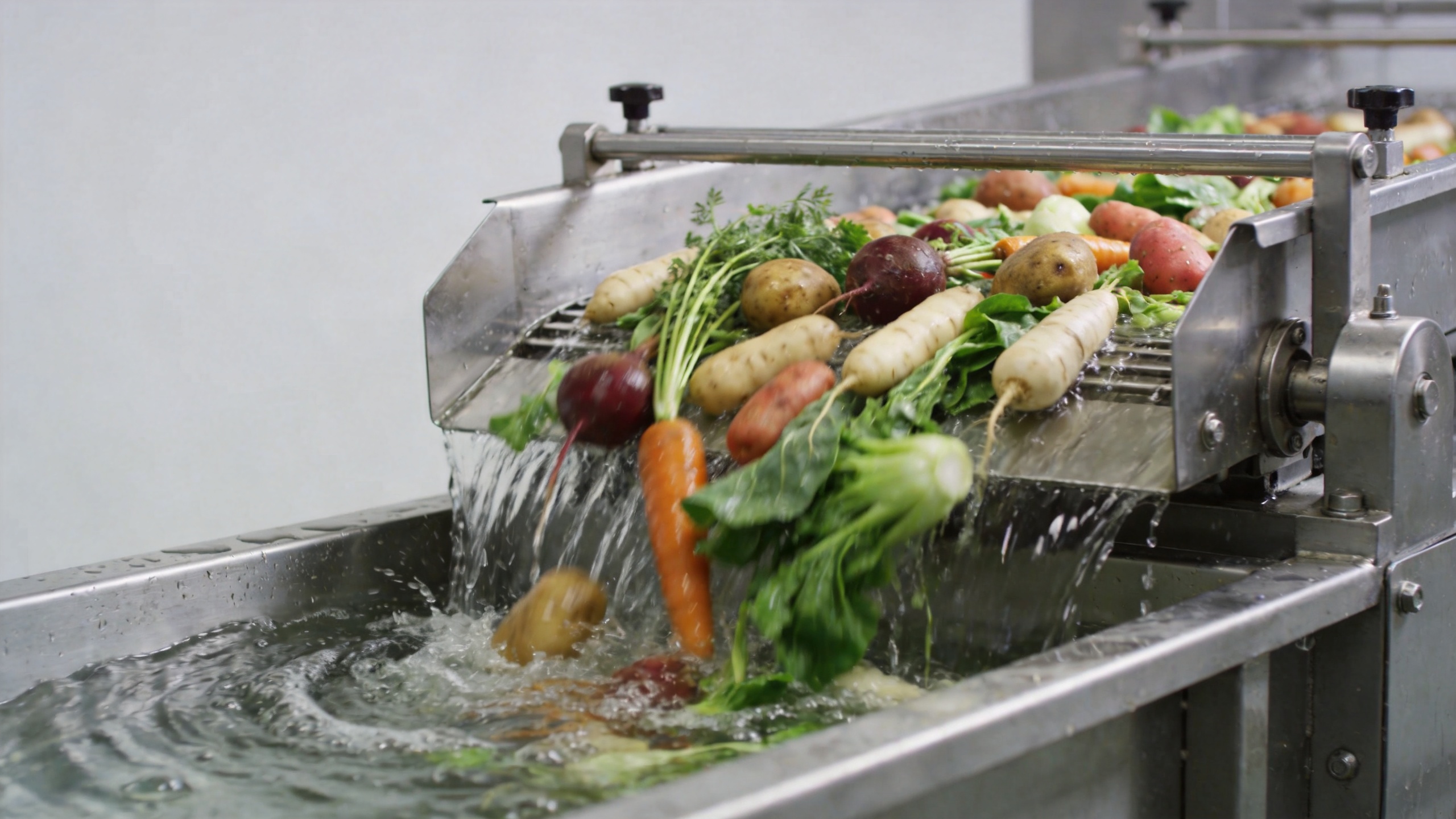
Potatoes, carrots, and similar robust crops may arrive with significant soil. They typically need enough water movement to loosen particles before downstream handling. A washer with recirculating water, controlled agitation, and an effective debris-removal arrangement can suit this type of duty. The selection question is not just whether the machine moves water; it is whether sediment can be separated and whether dirty water is kept from becoming the final rinse.
Firm produce can tolerate more contact than tender leaves, but the line still needs a trial with actual crop size, soil condition, and throughput. Crop condition changes by season, so a single nominal capacity figure does not replace an on-site process check.
2. Delicate leafy vegetables and herbs
Leafy greens, herbs, and other light products present a different challenge. Their folds can hold soil, yet leaves can tear or compact under aggressive handling. Here, gentler water circulation, air-bubble lift, or carefully controlled vortex movement may help open leaves and release debris with less physical contact. The aim is even exposure and controlled transport, not force for its own sake.
Water management becomes particularly important when product is immersed. Research summarized by the USDA Agricultural Research Service identifies cross-contamination during fresh-cut produce washing as a key concern: material removed from one item can enter the wash water and reach another. That is why line design should consider water refresh, filtration, sanitation controls where applicable, and a defined progression from dirtier to cleaner zones.
3. Smooth-skinned fruit and firm vegetables
Smooth-skinned orchard fruit, citrus, tomatoes, cucumbers, and similar produce are often evaluated for surface soil, residues from field handling, and cosmetic damage. A fruit vegetable washing machine for this group should offer a controllable water flow and conveyance speed so operators can balance dwell time with gentle handling. The FDA distinguishes firm produce that can be scrubbed from more delicate produce that should be treated gently; in an industrial setting, that same principle supports matching contact intensity to surface strength rather than applying one method to every product.
For smooth produce, inspect the transfer points as closely as the wash chamber. Drops, narrow guides, and poorly adjusted belts can cause marks even when the washing action itself is appropriate.
4. Berries and highly fragile produce
Berries, ripe soft fruit, and very thin-skinned items require the lowest-impact approach. Their risk profile often shifts the priority from aggressive soil removal to gentle handling, rapid drainage, and minimizing dwell time. If a process requires more intensive cleaning, test a representative batch and define acceptable limits for loss, bruising, and water retention before specifying the equipment.
Choose the Method, Then Verify the Whole Line
| Raw-material condition | Common cleaning emphasis | What to verify during trials |
|---|---|---|
| Heavy soil; firm roots | Water movement and debris removal | Sediment separation, final-rinse condition, product damage |
| Leafy or folded produce | Gentle lift and circulation | Leaf opening, trapped debris, water control, carryover |
| Smooth, firm produce | Controlled flow and optional light contact | Surface coverage, transfer damage, drainage |
| Soft or fragile fruit | Low-impact handling and quick drainage | Bruising, loss, residence time, handling after washing |
A useful buying process maps the washer to the full sequence: receiving, pre-cleaning, washing, rinsing, inspection, dewatering, cutting or packing. A washer may perform well in isolation but create a bottleneck if the next conveyor, blower, or inspection point cannot handle the actual product flow.
Use a Repeatable Fruit Vegetable Washing Machine Trial
A fruit vegetable washing machine should be trialed with real incoming produce, not only clean demonstration samples. For every fruit vegetable washing machine trial, record the crop variety, maturity, field condition, loading rate, water temperature, wash time, water-flow setting, and observations after discharge. This creates a practical baseline for comparing a fruit vegetable washing machine across seasons and suppliers.
For root crops, test whether the fruit vegetable washing machine releases embedded soil without carrying sediment into the final rinse. For leafy produce, test whether the fruit vegetable washing machine opens leaves without tearing them. For smooth-skinned produce, test whether the fruit vegetable washing machine covers the full surface while protecting the skin at transfer points. For berries and soft fruit, test whether the fruit vegetable washing machine keeps handling gentle enough for the required quality standard.
Ask operators to inspect samples before and after the fruit vegetable washing machine, then track water appearance and debris at each stage. A fruit vegetable washing machine that looks effective at the start of a run may behave differently after soil and plant matter accumulate. The trial plan should therefore include the expected operating duration, not only a short initial pass.
Questions to record during the trial
- Does the fruit vegetable washing machine handle the heaviest expected soil load?
- Can the fruit vegetable washing machine be cleaned and drained without difficult access points?
- Does the fruit vegetable washing machine match the speed of the upstream and downstream equipment?
- What product loss, bruising, or leaf damage occurs after the fruit vegetable washing machine?
- How does the fruit vegetable washing machine support the site’s water-control and sanitation procedures?
These questions keep the decision focused on fit. A fruit vegetable washing machine is most useful when its cleaning action, water path, and product transport align with the material risk profile established at receiving.
Practical Questions for an Early Equipment Discussion
- Which crops will use the machine, and can they be grouped by risk profile?
- What is the expected incoming soil condition in the most demanding season?
- What throughput is needed after allowing for loading, inspection, and drainage rather than only wash-chamber volume?
- How will water be refreshed, filtered, monitored, and separated between stages?
- What cleaning access, drainage, and floor space are available at the installation site?
- What trial criteria will define acceptable cleaning and acceptable product condition?
For processors exploring a vortex-style configuration, the Vegetable and Fruit High Efficiency Commercial Stainless Steel Disinfection vortex Fruit Washing Machine can be discussed as a product option within a wider process review. Its suitability should be assessed against the crop, the required cleaning action, the water-control plan, and the downstream line—not assumed from its name alone.
A Simple Decision Rule for Food Processors
Match the mildest cleaning action that can address the verified risk, then strengthen the process through water management, zoning, inspection, and repeatable operating procedures. This approach helps a fruit vegetable washing machine fit the ingredient rather than forcing the ingredient to fit a generic machine. It also gives new processing projects a clearer basis for trials, supplier conversations, and line-layout planning.
For an early-stage project, document the crop list, incoming condition, target output, and available utilities before requesting a proposal. That information lets equipment specialists provide more relevant configuration guidance and lets your team compare options on process fit rather than headline claims.