EN


What to Include in a Food Drying Equipment RFQ for Fruit and Vegetable Processing
For a fruit or vegetable processor, a useful RFQ turns an operating need into a quotation that can be technically compared. It gives every supplier the same information about product condition, output target, site limits, and acceptance method. That is more reliable than asking only for a machine price or a broad kilogram capacity.
This buyer checklist is designed for a decision-stage purchase. Use it when evaluating equipment for slices, dices, leaves, herbs, or other prepared produce. The objective is to make each response traceable to the same production assumptions, especially when seasonality or several products affect the drying plan.
Product and production information
- Heat pump condenser dryer: identify each fruit, vegetable, herb, or agricultural product planned for processing.
- State whether feed arrives whole, sliced, diced, shredded, peeled, blanched, or frozen.
- Provide typical and worst-case incoming moisture content for every representative product.
- State the incoming product temperature and any time limit before loading.
- List slice thickness, piece dimensions, and allowed loading depth on trays.
- Define the target final moisture or water-activity range for the finished product.
- Describe appearance, color, texture, shrinkage, and breakage limits that matter commercially.
- Identify pretreatments such as washing, blanching, sulfiting, sugaring, or salting.
- Specify batch load, batches per day, operating shifts, and seasonal peak volumes.
For each product, ask suppliers to show the assumptions behind their recommendation. Food drying is product-sensitive: a suitable airflow, humidity profile, and loading arrangement for one sliced fruit may not suit a leafy vegetable. Moderate drying temperatures are often used in heat-pump food applications, but the RFQ should ask for the proposed product-specific stages instead of assuming one setpoint works for every material.
Capacity and process-performance requirements
- Heat pump condenser dryer: state wet feed mass per batch and the expected net finished-product output.
- Request calculated water-removal duty using the stated initial and final moisture basis.
- Clarify whether moisture figures use wet basis or dry basis measurements.
- Set the maximum allowable drying cycle, including loading, unloading, and cleaning time.
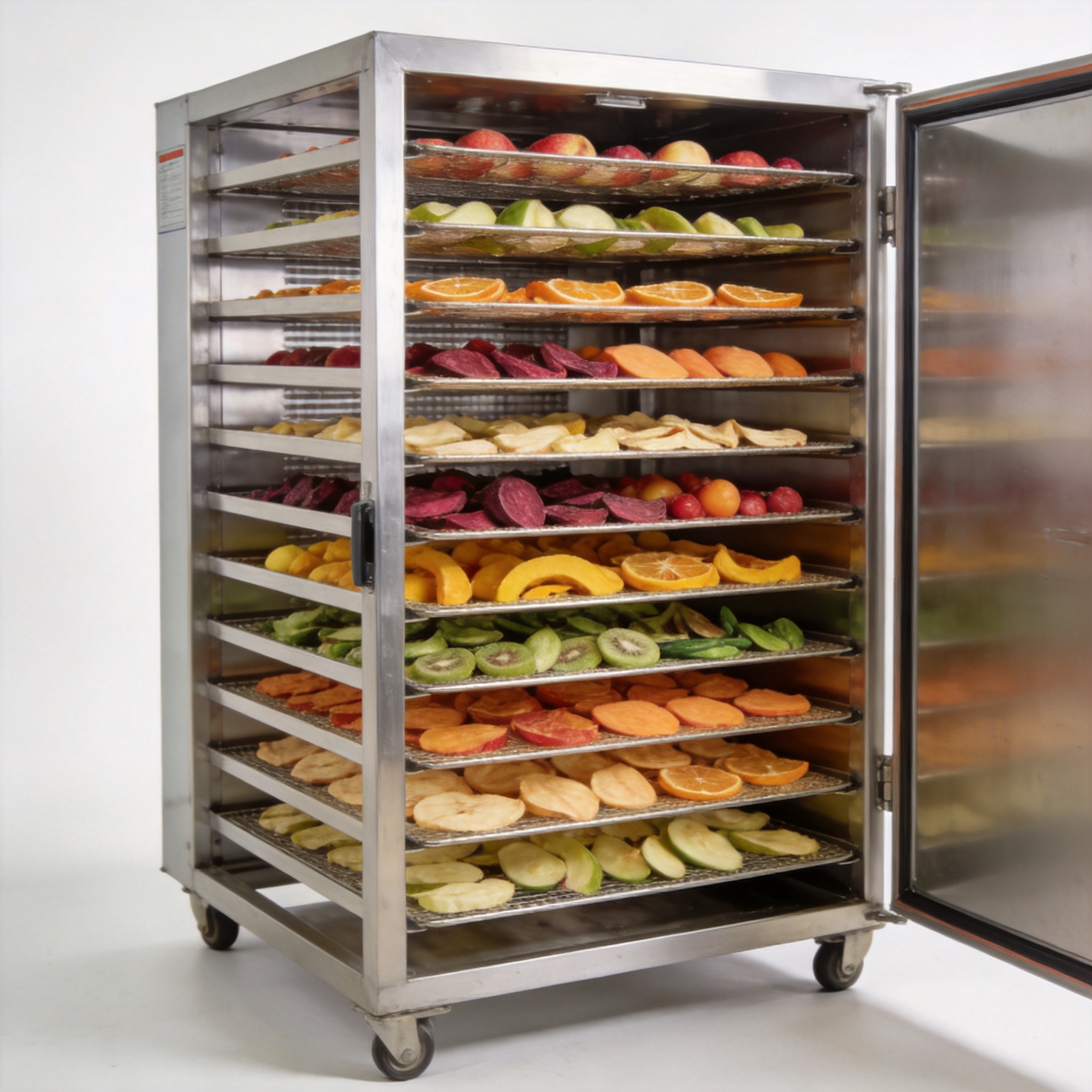
- Request usable tray area, trolley quantity, tray dimensions, and maximum loading density.
- Request proposed air temperature, relative humidity, airflow direction, and recirculation method.
- Ask for expected hourly moisture removal under the quoted product and ambient conditions.
- Ask suppliers to distinguish rated figures from values expected in your actual process.
- Request separate performance schedules when several products will run on one line.
A capacity figure is comparable only when its calculation basis is comparable. Ask each supplier to state the sample product, incoming moisture, final target, batch load, ambient condition, and test method behind the response. Performance can change with operating conditions, so a generic brochure figure is not a substitute for a defined proposal basis.
Equipment, hygiene, and site requirements
- Heat pump condenser dryer: specify the preferred chamber, trolley, tray, or continuous configuration.
- Attach the installation layout, floor dimensions, ceiling height, access route, and expansion allowance.
- State required food-contact materials, tray mesh, and accessible cleaning areas.
- Request a description of drainage, condensate handling, seals, and insulation.
- State available voltage, frequency, phase, electrical load, and power-quality limitations.
- Describe indoor or outdoor installation and the relevant ambient temperature and humidity range.
- Identify available drainage, water points, ventilation limits, and service-clearance constraints.
- List requirements for recipe storage, data logging, alarms, language, and remote support.
- Request manuals, wiring diagrams, recommended spares, maintenance intervals, and available inspection records.
Use the same response format for every quotation. For category context, buyers can review the confirmed Fruit Vegetable Agricultural Product Dehydration Air Source Heat Pump Drying Machine page, but the RFQ should define your own requirements rather than infer performance or options from a product title.
Commercial scope and acceptance criteria
- Heat pump condenser dryer: request separate pricing for core equipment, trays, controls, guidance, commissioning, and spare parts.
- State delivery destination, preferred shipping terms, delivery window, and required export packing.
- Ask suppliers to identify exclusions for civil work, wiring, lifting, and local services.
- Define the representative product and load to be used for factory acceptance testing.
- Specify moisture measurement method, permitted cycle time, measured outputs, and supplied test records.
- State who supplies trial materials and how deviations will be documented and resolved.
Before selecting a supplier, compare the same items across all proposals: water-removal basis, cycle time, usable loading area, utility demand, included scope, test method, documentation, and support. A complete RFQ gives purchasing and production teams a common decision record and makes it easier to identify where a quotation relies on assumptions that should be clarified before ordering.