EN


Fruit Dehydrator Machine: Which Drying Method Fits Mango and Other Fruits?
Choosing a fruit dehydrator machine is not simply a question of buying heat and trays. For a processor handling mango, banana, pineapple, apple, or mixed fruit snacks, the most suitable drying method depends on the fruit’s sugar level, thickness, desired texture, daily throughput, utility costs, and the quality checks used before packing. This guide compares the main options from a practical equipment-selection perspective.
Start with the finished fruit product, not the machine
Start the purchase discussion with the target product. Soft, pliable mango strips need a different process window from crisp apple chips or powdered fruit ingredients. Define the incoming fruit condition, slice geometry, target moisture or water activity, expected batch size, and packaging format before comparing a fruit dehydrator machine.
Water activity is especially important because it affects stability after drying. USDA reference material lists dried fruit at a typical water activity of 0.6, while FDA guidance notes that water activity must be reduced to and maintained at a suitable level for food stability. These references are starting points rather than a universal release limit: each processor should validate its own fruit variety, recipe, packaging, and storage conditions.
Four drying methods to compare
| Method | Best fit | What to assess |
|---|---|---|
| Hot-air tray drying | Mango slices, banana chips, pineapple pieces, mixed fruit batches | Air distribution, temperature control, loading density, cleaning access |
| Heat-pump drying | Processors seeking lower-temperature, energy-conscious drying | Humidity removal capacity, cycle time, ambient operating conditions |
| Vacuum drying | Products where lower-temperature processing or porous texture matters | Capital cost, vacuum control, product handling, maintenance support |
| Freeze-drying | Premium products that justify high texture and aroma retention | High investment, long cycle planning, cold-chain and service capability |
For many commercial fruit lines, a hot-air fruit dehydrator machine is the practical baseline because it can handle varied fruit formats and straightforward batch workflows. The decision then shifts to airflow uniformity, usable tray area, controls, sanitation, and how consistently the system reaches the validated endpoint.
Why mango needs special attention
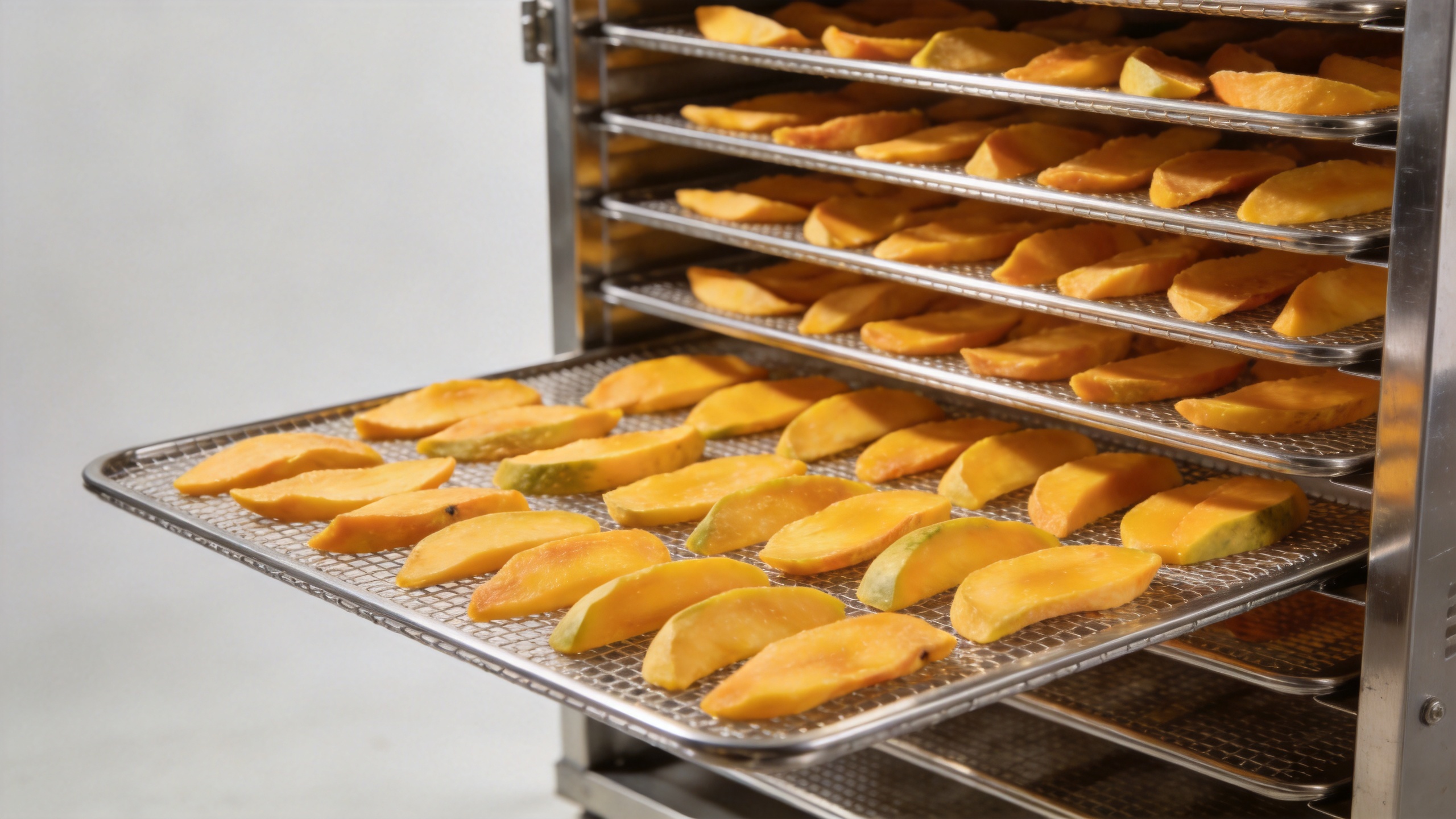
Mango is juicy and naturally high in sugar, so it can dry unevenly when slice thickness or tray loading varies. A small-scale mango reference suggests about 57°C (135°F) for roughly 8–12 hours until slices are pliable. In commercial production, treat that as a development reference only—not a fixed production recipe. Actual time changes with cultivar, ripeness, pretreatment, slice thickness, load depth, inlet air condition, and the desired final chew.
When evaluating a fruit dehydrator machine for mango, ask suppliers to explain how air moves through each tray level and how operators verify consistency between the center and edges of a batch. A system with adjustable temperature, timer control, and sensible loading practices can help teams build repeatable work instructions. It does not eliminate the need for sample testing and documented release checks.
Capacity is more than the number of trays
Tray count is easy to compare but can mislead buyers. Effective capacity depends on usable drying area, permitted product load per tray, airflow resistance, loading and unloading labor, and the time needed to clean and reset the chamber. A plant processing several fruit types should also consider changeover requirements and whether operators can keep one product’s flavor or allergen controls separate from another.
Put together a simple capacity model: kilograms of prepared fruit per batch, expected yield after drying, batches per shift, and the time reserved for cooling, inspection, and packaging. This reveals whether a larger cabinet, several smaller units, or a continuous solution makes more operational sense than relying on a nominal tray figure.
A procurement checklist for a fruit dehydrator machine
- Product fit: Can the dryer accommodate your thickest and thinnest fruit cuts without excessive rework?
- Air management: Is airflow designed to reach all tray levels consistently under a real product load?
- Controls: Can the team set and record temperature, time, and process stages required by its validation plan?
- Sanitation: Are food-contact surfaces and tray areas accessible for cleaning and inspection?
- Utilities: What electrical, ventilation, humidity, and heat-recovery conditions are required at your site?
- Quality release: How will the team sample moisture or water activity, cool product, and protect it from moisture pickup before packing?
- Support: Can the supplier provide operating documentation, remote technical guidance, and spare-parts planning for export operations?
Match the machine to your production plan
For buyers comparing commercial options, the Industrial Drying Vegetable Dryer Fruit Drier Machine Dehydrator Automatic is a relevant product category to review alongside your own capacity, utility, and validation requirements. Confirm the exact configuration, food-contact specification, and process suitability with the supplier before purchase.
Zhengzhou HongLe Machinery Equipment Co., Ltd. serves food-processing equipment buyers in multiple export markets and can provide selection discussion and remote technical guidance. A useful supplier inquiry includes fruit type, slice dimensions, planned daily input, power conditions, target product texture, and packing method.
Make the final choice with a trial plan
The right fruit dehydrator machine is the one that produces the desired mango or fruit product consistently at a capacity your team can operate and verify. Before finalizing a purchase, run representative fruit samples, inspect color and texture across the load, measure the quality endpoint used by your system, and review the labor needed for loading, cleaning, cooling, and packing. A documented trial plan turns an equipment comparison into a more reliable production decision.
Questions to settle before commissioning
What should I test with a fruit dehydrator machine?
Test representative mango slices at the intended load, including pieces from different ripeness levels. A fruit dehydrator machine should be assessed for color, texture, endpoint consistency, cooling behavior, and the results of the quality checks your operation has defined.
Can one fruit dehydrator machine handle several fruits?
Often it can, but each product needs its own documented loading, time, temperature, and quality-release procedure. When a fruit dehydrator machine switches from mango to apple or pineapple, plan cleaning and changeover steps as carefully as the heat setting.
Which fruit dehydrator machine controls matter most?
Prioritize controls that allow operators to repeat the approved process and record the settings. For commercial work, a fruit dehydrator machine also needs airflow and tray access that make visual inspection and corrective action practical.
How should a buyer compare quotations?
Compare the complete operating plan, not the quoted cabinet alone: usable loading area, drying time at your product conditions, power demand, cleaning time, commissioning support, and spare-parts access. This makes the fruit dehydrator machine comparison more meaningful than tray count alone.