EN


Fruit Dryer Machine: A Practical Guide to Capacity and Airflow
Buying a fruit dryer machine is not simply a matter of choosing the largest cabinet or the highest fan rating. For a fruit processor, the useful question is: how much saleable dried product can the machine deliver per shift, at a consistent quality level? The answer depends on the relationship between wet-product loading, tray area, air distribution, temperature control, exhaust, and the time needed for each recipe.
As a technical advisor for food-processing equipment selection, I start with the production rhythm rather than a catalogue capacity. A fruit dryer machine can look generous on paper and still become the bottleneck if slices are loaded too densely, air does not reach the center trays, or wet air cannot leave the chamber efficiently.
Start with usable capacity, not the headline capacity
Suppliers may describe capacity by tray count, chamber volume, or kilograms per batch. Each is useful, but none is enough on its own. Tray count tells you how much product can be spread out. Chamber volume indicates the physical envelope. Kilograms per batch is only meaningful when the supplier states the fruit type, slice thickness, starting moisture, loading pattern, drying temperature, and target final moisture.
For planning purposes, work backwards from your shift target:
- Define the kilograms of fresh fruit that must be processed per day.
- Separate products by size, sugar level, slice thickness, and expected drying time.
- Estimate how many batches fit into the real operating window, including loading, unloading, cleaning, and changeovers.
- Ask the supplier to confirm the recommended kilograms per tray for your product, not a generic maximum load.
A practical fruit dryer machine selection therefore includes a loading trial. Thin apple slices, mango pieces, banana chips, berries, and vegetable flakes do not present the same resistance to air or release moisture at the same rate. If the product mix changes often, a flexible tray layout can be more valuable than a single optimistic batch number.
Why airflow determines whether capacity is usable
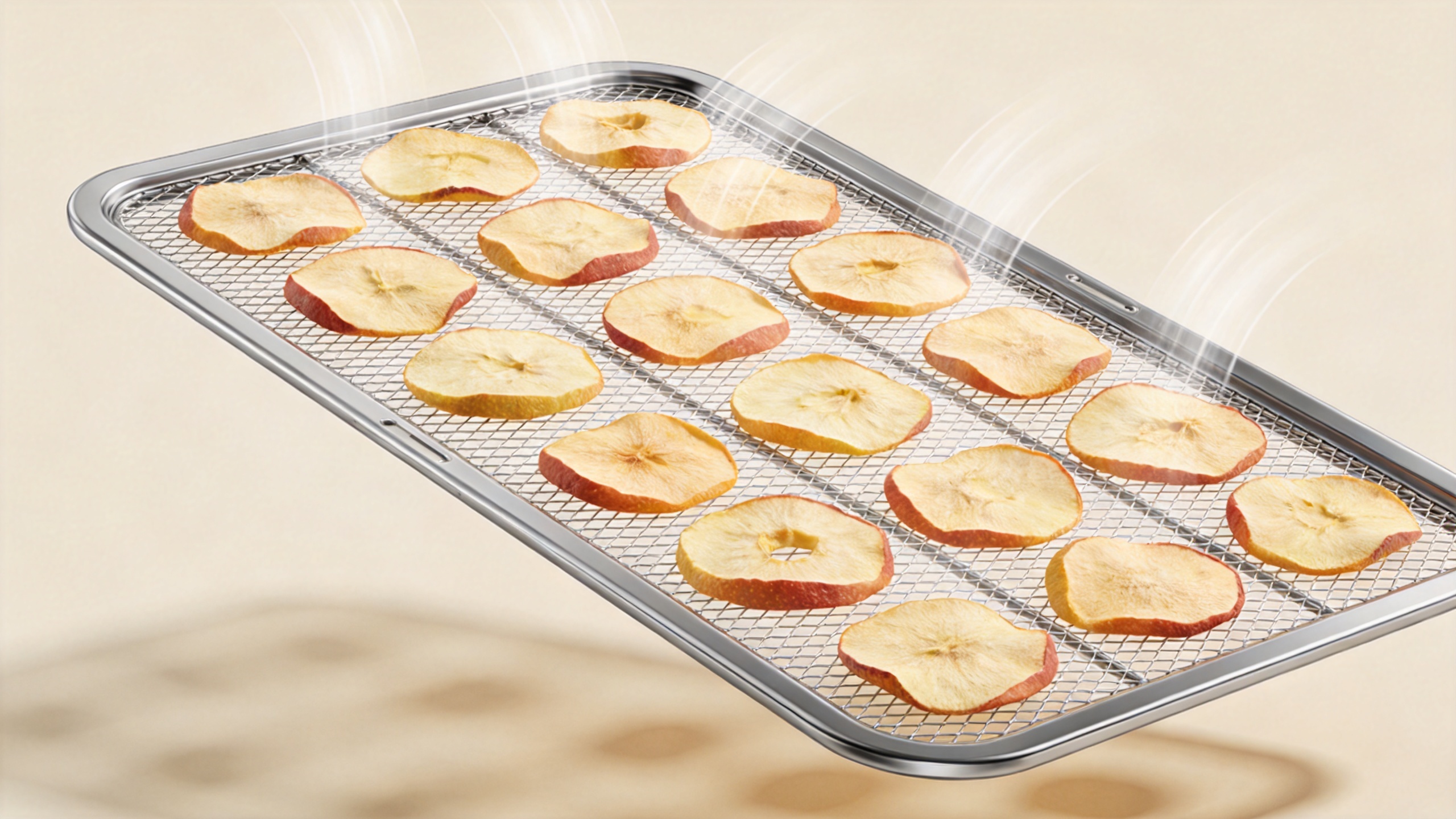
Drying works by moving warm, relatively dry air over exposed product surfaces and carrying moisture away. Good airflow is important, but fan size alone does not prove drying performance. The air path must reach every tray, pass through or across the product consistently, and exit without creating damp zones.
In practice, look at four things together:
- Air distribution: Does the ducting deliver air evenly from front to back and from top to bottom?
- Air velocity at the product: Is the flow strong enough to remove moisture without disturbing light pieces or causing uneven surface drying?
- Exhaust and fresh-air control: Can humid air leave the chamber at a controlled rate?
- Loading pattern: Are there clear rules for slice spacing, tray fill depth, and tray rotation when needed?
This is where a common assumption needs correcting: a larger fruit dryer machine does not automatically create more usable output. If airflow is poorly balanced, operators may have to rotate trays, extend the batch, or accept uneven moisture. The nominal capacity stays the same, but the capacity you can confidently sell is lower.
Match airflow to the product and the drying stage
Fresh fruit releases moisture quickly at the beginning of a batch. Later in the cycle, moisture migration from the interior becomes slower. Temperature, airflow, and exhaust settings should support both phases rather than force one fixed setting for every product.
Too little air movement can slow drying and leave moisture pockets. Excessive heat early in the process can form a dry outer layer before interior moisture has moved out. That is why the right question for a supplier is not “What is the fan power?” but “How do you control temperature, airflow direction, and humid-air removal for my material?”
Ask for a simple process sheet showing product preparation, tray loading, set temperature, estimated time, end-point check, and cleaning steps. Drying times are conditional: initial moisture, room humidity, fruit maturity, slice thickness, and batch load all affect the result. A fruit dryer machine should give operators repeatable controls, not a promise that one recipe will fit every fruit.
Compare cabinet designs with a production-line view
For small and medium batches, tray dryers are often practical because recipes can be separated and loading is visible. Larger operations may need more chamber capacity, better insulation, more structured airflow, and a loading method that reduces handling time. The appropriate approach depends on the production requirement.
| Selection factor | What to check | Why it matters |
|---|---|---|
| Tray area | Usable area per tray and recommended product depth | Determines how much surface is available for evaporation. |
| Air path | Horizontal, vertical, or mixed circulation; duct position | Influences uniformity across trays and whether rotation is needed. |
| Batch rhythm | Loading, drying, cooling, unloading, and cleaning time | Shows realistic shift output rather than isolated drying time. |
| Controls | Temperature, timer, airflow, and exhaust settings | Helps operators repeat recipes and diagnose variation. |
| Site conditions | Power supply, ventilation, floor space, and access | Prevents installation constraints from limiting performance. |
If you are building or expanding a food-processing line, evaluate the dryer alongside washing, cutting, pretreatment, packaging, and material handling. A dryer that matches the upstream preparation rate and downstream packing rate is normally more useful than one selected only for its maximum chamber volume.
A buyer checklist before you order
Before confirming a fruit dryer machine, prepare samples or clear specifications for your main products. Ask the supplier to discuss expected loading and airflow for the exact material. Clarify whether the recommended output is based on fresh input or finished dried product, and whether it assumes continuous operation.
- What fruit and slice thickness were used to state the capacity?
- How are temperature and humid-air exhaust adjusted during a batch?
- How is airflow verified across different tray positions?
- Does the process require tray rotation, and how does that affect labor?
- What cleaning access, spare parts, manuals, and remote technical support are available?
- Can the design be matched to your local voltage, ventilation, and planned production layout?
For a product reference, you can review this industrial drying vegetable dryer fruit drier machine dehydrator automatic and use the checklist above to discuss your application requirements with the equipment team.
Make the final decision on a trial, not on a single specification
The most useful capacity figure is the one proven with your fruit, your cut size, your target texture, and your planned working hours. Request a documented trial or a detailed process discussion before finalizing the configuration. Record the fresh load, tray arrangement, drying time, final condition, and any tray-to-tray variation.
For awareness-stage buyers, the takeaway is straightforward: select a fruit dryer machine by combining usable tray capacity with a controlled airflow path. When those two elements are balanced, you have a clearer foundation for stable drying quality, realistic scheduling, and future line planning.
Fruit Dryer Machine Questions Buyers Should Ask
How do I calculate fruit dryer machine capacity?
Calculate fruit dryer machine capacity from the fresh load per tray, the number of usable trays, and the actual batches completed in a shift. A fruit dryer machine quotation should identify the product basis for that calculation, because a fruit dryer machine handling thin apple slices will not necessarily achieve the same load with thick mango pieces.
How much airflow does a fruit dryer machine need?
There is no single airflow number that fits every fruit dryer machine. The right setting depends on chamber size, tray arrangement, fruit surface area, moisture release, and the exhaust path. Instead of comparing only fan power, ask how the fruit dryer machine keeps air distribution even at full loading.
Can a fruit dryer machine dry different fruits in one batch?
A fruit dryer machine may process compatible products together when their preparation, temperature, and expected drying time are similar. However, a fruit dryer machine should not be overloaded with mixed products simply to fill empty trays. Different sizes and moisture levels can make the batch harder to control.
What should I verify during a fruit dryer machine trial?
During a fruit dryer machine trial, record the fresh input weight, slice thickness, tray loading pattern, setpoints, time to reach the target condition, and variation between trays. This gives a more useful basis for selecting a fruit dryer machine than a one-time visual demonstration.
When should I choose a larger fruit dryer machine?
Choose a larger fruit dryer machine when forecast demand, loading labor, utilities, and downstream packaging can support the added throughput. If demand is still variable, a fruit dryer machine with manageable batch control and room for planned expansion can be the safer choice.