EN


How a Peanut Butter Production Line Works from Grinding to Packing
For a plant buyer, a peanut butter making machine is not just one grinder. It is the central part of a connected process that receives prepared peanuts, turns them into a stable paste, and sends that paste to the right package without disrupting texture or hygiene. Looking at the line as a sequence helps procurement teams compare equipment on process fit rather than on a single machine specification.
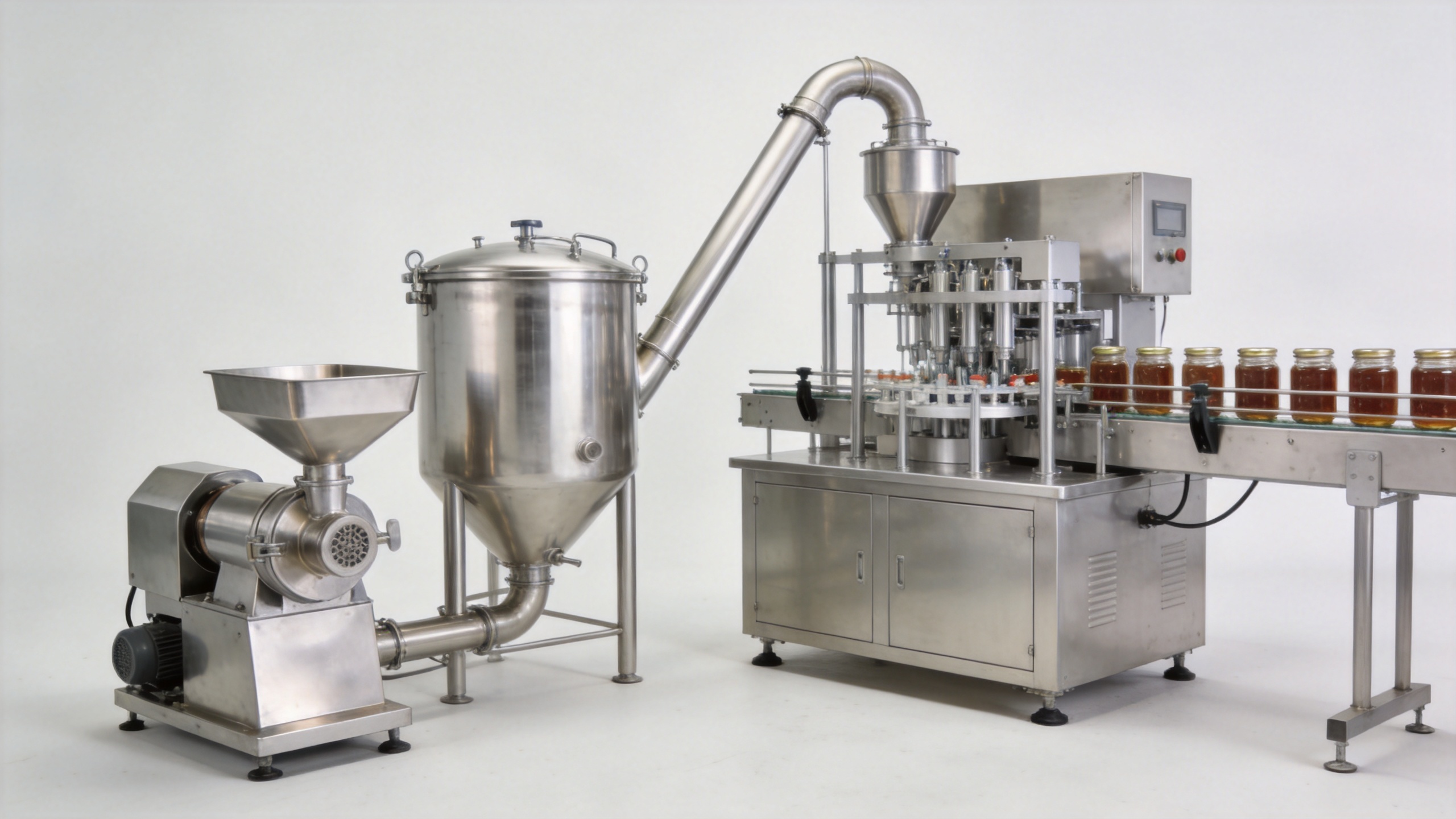
This overview follows the practical route from grinding to packing. It focuses on the handoffs that make a commercial line work: particle reduction, formula blending, controlled transfer, filling, sealing, and routine checks. A nut butter making machine can be configured for different recipes, but the production logic stays similar.
Start with prepared peanuts and a steady feed
Grinding performs reliably when the upstream preparation stage delivers clean, roasted, and consistently handled kernels. Roasting develops flavor and reduces moisture; cooling and sorting help keep the feed uniform before it reaches the mill. If feed conditions vary from batch to batch, even a well-built peanut butter making machine can produce a paste that needs more adjustment later.
At this point, buyers should think about capacity as a line question. The feed system, grinder, holding tank, and filler need compatible output rates. A bottleneck after the grinder can force long waiting times, while an oversized downstream section wastes floor space and operator attention.
Grinding creates the base texture
The grinding section is where a peanut butter making machine converts roasted peanuts into paste. In commercial production, the goal is repeatable particle reduction and dependable flow, not simply the highest possible speed. Many lines use staged grinding so the material can move from an initial paste toward the texture specified for the finished product.
Operators normally monitor temperature, throughput, and the visual feel of the paste during this stage. Excess heat or inconsistent feed can affect flow behavior and make later mixing harder. A sensible line layout leaves enough access for cleaning and inspection around the grinder, transfer pipes, and product-contact components.
Mixing turns ground paste into a controlled formula
After grinding, the paste enters a mixing or conditioning stage. Here, a peanut butter making machine line can combine the ground material with recipe ingredients such as salt, sugar, or stabilizing components when the product specification calls for them. The purpose is to distribute ingredients consistently and create a paste that can move predictably to filling.
Mixing is also the point where production teams check whether the formula remains uniform from the beginning to the end of a batch. A tank that is too small may limit dwell time; one that is poorly matched to the transfer system may create avoidable hold-ups. For buyers, the important question is how the grinder, mixer, and transfer pump are sized as one system.
Why transfer design matters
Peanut butter is a thick product, so transfer is more than a plumbing detail. Pipe routing, pump selection, valves, and tank outlet design influence whether the product reaches the filler smoothly. A commercial peanut butter making machine should support a controlled handoff rather than sending uneven surges to packaging equipment.
Condition the product before filling
Depending on the recipe and line design, the paste may be held, cooled, deaerated, or otherwise conditioned before filling. The aim is to deliver a stable, fill-ready product to the packaging section. This stage can reduce variation in flow and help the filler operate with fewer interruptions.
It is useful to review the production line from the packaging end backward: what product state does the filler need, and what upstream conditions create it? That question often reveals whether a peanut butter making machine proposal includes the tanks, controls, and transfer capacity needed for a practical installation.
Filling, sealing, and packaging protect the finished product
Once the paste reaches the filler, the line doses it into the selected container format. The packaging section may include filling, capping or sealing, coding, labeling, and final handling. Accurate filling depends on a consistent incoming product stream, which is why the earlier stages of a peanut butter making machine line matter so much.
Packaging choices should be made early because jar, pouch, or other formats affect filling equipment, cap or seal handling, and line layout. Buyers should define their target pack size, expected changeover needs, and downstream inspection requirements before finalizing a system. The goal is a line that can maintain a repeatable sequence rather than a collection of standalone machines.
Build the line around connected operating decisions
For an awareness-stage buyer, the key takeaway is simple: a peanut butter making machine operates more consistently when grinding, mixing, transfer, and packaging are planned together. The same principle applies whether the project starts with one machine or an integrated plant.
When evaluating a supplier, ask for a process flow that shows material movement, expected capacity at each stage, cleaning access, and the required utilities. Hongle Machinery supplies food-processing equipment and can discuss line planning around capacity targets and site conditions. For a product-level starting point, review the automatic peanut butter production machine alongside your required packaging format and process sequence.
Practical checklist before you specify equipment
- Define the desired hourly output and expected operating schedule.
- Confirm the recipe, target texture, and container format.
- Map each handoff from prepared peanuts to finished packs.
- Review cleaning access and product-contact areas.
- Match grinder, mixer, transfer, and filling capacities.
By treating the peanut butter making machine as part of a complete production path, buyers can ask clearer technical questions and reduce integration surprises. The result is a more coherent route from grinding to packing and a stronger basis for selecting commercial peanut butter equipment.