EN


How Air Bubble Vegetable Washers Improve Cleaning for Ready-to-Process Produce
Before cutting, blanching, packing, or further processing, produce needs a cleaning step that is consistent without being unnecessarily harsh. An air bubble vegetable washer is designed for that early-stage job: water supports the product while injected air and controlled circulation help loosen soil and light surface debris. For a processor moving beyond hand washing, the key question is not simply whether a machine can wash faster. It is whether the washing action suits the crop, the line layout, and the level of cleaning required before the next process.
As a technical advisor evaluating food-processing equipment, I would start with the operating conditions rather than a headline capacity. Produce differs in shape, surface texture, field soil, maturity, and susceptibility to bruising. More reliable results depend on matching the water action and handling path to those realities.
Why Manual Produce Washing Becomes Hard to Control
Hand washing can be flexible for small batches, but consistency becomes difficult when volumes rise or several operators work at once. Contact time, water movement, sorting discipline, and final rinsing can vary from batch to batch. An air bubble vegetable washer gives the pre-cleaning stage a repeatable movement pattern, so the line can be checked and adjusted as a process rather than managed as a collection of individual washing habits.
That does not mean any automated washer is automatically right. Leafy greens, tomatoes, root vegetables, and firm fruit behave differently in water. A sound purchasing decision considers the raw material first, then the required flow rate, downstream equipment, drainage, and sanitation procedure.
How Air Bubbles and Water Flow Support Cleaning
Inside an air bubble vegetable washer, air introduced into the wash water creates rising bubbles and gentle agitation around the product. This movement can help separate loose soil and debris from surfaces, crevices, and leaves while the water cushions the produce. Depending on the machine configuration, circulation or vortex-style water flow can add movement, and a conveyor can carry produce onward at a controlled pace.
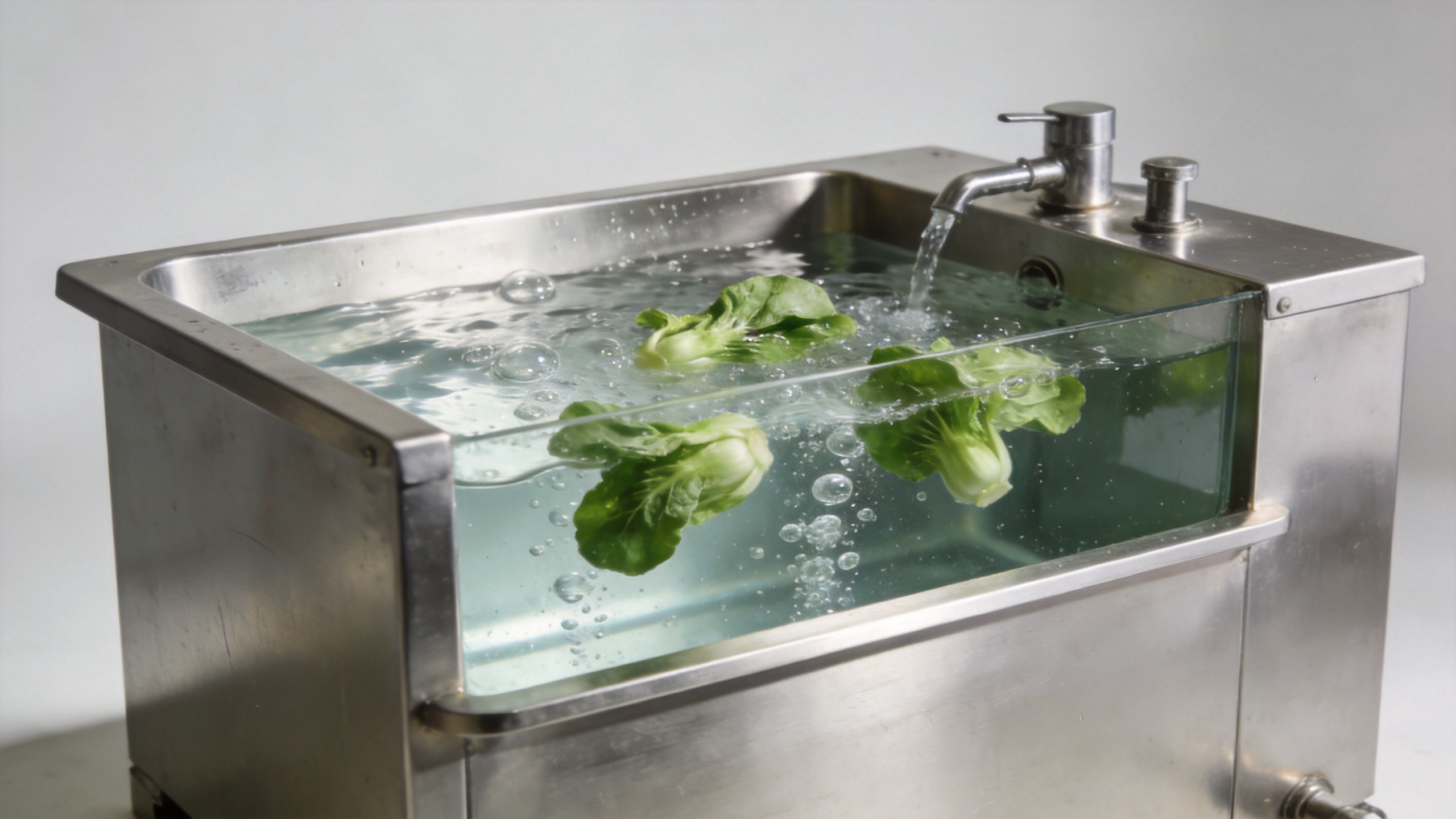
The useful distinction is that bubbles create movement; they do not replace every other part of a hygiene program. Soaking time, water quality, rinse design, sanitation chemistry where applicable, and the condition of incoming produce still matter. A practical sequence may include loading, immersion and bubble agitation, lifting, spraying, inspection, and transfer to the next station. Keeping those stages distinct makes it easier to identify where cleaning performance needs attention.
Cleaner Handling Does Not Need to Mean Rougher Handling
Many buyers initially assume stronger agitation automatically means better cleaning. In practice, the suitable intensity depends on the crop. Delicate leaves may need enough movement to open and rinse the product without excessive tumbling. Firm produce may tolerate a more active wash, while root crops with attached soil may benefit from upstream sorting or a dedicated soil-removal stage. The point is to use an air bubble vegetable washer as a controlled pre-cleaning tool, not to force one washing recipe onto every raw material.
This matters especially when visual quality is part of the finished product. A washing system should be evaluated not only by what it removes, but also by how it protects usable product during transfer. Ask to see how the infeed, water level, conveyor transition, and spray section handle your own sample material.
What Continuous Conveying Adds to the Process
Continuous movement helps create a defined residence time instead of relying on a worker to judge when a basket has been washed long enough. It also supports a clearer handoff to trimming, inspection, dewatering, or packaging. For operations seeking produce washing equipment, this is often where the real value appears: cleaning becomes easier to coordinate with the pace of the broader line.
Still, a conveyor should be matched to the actual production rhythm. If the washer feeds a slower downstream station, product can accumulate and lose the benefit of orderly handling. Before selecting a system, map the whole path: receiving, sorting, washing, rinsing, draining, inspection, and the next process. The washer should fit that path rather than become an isolated island of capacity.
A Material-by-Material Check Before You Buy
- Leafy vegetables: Confirm that the water movement opens leaves and releases loose debris without excessive compression or tangling.
- Tomatoes and similar delicate produce: Review transfer points and spray pressure to reduce avoidable impact.
- Root vegetables: Decide whether incoming soil requires a separate pre-wash or brushing step before bubble washing.
- Firm fruit and cut-ready vegetables: Check whether the wash path and final rinse align with your inspection and preparation sequence.
It is also worth confirming how operators will drain, clean, and inspect the machine between runs. Equipment selection is not only about the wash tank. Access for routine cleaning, practical water management, and operator training influence whether the intended process remains consistent over time.
Using an Air Bubble Vegetable Washer in a Commercial Pre-Processing Line
For buyers building or upgrading a produce preparation area, an air bubble vegetable washer can provide a structured foundation for pre-cleaning. The relevant product page for a Vegetable and Fruit High Efficiency Commercial Stainless Steel Disinfection vortex Fruit Washing Machine can be used as a starting point for discussing line fit, but the final configuration should be checked against actual produce, throughput, and process requirements.
Start with a trial plan: define the incoming condition of the produce, the result the wash stage must support, the available floor space, and the downstream pace. Then evaluate water action and conveying as part of one connected workflow. That approach keeps the conversation focused on cleaning consistency and material care instead of relying on generic claims.
Final Takeaway
An air bubble vegetable washer improves pre-processing by introducing controlled buoyancy, agitation, and product movement into the washing stage. When it is matched to the material and line conditions, it can help processors move from variable manual washing toward a more repeatable workflow. The most useful next step is to review representative produce and the full production path with the equipment supplier, then set operating conditions that protect product quality while supporting the cleaning objective.