EN


How to Choose a Commercial Fruit Washing Machine for Your Processing Line
Choosing a fruit vegetable washing machine is a line-design decision, not simply a purchase of a wash tank. A machine that handles incoming produce gently, fits the available processing rhythm, and can be cleaned consistently gives a food processor a stronger starting point for downstream sorting, cutting, drying, packing, or further processing. For B2B buyers, the useful question is not “Which unit looks more powerful?” It is “Which wash method, material flow, and sanitation arrangement fit our actual raw material and operating routine?”
This guide uses a practical procurement lens for processors building or updating a produce line. It focuses on the relationship between product condition, wash action, water management, and line handoff—areas often absent from consumer-oriented search results for a fruit vegetable washing machine.
Start With the Produce, Not the Equipment Brochure
First map the fruit and vegetables that will enter the line. Firm root vegetables, leafy produce, delicate berries, round fruit, and irregularly shaped items carry dirt differently and react differently to water movement. List each product family, its typical incoming condition, whether it is loose or packed, and the acceptable rate of bruising or leaf loss. If seasonal materials change substantially, record the peak-season mix rather than only the current mix.
A fruit vegetable washing machine should be selected around the cleaning task. For each fruit vegetable washing machine under review, document the intended product mix and wash objective. Soil attached in crevices may call for a different action than field dust or loose debris. Delicate items need controlled movement and careful transfer points; tougher produce may tolerate a more active wash stage. Ask suppliers to explain the path from infeed to discharge, including where product accumulates, turns, rises, and leaves the water. These details matter more than a broad label such as “high efficiency.”
Match the Wash Method to the Required Cleaning Outcome
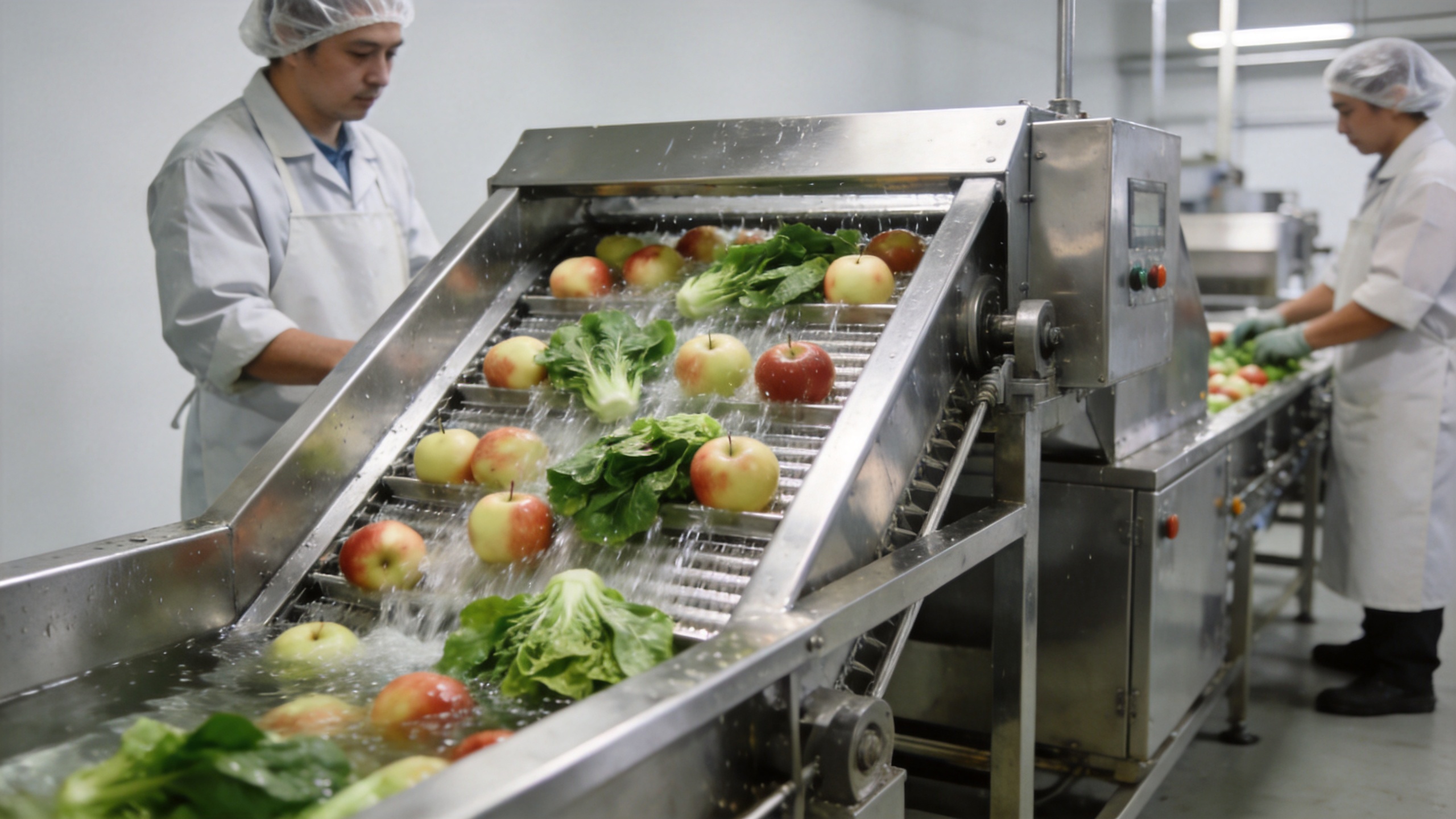
Commercial systems may combine soaking, water circulation, bubble or vortex-style agitation, spray rinsing, brushing, flotation, or conveyor transfer. The right combination depends on the produce and on the purpose of the wash step. Is the operation removing visible soil, separating floating debris, providing a final rinse, or supporting a wider documented sanitation program? State the target outcome before comparing configurations.
An ozone vegetable and fruit purifier may be discussed during process planning, but it should be evaluated as one part of a validated workflow rather than a substitute for product-specific water, cleaning, and verification procedures. The supplier should be able to describe how any treatment method fits the tank design, contact time, water turnover, safety measures, and cleaning routine. Buyers should verify local food-safety requirements and their own process controls before specifying such an option.
For operations subject to applicable U.S. produce-safety requirements, FDA guidance says agricultural water used for harvest and post-harvest purposes must have no detectable generic E. coli per 100 mL, and untreated surface water must not be used for those purposes. This is a reminder to evaluate water management together with the machine—not a one-size-fits-all machine specification.
Size the Fruit Vegetable Washing Machine Around Line Rhythm
Capacity should be assessed as a system calculation. Start with the required finished output per hour, then account for incoming condition, expected rejects, changeovers, breaks, batch size, and downstream restrictions. A wash unit with a high nominal figure can still create a bottleneck if the elevator, dewatering stage, inspection table, or cutter accepts product at a different pace.
During technical discussions, ask for the assumptions behind throughput: produce type, loading depth, manual feeding, water condition, and conveying speed. Then compare those assumptions with a representative production shift. It is sensible to request a layout showing infeed height, discharge height, floor space, water connections, drain position, power requirements, and access zones. The aim is a balanced flow, not an isolated capacity number. This is why fruit vegetable washing machine selection should be reviewed with the downstream line team.
| Selection question | Why it matters | What to confirm |
|---|---|---|
| What produce enters the washer? | Fragility and soil load influence wash action. | Samples, seasonal mix, acceptance criteria. |
| What rate must the line sustain? | Nominal output may differ from usable output. | Hourly target, peak demand, downstream speed. |
| How will water be managed? | Water quality and renewal affect the process. | Inlet, overflow, filtration, drainage, monitoring. |
| How will the unit be cleaned? | Accessible surfaces support repeatable sanitation. | Tank access, removable parts, drainability, cleaning procedure. |
Examine Hygienic Design and Daily Cleanability
A commercial washing line built around a fruit vegetable washing machine needs more than corrosion-resistant material. Look at whether food-contact areas are smooth, visible, and reachable; whether debris has places to collect; whether tanks drain fully; and whether guards or covers can be opened safely for inspection. Hygienic design guidance consistently emphasizes accessible, cleanable surfaces because sanitation is difficult when operators cannot see or reach the areas that need attention.
Ask to review the cleaning procedure before placing an order. It should identify access points, detachable components, drain steps, and the utilities that must be isolated. Also consider who will perform the work and how much time the production schedule permits. A fruit vegetable washing machine that is technically suitable but difficult to reset between lots can create operational friction later.
Check the Handoffs Before and After Washing
A fruit vegetable washing machine rarely stands alone in a processing line. Upstream, consider receiving, manual sorting, crate dumping, or pre-rinsing. Downstream, consider inspection, spray rinse, dewatering, air drying, cutting, freezing, or packing. Every transition creates a chance for product damage, water carryover, or queueing. A simple line sketch with product direction and elevation changes often reveals constraints early.
Where a vortex-style commercial configuration is relevant, buyers can review the available Vegetable and Fruit High Efficiency Commercial Stainless Steel Disinfection Vortex Fruit Washing Machine as a starting point for a supplier discussion. Confirm the configuration, product suitability, and line connection against your own material before making a specification decision.
Send Suppliers a Clear Requirement Sheet
Better quotations usually follow better input. Share produce photos or samples where possible, target hourly output, product dimensions, available utilities, hygiene expectations, layout limits, downstream equipment, and the required delivery market. Ask suppliers to identify what they have assumed rather than leaving key decisions implicit. For export projects, clarify documentation, electrical standards, commissioning support, spare-part planning, and the scope of operator training.
It also helps to evaluate proposals with production, quality, maintenance, and purchasing teams together. Production can assess flow; quality can assess cleaning access and water controls; maintenance can assess serviceability; purchasing can compare scope and lifecycle requirements. This reduces the risk of selecting solely on initial price.
Use a Shortlist That Reflects Your Actual Process
Before final selection, compare each candidate fruit vegetable washing machine against the same checklist: produce compatibility, wash action, usable capacity, water arrangement, cleanability, transfer connections, utilities, delivery scope, and supplier communication quality. If a trial is possible, use representative produce and define what will be observed in move forward. The goal is not to prove a generic claim; it is to establish whether the proposed arrangement supports your processing line under realistic conditions.
A well-chosen commercial washer becomes a reliable part of the material flow because its configuration is connected to the product, the people operating it, and the equipment around it. Start with those facts, document open questions, and turn the final specification into a shared reference for the supplier and your internal team.