EN


How to Choose a Commercial Vegetable Dicer for Potato and Root Vegetables
Potatoes, carrots, sweet potatoes, beets, turnips, and similar roots can all be diced at scale, but they do not load, cut, or clean up in exactly the same way. A commercial vegetable dicer should therefore be selected as part of a production process, not simply by choosing the biggest motor or the lowest quoted price. For a foodservice operator, central kitchen, frozen-food producer, or produce processor, the right choice starts with the crop condition, the required cube, the hourly demand, and the time available for sanitation.
This guide uses a practical procurement lens: define the job first, then test the machine against real incoming vegetables. The aim is consistent dice quality with a workflow that operators can load, inspect, and clean without turning every shift change into a bottleneck.
Start with the produce, not the commercial vegetable dicer brochure
A commercial vegetable dicer handles a cutting problem, and that problem changes with the product. Fresh potatoes may be firm and uniform; stored potatoes can vary in moisture and firmness. Carrots and beets are dense and abrasive. Sweet potatoes may be irregular in shape. Before comparing models, list the vegetables you will run most often, their typical diameter range, whether they are peeled, and whether they arrive washed, chilled, or at ambient temperature.
Ask commercial vegetable dicer suppliers to explain the feed opening, cutting sequence, and recommended preparation for your exact produce. A machine that performs well on a small sample of clean, uniform potatoes may need different pre-cutting, trimming, or loading practices when faced with mixed-size root vegetables. It is also useful to clarify how the machine handles misshapen pieces and what happens when a hard end piece reaches the cutting area.
- Potatoes: check cube integrity, starch buildup, and whether peeling or pre-sizing is needed.
- Carrots and beets: check blade wear expectations and the stability of the product during feeding.
- Sweet potatoes and turnips: check the practical limits for irregular shapes and larger diameters.
- Mixed vegetable lines: confirm how quickly operators can change the cutting setup and clean between products.
Choose commercial vegetable dicer dice size by the finished product specification
For every commercial vegetable dicer, the next question is not “what sizes are available?” but “which cube dimensions are acceptable after downstream handling?” Soup mixes, frozen vegetable blends, salad preparation, filling lines, and dehydrated ingredients can each tolerate different variation. Write down the target dice size, the permitted range, and the proportion of slivers, broken pieces, and oversized pieces your process can accept.
A capable commercial vegetable dicer should offer a documented method for changing the relevant cutting components. During a supplier discussion, ask to see the blade set associated with your intended cube rather than relying on a generic image. Confirm which parts are included, which are optional, and how the operator verifies that a reassembled set is correctly seated before production begins.
Do not treat a cutter for strips or slices as automatically equivalent to a dicer. Dicing normally depends on a sequence of cuts that creates a cube; the consistency of that sequence matters more than a broad list of possible cut styles. If green onion is also in your program, discuss that as a separate application. A japanese green onion cutting machine may serve a distinct cut pattern and loading method, so it should not be assumed to replace a root-vegetable dicer.
Translate commercial vegetable dicer hourly output into a realistic requirement
Commercial vegetable dicer capacity should be evaluated as usable output during a normal shift, not only as a nameplate number. Start with the kilograms of diced product required per hour, then add the time needed for washing, peeling, trimming, loading, collecting, inspection, blade changes, and planned cleaning. If one person must feed the machine continuously, the feed arrangement and discharge flow can matter as much as the cutting mechanism.
For a meaningful commercial vegetable dicer trial, use your own potatoes or root vegetables whenever possible. Record input weight, finished yield, cut quality, operator time, and any stops caused by bridging or cleaning. Compare that result with the production schedule rather than treating a short no-load demonstration as proof of throughput. A commercial vegetable dicer is a better fit when its demonstrated output leaves room for normal interruptions and still meets the line target.
| Question | Why it matters | What to request |
|---|---|---|
| What is the required finished kg/hour? | Sets the real line target. | Trial output using representative produce. |
| How many operators are available? | Feeding and collection may limit output. | Recommended operating layout. |
| How often will the dice size change? | Changeovers affect usable capacity. | Blade-change procedure and parts list. |
| What happens to off-cuts? | Yield affects cost and downstream handling. | Sample yield and quality observations. |
Make commercial vegetable dicer sanitation and access a purchase criterion
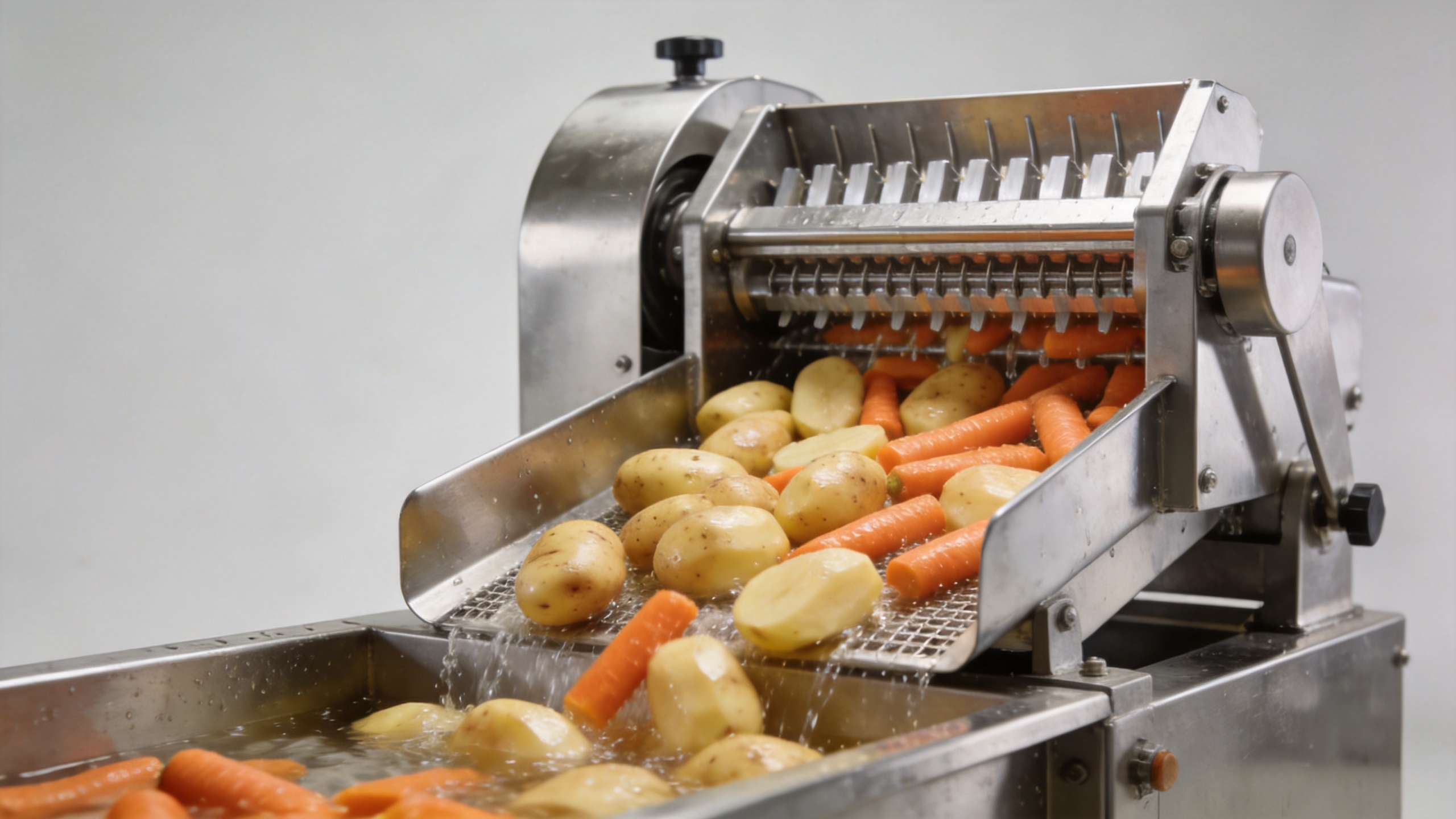
For root vegetables, soil residue, peel fragments, starch, and moisture can collect around feed areas and cutting components. That makes cleanability central to the buying decision. The FDA Food Code describes multiuse food-contact surfaces as smooth, free of cracks and crevices, and accessible for cleaning and inspection; it also requires food-contact surfaces and utensils to be clean to sight and touch. These principles are useful evaluation questions even when a buyer operates under another local food-safety regime.
Inspect how each commercial vegetable dicer opens, disassembles, drains, and reassembles. Look for access to the blade zone, feed chute, discharge area, guards, and any surfaces where residue may lodge. Ask which steps require tools, how parts are identified after removal, and whether the cleaning procedure is documented for operators. A shorter, clearer cleaning routine is valuable only if it still gives staff visual and physical access to food-contact surfaces.
- Request the cleaning and sanitation instructions before placing an order.
- Ask an operator to demonstrate disassembly and reassembly.
- Inspect joints, guards, and corners for reachable cleaning access.
- Confirm the availability of replacement blades and wear parts.
- Include cleaning time in the capacity calculation for every shift.
Evaluate commercial vegetable dicer safety, service, and integration
Commercial vegetable dicer mechanical safety and daily maintainability deserve the same attention as output. Confirm the guarding arrangement, emergency-stop access, electrical requirements, and the procedure for clearing a jam. Ask what routine checks operators perform before startup and what maintenance tasks require trained service personnel. For export projects, clarify the documentation, spare-parts plan, remote support method, and lead time for common wear components.
Commercial vegetable dicer integration questions are equally important. Consider the height of the discharge point, the container or conveyor used to receive diced product, drainage around the machine, and the available floor space for loading and cleaning. If the dicer will sit after a washer or peeler, verify how product is transferred without overloading the feed area. These details often determine whether a machine supports a smooth line or creates a new manual handling step.
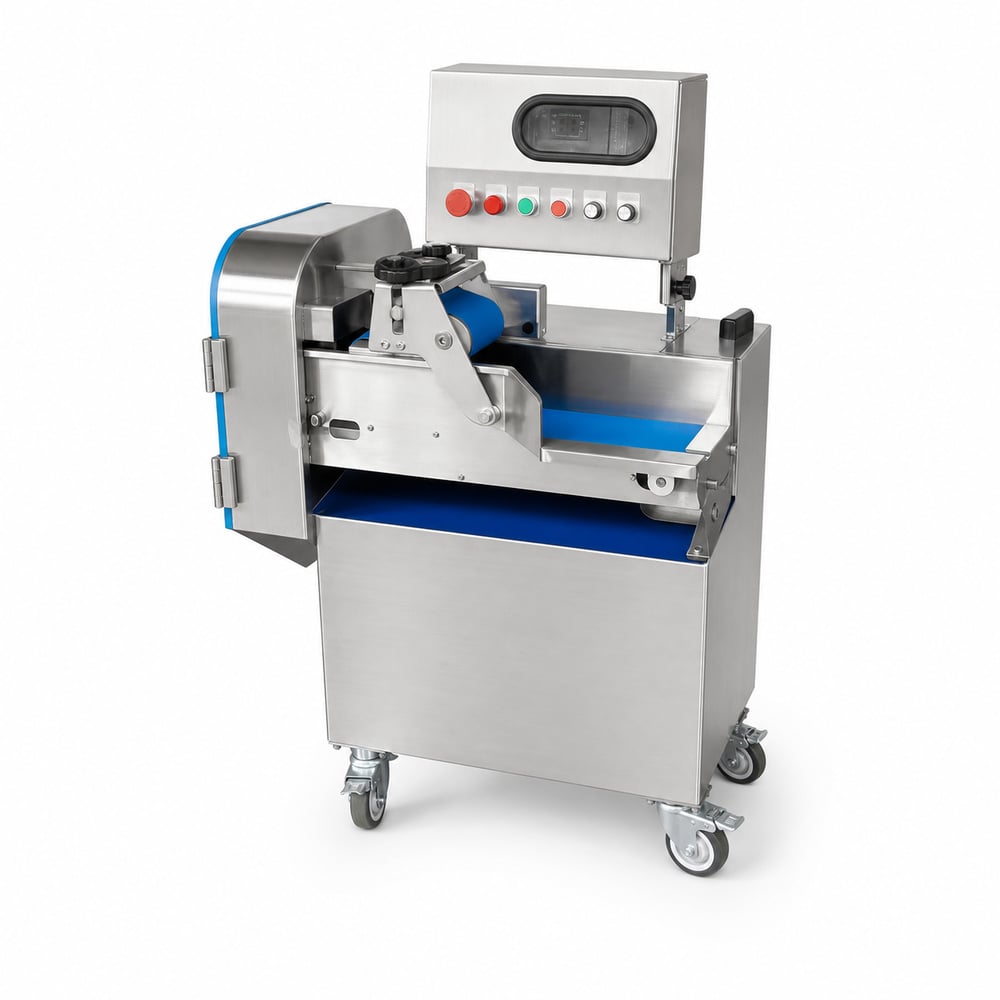
When reviewing options, you can use the product page for a commercial industrial electric vegetable cutter dicing machine for potato, fruit, and green onion as a starting point for a supplier discussion. The final selection should still be based on confirmed compatibility, trial results, installed-site requirements, and the written scope of supply.
Commercial vegetable dicer questions to ask before ordering
Can the commercial vegetable dicer run my actual potatoes and roots?
A commercial vegetable dicer should be demonstrated with representative incoming produce, including the sizes and conditions that occur in normal purchasing.
Which commercial vegetable dicer blade set makes the required cube?
Request the commercial vegetable dicer blade configuration, included parts list, and changeover procedure in writing.
How is commercial vegetable dicer capacity verified?
Evaluate commercial vegetable dicer output using finished product weight, normal feeding, expected stops, and cleaning time.
Is the commercial vegetable dicer easy to sanitize?
Ask to inspect the commercial vegetable dicer cutting zone, feed area, guards, and food-contact surfaces after disassembly.
What support comes with a commercial vegetable dicer?
Confirm commercial vegetable dicer installation requirements, operating documents, replacement parts, and remote service arrangements.
A practical commercial vegetable dicer buying checklist
Before issuing a commercial vegetable dicer purchase order, bring the selection back to a short set of documented answers. Which vegetables will be processed most often? What finished dice size and quality level are required? What output is needed after accounting for setup and cleaning? Can staff safely access and sanitize the food-contact areas? Are spare cutting parts, service instructions, and installation requirements clear?
A well-matched commercial vegetable dicer does more than cut potatoes quickly. It gives a processing team repeatable dice quality, realistic capacity, and a sanitation routine that can be followed consistently. By testing the machine with representative root vegetables and evaluating the whole workflow, buyers can make a comparison that supports both daily production and long-term operating control.