EN


How to Choose a Fruit and Vegetable Dryer for Consistent Moisture Control
A fruit and vegetable dryer is not simply a source of heat. For a processor, it is the point where product preparation, air movement, loading practice, and control settings meet. If those elements do not work together, one batch may contain brittle pieces beside soft pieces, or show a dry surface while moisture remains inside. The more useful question is therefore not “Which dryer is biggest?” but “Which drying system can repeat the moisture result my products need?”
From an equipment-selection perspective, start with the product and process rather than a catalog capacity. Slice thickness, starting moisture, sugar level, loading depth, and the desired final texture all influence the drying curve. A dryer that is appropriate for apple slices may require a different operating window for leafy vegetables or diced roots.
1. Define the moisture-control target before comparing machines
Write down the acceptance criteria for each product family: target final moisture or water activity if your quality system uses it, acceptable variation between trays, expected texture, batch size, and the time available for a cycle. This turns an open-ended purchase conversation into a process specification.
Do not rely on a single final moisture number alone. A practical target includes how you will sample the load: which trays, how many pieces per tray, and when the batch is considered conditioned and ready to pack. That plan is especially important when a fruit and vegetable dryer will process mixed varieties or seasonal raw materials.
For early trials, keep a simple record of raw-material size, load weight, set temperature, airflow setting, cycle time, and moisture results by tray position. It is much easier to identify a circulation or loading problem when the data are tied to each batch.
2. Match chamber and batch size to your real loading pattern
Batch capacity should be evaluated as usable product area, not just chamber volume. Ask how many trays can be loaded without blocking air passages, how much product can be placed on each tray at the chosen cut size, and whether the stated capacity assumes a product you actually make. A shallow, evenly spread load usually behaves differently from a deep or crowded one.
Also consider operational rhythm. If washing, cutting, drying, cooling, and packing are handled in batches, the dryer needs to fit the handoff between those stages. Oversizing can leave equipment lightly loaded and difficult to validate; undersizing can encourage operators to overload trays, which makes moisture variation more likely.
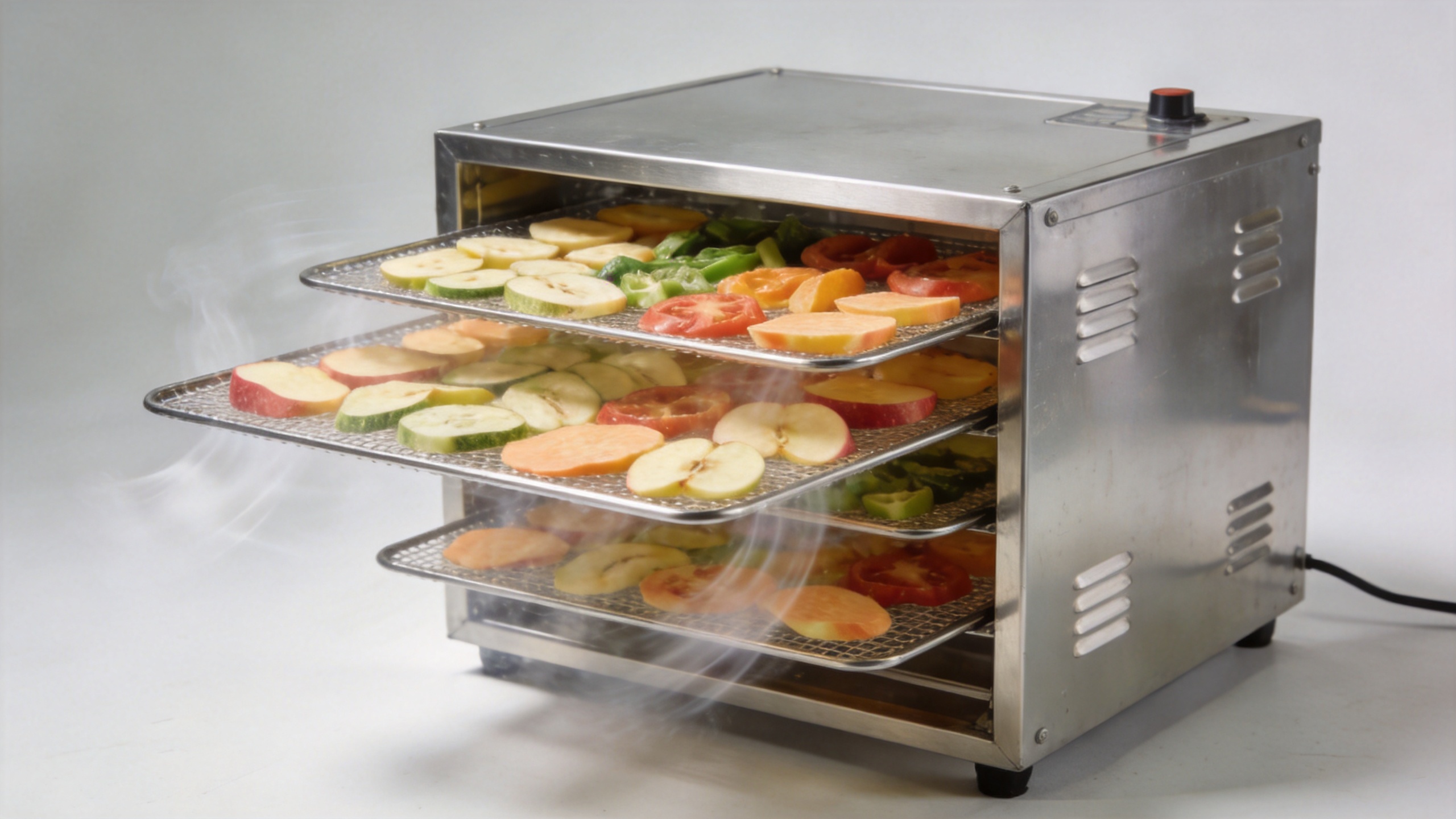
Where batch dehydration is the preferred workflow, review the box-type dryer for batch dehydration and drying of fruits and vegetables as a category example, then confirm the actual tray layout, loading guidance, and controls with the supplier before purchase.
3. Evaluate temperature control as a drying profile, not a single setting
Stable drying depends on how heat is applied over time. Starting too aggressively can dry the outer surface first and make it harder for internal moisture to migrate outward. Starting too gently can extend the cycle and reduce process efficiency. The right profile depends on the crop, cut geometry, initial moisture, and final quality requirement.
Ask suppliers how the setpoint is measured, where sensors are located, how control responds to temperature drift, and whether the recipe can be adjusted by stage. For processors with several products, repeatable setpoint control and clear operating records are more valuable than an unverified claim of universal drying speed.
A good factory acceptance trial should use your own representative material whenever possible. Compare the displayed temperature with independent readings at more than one chamber location, and inspect moisture variation after cooling rather than judging only the hot product.
4. Treat airflow as the main driver of uniformity
Warm air removes moisture only when it reaches the product surface and carries humid air away. That is why airflow path, fan arrangement, tray spacing, and exhaust management deserve the same attention as heater rating. Extension guidance on food dehydration notes that temperature and circulation must be controlled, and warns that poor removal of moist air slows drying. In practice, the key is even exposure to moving air across the usable tray area.
During an evaluation, ask whether airflow is horizontal, vertical, or reversible; whether the supplier recommends tray rotation; and how the system handles humid exhaust. A fruit and vegetable dryer may still produce uneven results if operators leave large gaps in some trays, stack wet product too deeply, or repeatedly open the door during the most sensitive part of the cycle.
| What to check | Why it matters for moisture control | Practical question |
|---|---|---|
| Air distribution | Reduces tray-to-tray variation | Where are the highest and lowest air-velocity zones? |
| Adjustable circulation | Supports different drying stages and products | Can airflow be tuned without changing the product load? |
| Exhaust path | Helps remove humid air from the chamber | How is exhaust managed during the cycle? |
| Tray clearance | Prevents local air blockage | What loading depth is recommended for our cut size? |
5. Build product variation into the selection decision
Fruit and vegetables do not arrive with identical moisture, maturity, or geometry. A robust process accounts for variation instead of assuming one recipe will fit every delivery. Group products by behavior: thin slices versus dense cubes, low-sugar versus high-sugar material, and high-moisture leafy products versus firmer roots.
For each group, request a trial plan with a defined loading density and sample locations. If the business expects frequent product changes, prioritize controls that make recipes, setpoints, and batch records easy to reproduce. If output is concentrated in one seasonal product, prioritize stable operation at that product’s actual load.
6. Use a supplier test to verify the complete process
Before making a final choice, agree on a written test protocol. It should state the raw material, cut size, starting load, tray loading method, temperature and airflow stages, cycle endpoint, cooling method, and sampling plan. Review not only average moisture but also the spread between front and rear, upper and lower, and center and edge trays.
The most suitable fruit and vegetable dryer for consistent moisture control is one that can document repeatability under your operating conditions. Pair the machine evaluation with operator training, cleaning access, spare-parts planning, and a clear response procedure when a batch is outside specification. That approach gives procurement teams a more dependable basis for comparing equipment than headline capacity alone.
How to compare two fruit and vegetable dryer proposals
When two quotations appear similar, compare the operating assumptions behind them. Ask each supplier to state the product type, slice thickness, initial load, tray loading density, target endpoint, and test method used for the proposal. A fruit and vegetable dryer should be compared under the same process assumptions; otherwise, differences in stated cycle time or capacity may reflect different loads rather than a better-controlled system.
Review the controls with the people who will run the line. Operators should be able to see the active setpoint, record any changes, and follow a consistent unloading and cooling procedure. Maintenance staff should be able to inspect fans, sensors, heaters, and airflow passages without turning routine cleaning into a major shutdown. These details influence whether a carefully selected fruit and vegetable dryer stays consistent after installation.
What to ask before placing an order
- Can the supplier demonstrate the fruit and vegetable dryer with representative material or a documented equivalent process?
- What is the recommended maximum loading depth per tray for our cut size?
- How are chamber temperature, circulation, and exhaust observed and adjusted during a batch?
- Which locations should be sampled to confirm uniform final moisture?
- What operating records, maintenance guidance, and spare-parts information are included with the equipment?
Selection checklist
- Define final moisture, texture, and sampling requirements for each product group.
- Calculate usable tray area and loading density from real product dimensions.
- Confirm how temperature, airflow, and humid-air exhaust are controlled.
- Request a representative-material trial and tray-by-tray moisture review.
- Choose documented repeatability and service support over unsupported performance promises.