EN


How to Choose a Vacuum Drying Machine for Food Processing
Choosing a vacuum drying machine is not simply a matter of comparing chamber size or asking for a quotation. For a food processor, the right choice starts with the product: its heat sensitivity, shape, moisture behavior, target texture, and planned production rhythm. A machine that fits dried chili, herbs, fruit pieces, or ingredients for further processing may not fit every other food equally well.
From a B2B procurement perspective, the useful question is: what operating window must the vacuum drying machine support so the product meets your quality target at a workable batch size? That approach gives technical, production, and purchasing teams a shared specification instead of a list of disconnected features.
Start with the food material and the quality target
List the product characteristics before reviewing models. Record incoming moisture, piece size, loading depth, sugar or oil content, sensitivity to heat, desired final moisture, color expectations, and whether the product will be sold whole, milled, or rehydrated. These details determine how a vacuum drying machine should handle heating, vacuum level, circulation, and unloading.
Vacuum lowers pressure around the product so water can evaporate at a lower temperature than in an atmospheric process. That can be valuable for heat-sensitive foods, but it does not mean one setpoint works for every formulation. Research on vacuum microwave drying of berries, for example, discusses effective dehydration at product temperatures around 45°C to 65°C in specific applications. Treat that range as a process-development reference, not a universal setting. Your own trials should confirm product temperature, final moisture, appearance, aroma, and texture.
A practical specification asks the supplier how temperature is measured: chamber air, shelf, product surface, or product core. It should also state whether the controller can follow staged recipes and record the conditions needed for repeatable batches. A vacuum drying machine with a clear recipe and logging approach is easier to validate than one defined only by a maximum temperature.
Match batch size to the real production schedule
Nominal capacity is only a starting point. Work backward from the required weekly output, expected drying cycle, loading and unloading time, cleaning time, changeovers, and planned maintenance. Then define the working load rather than assuming the chamber should not be assumed to use its full physical volume in every batch. Thin layers and dense loads can behave very differently in the same vacuum drying machine.
Many buyers initially assume that a larger capacity figure is automatically more valuable. A more accurate view is that useful capacity depends on product geometry, tray arrangement, and the time needed between batches. Ask for a layout drawing showing tray count, usable loading area, access clearance, and the intended loading depth for your material. If output varies by season, consider whether one adaptable batch unit or a planned modular expansion is more appropriate than an oversized first purchase.
Understand vacuum drying vs freeze drying before choosing a process
The comparison of vacuum drying vs freeze drying should begin with the food and commercial objective, not the equipment name. A vacuum drying machine removes moisture under reduced pressure, commonly with controlled heat. Freeze drying first freezes the product and removes ice by sublimation under vacuum. Freeze drying can be appropriate where a highly porous structure, rapid rehydration, or specific quality characteristics justify its process complexity.
For many food applications, a vacuum drying machine may offer a different balance of cycle time, energy use, footprint, and product result. However, it should not be presented as a substitute in every case. During a vacuum drying vs freeze drying review, compare your target moisture, texture, ingredient stability, packaging format, batch time, refrigeration needs, and total operating workflow. Request trial samples under defined conditions so the decision is based on the finished food rather than a general claim.
| Decision point | Questions for the process team |
|---|---|
| Product quality | Which attributes must remain stable: color, aroma, structure, rehydration, or ingredient activity? |
| Batch plan | What is the usable load per batch after allowing for tray depth and handling time? |
| Utilities | What heating source, cooling arrangement, electrical supply, and vacuum performance are available on site? |
| Validation | Which product-temperature and final-moisture checks will define acceptance? |
Specify control, hygiene, and maintenance details
Temperature control and vacuum stability affect consistency, especially when raw-material moisture changes between lots. Ask how the vacuum drying machine manages the heating stages, how it alerts operators to abnormal conditions, and what data can be reviewed after a batch. If microwave energy is part of the process, clarify how power control is coordinated with temperature and vacuum so the recipe is not reduced to a single timer.
Food equipment should also support effective cleaning and reduce areas where product can accumulate. Review food-contact materials, weld finish where relevant, door seals, drainage, removable trays, access for inspection, and the cleaning method required between products. Do not rely on a generic material label alone; match the construction and cleaning access to your allergen, sanitation, and product-changeover plan.
Maintenance deserves the same attention as performance. Confirm the pump service interval, seal inspection points, spare-parts list, expected consumables, fault-support process, and operator training. The purchase price is only one part of ownership cost; a difficult-to-service vacuum drying machine can disrupt a production plan when a basic wear item is unavailable.
Turn supplier discussions into a usable procurement checklist
Before comparing offers, send every supplier the same brief: product description and samples, target output, moisture in and out, loading format, utility details, food-contact expectations, site layout constraints, and acceptance tests. Then ask each supplier to identify assumptions rather than filling gaps with broad promises. This makes quotations easier to compare and shows where a proposed vacuum drying machine has not yet been matched to the process.
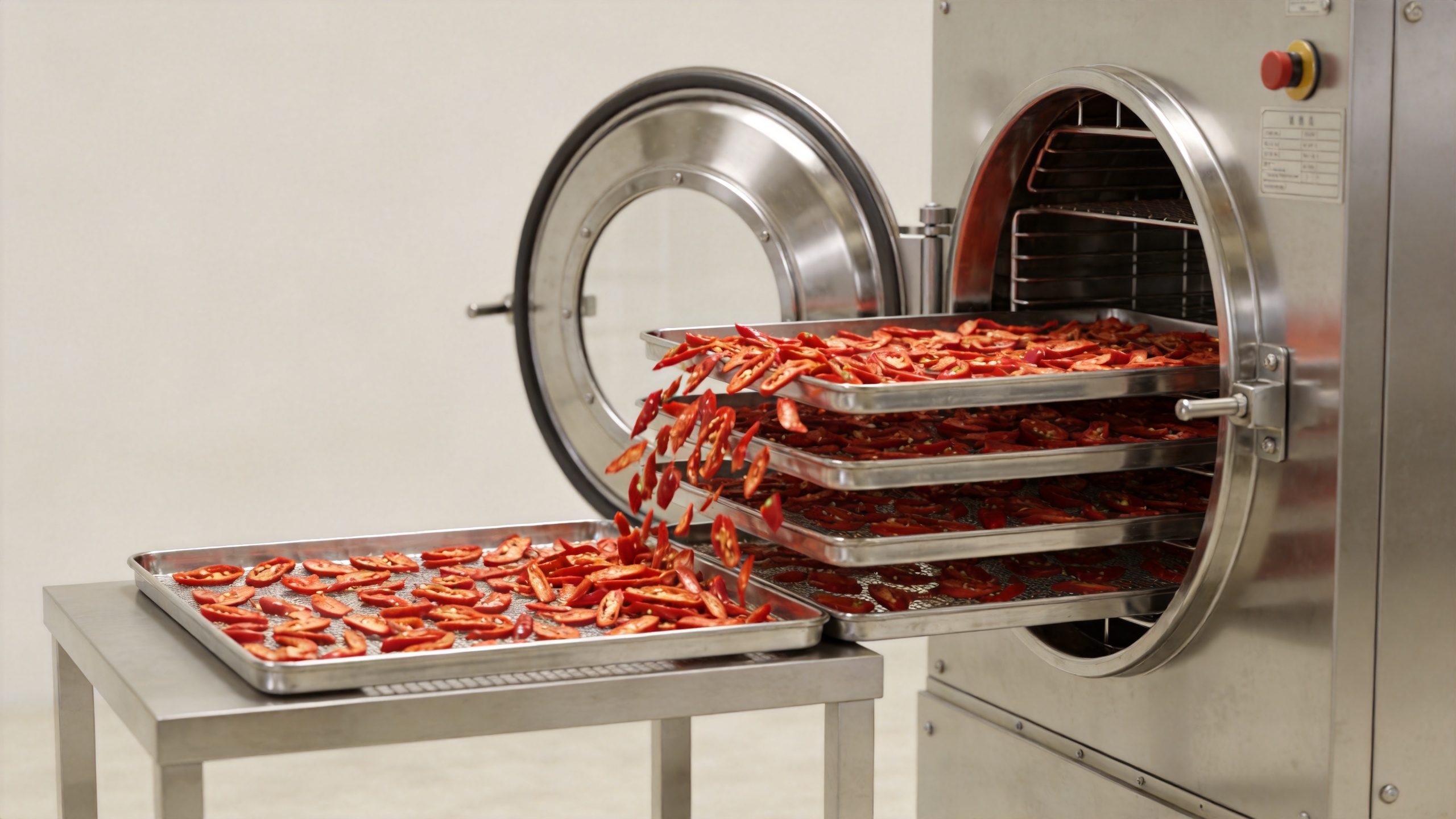
For buyers evaluating microwave-assisted vacuum drying for chili or related food materials, review the available Automatic Industrial Microwave Drying System 220V Electric Vacuum Dryer for Chili Food Drying Equipment as a starting point for a technical discussion. Confirm the actual product fit, loading plan, controls, and site requirements before making a decision.
Final selection priorities
A suitable vacuum drying machine is the one whose process window, practical batch capacity, controls, hygienic design, and maintenance plan align with your food and operating team. Start with a product trial and a written acceptance plan. Then use the vacuum drying vs freeze drying comparison only where it helps clarify the required product result. That sequence gives procurement teams a clearer basis for selecting equipment and communicating specifications.