EN


How to Compare Commercial Juicers by Extraction Method and Capacity
For a food-processing buyer, selecting a commercial juicer is less about choosing a familiar machine format and more about matching extraction physics to the fruit, vegetable, recipe, and production schedule. A restaurant bar may need a compact citrus unit for short bursts. A processor turning washed apples, tomatoes, ginger, berries, or mixed vegetables into bulk juice needs a commercial juicer that can work with upstream preparation, pulp handling, sanitation, and a realistic hourly target.
This guide gives procurement teams a practical way to compare a commercial juicer by extraction method and capacity. Start with the material, then check the processing path, and finally test whether the quoted rate matches the output your line can actually sustain.
Begin with the raw material, not the machine label
A commercial juicer should be evaluated against the feedstock’s structure. Citrus has a peel and segment pattern that favors purpose-built reamers or presses. Firm apples and pears often need washing, sorting, milling, then pressing. Soft tomatoes, berries, stone-fruit pulp, and fibrous vegetables place different demands on screens, conveying, and pomace discharge. Ginger and leafy ingredients may require trials because their fiber, moisture level, and particle size can change both extraction behavior and cleaning time.
Ask suppliers to document the intended material condition: whole, halved, crushed, deseeded, peeled, or pre-pulped. This matters because a capacity claim for prepared pulp is not directly comparable with a capacity claim for whole fruit entering a commercial juicer.
Compare the main extraction methods
| Method | Where it fits | Procurement questions |
|---|---|---|
| Citrus reaming or pressing | Oranges, lemons, grapefruits, and similar fruit | What peel handling is required? How is bitterness controlled? What is the feed and discharge rhythm? |
| Centrifugal extraction | Operations prioritizing fast separation for selected prepared fruits and vegetables | Which produce is suitable? What particle size is required? How does the screen affect pulp carryover and cleanup? |
| Screw press / cold press | Fruit and vegetable processing where continuous pressing and pomace separation are relevant | What screw, screen, and pressing zone are proposed for the material? How are moisture and fiber variation handled? |
| Hydraulic or batch pressing | Smaller lots or processes where batch control is more important than continuous flow | How long is each cycle, including loading, pressing, unloading, and washing? |
A commercial cold press juicer machine is often considered when buyers want a continuous pressing route rather than a high-speed spinning process. Yet “cold press” is not a capacity answer by itself. The useful comparison is the material path: feed preparation, press throughput, juice clarification if needed, pomace removal, and cleaning between recipes.
Translate rated capacity into usable line capacity
Quoted capacity is usually a starting point, not a production plan. For a commercial juicer, calculate the rate at the narrowest point in the line. A press may be rated for one throughput range, while washing, cutting, milling, transfer pumps, filtration, or packaging run slower. Product changeovers can also reduce the available operating window.
Use this simple review sequence:
- Set the required finished-juice volume per shift and the planned operating hours.
- Estimate raw-material input from a verified trial yield for each recipe; do not use one yield assumption for every fruit or vegetable.
- Compare the required raw-material rate with the stated input rate of the commercial juicer.
- Check the capacity of preparation, pressing, filtration, storage, and filling equipment at the same basis.
- Reserve time for washdown, screen changes, inspection, and expected material variation.
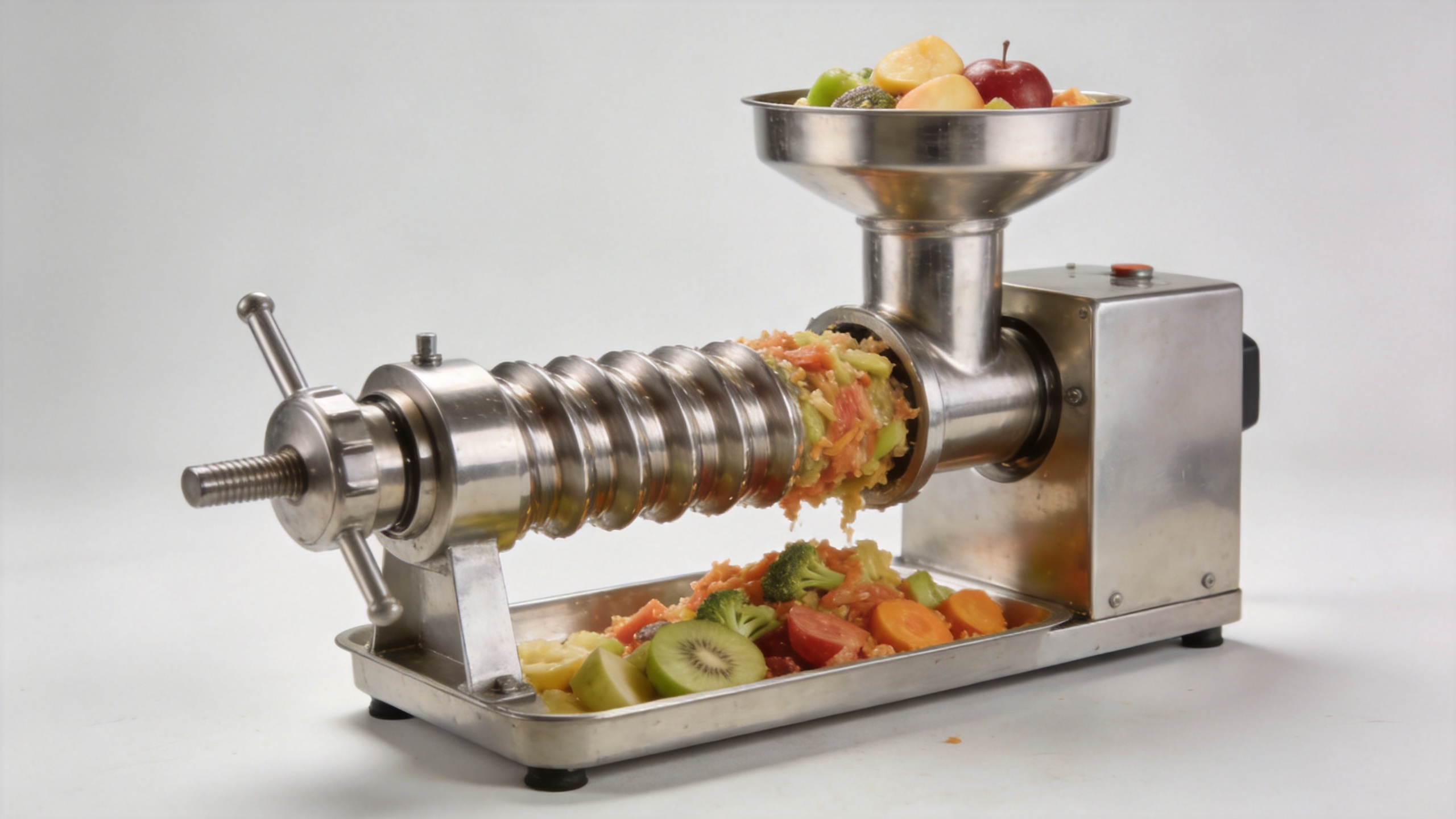
For example, the confirmed Food-Grade Screw Press 80% Juice Yield 0.5-1T/H SUS304 for Fruit & Vegetable Processing is presented as a fruit-and-vegetable screw-press option with a stated 0.5–1 T/H processing range and an up-to-80% yield specification. Treat those figures as model-specific specifications to validate with your own material, preparation method, and juice standard—not as a universal yield promise for every application.
Use yield, pulp specification, and product quality together
Comparing one commercial juicer only by liquid volume can lead to a poor fit. Higher extraction pressure may change pulp carryover, color, texture, or downstream clarification needs. A lower apparent yield can still be workable if it reduces filtration load, supports the desired beverage texture, or makes sanitation easier. Define the finished product first: clear juice, cloudy juice, puree-style beverage, concentrate feed, or an ingredient for further processing.
During trials, record raw input weight, juice weight, pomace condition, visible solids, operating time, and cleanup time. These records give buyers a more defensible basis for comparing a commercial juicer than a brochure claim alone.
Check construction and sanitation as capacity factors
In commercial production, hygiene design affects output. Ask how product-contact areas are accessed, whether screens and press components can be removed safely, where residue can collect, and what cleaning procedure is expected. Material selection, weld finish, seals, drainage, and spare-screen availability all influence the usable uptime of a commercial juicer.
For export-oriented projects, also align the electrical supply, installation space, drainage, operator access, and maintenance plan before finalizing the equipment. Zhengzhou HongLe Machinery Equipment Co., Ltd. can use the buyer’s material, target rate, and line layout to discuss equipment selection and related food-processing steps rather than treating the press as an isolated purchase.
A buyer’s comparison checklist
- Which fruits or vegetables will be processed, and in what condition?
- Is the required figure raw-material input, finished-juice output, or both?
- What production rate is needed after downtime and cleaning are included?
- What yield and pulp target will be accepted for each recipe?
- Which upstream and downstream machines could limit the commercial juicer?
- What trial data will be used to confirm suitability before purchase?
Make the final comparison on a common basis
The right commercial juicer is the one that supports your raw materials, product specification, sanitation plan, and sustained processing rhythm. Put every candidate on the same worksheet: prepared feed condition, validated input rate, expected yield range, pulp result, labor needs, cleaning time, and line interfaces. This approach makes it easier to compare centrifugal, citrus, batch, and screw-press options without relying on machine names alone.
When continuous fruit and vegetable pressing is under consideration, a commercial cold press juicer machine or screw press can be assessed as part of the complete flow—from preparation through pomace handling—so the final selection is tied to practical capacity rather than a single headline number.