EN


How to Select a Food Dehydrator Machine for Different Food Products
Choosing a food dryer machine starts with the product, not the catalog. Apples, leafy vegetables, herbs, chilli pieces and jerky all release water at different rates, tolerate heat differently and require different handling after drying. For a processor planning commercial production, the useful question is not “Which dryer has the most trays?” but “Which drying method gives my product a repeatable final moisture level, acceptable appearance and practical throughput?”
As an equipment-selection adviser, I normally begin with the food’s starting moisture, cut size, oil or sugar content, daily batch volume and cleaning requirements. Those five points turn a broad food dryer machine search into a workable specification.
Start with the food’s moisture behavior and heat sensitivity
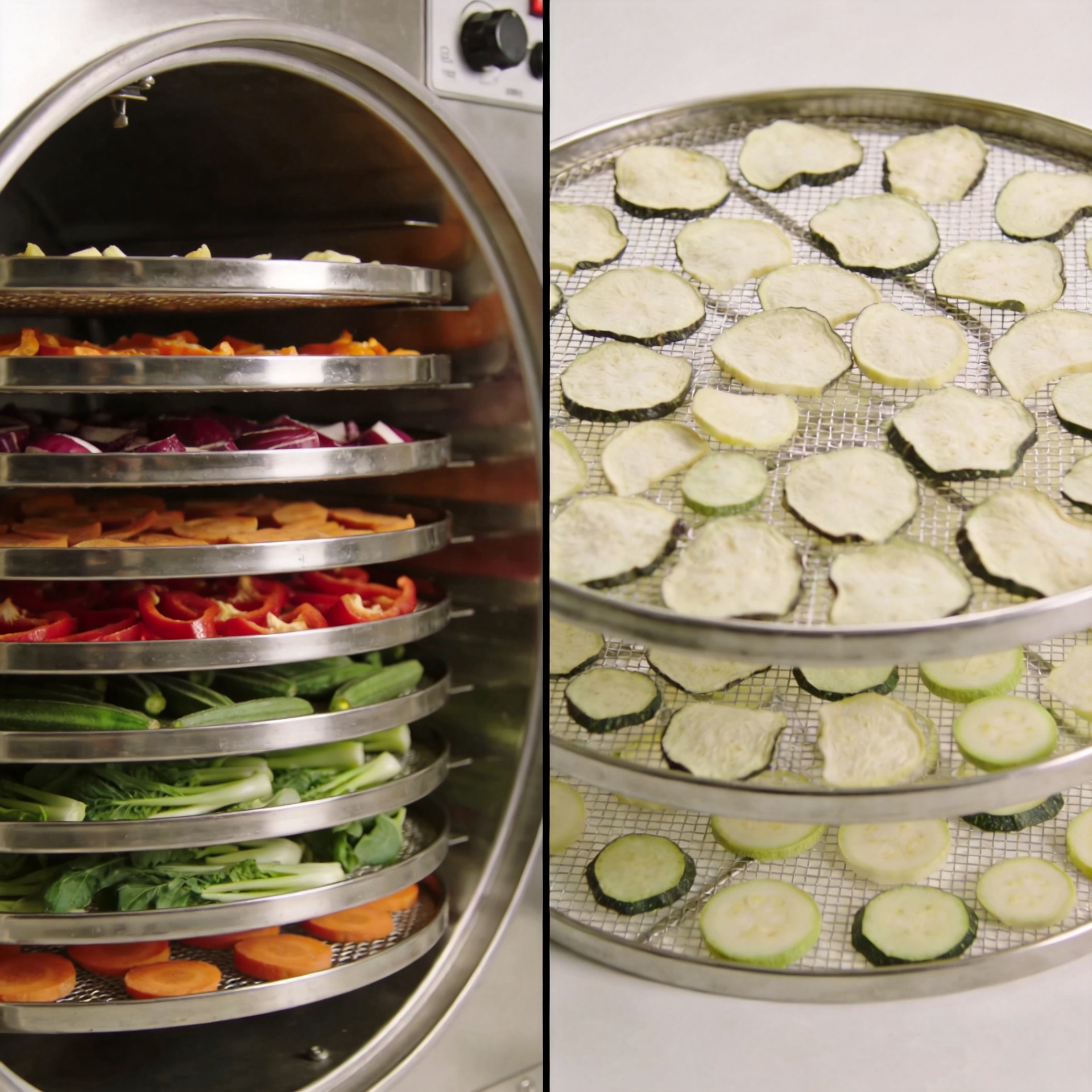
Fresh fruit and vegetables contain a large amount of water, but they do not behave alike in a dryer. Thin apple slices and banana chips need even airflow to avoid soft centers. Raisin-style products need a longer, gentler drying curve to limit surface hardening. Leafy vegetables and herbs are light and can move in high airflow, so tray design and air velocity matter as much as heater power.
For many fruit and vegetable applications, extension guidance commonly uses about 140°F (60°C) as a drying reference point. That is not a universal recipe: the final setting should be validated for the specific product, slice thickness, loading depth and desired quality. The practical implication is clear: choose a food dryer machine with stable, adjustable temperature control rather than relying on a single fixed heat setting.
Match the drying configuration to each food category
| Food category | What to protect | Machine features to prioritize |
|---|---|---|
| Fruit slices and berries | Color, flavor, uniform finish | Gentle, even airflow; adjustable temperature; tray spacing for slice thickness |
| Vegetable flakes, strips and roots | Consistent drying through dense pieces | Reliable air distribution, practical loading density and easy tray cleaning |
| Herbs, leaves and spices | Aroma, low breakage and product retention | Lower-temperature control, moderated airflow and fine-mesh tray options |
| Meat or jerky products | Food-safety process control and uniformity | Documented temperature capability, sanitation access and process validation points |
| Powdered or small particulate ingredients | Containment and easy discharge | Suitable tray or belt surface, sealed handling and cleaning access |
Meat deserves a separate safety review. USDA jerky guidance calls for heating meat to 160°F and poultry to 165°F before dehydration, with drying equipment able to maintain at least 130–140°F during the drying stage. Buyers should treat this as a reason to define a verified process with their food-safety team, not as a claim that any dryer alone makes a product safe.
Choose batch or continuous drying from your production rhythm
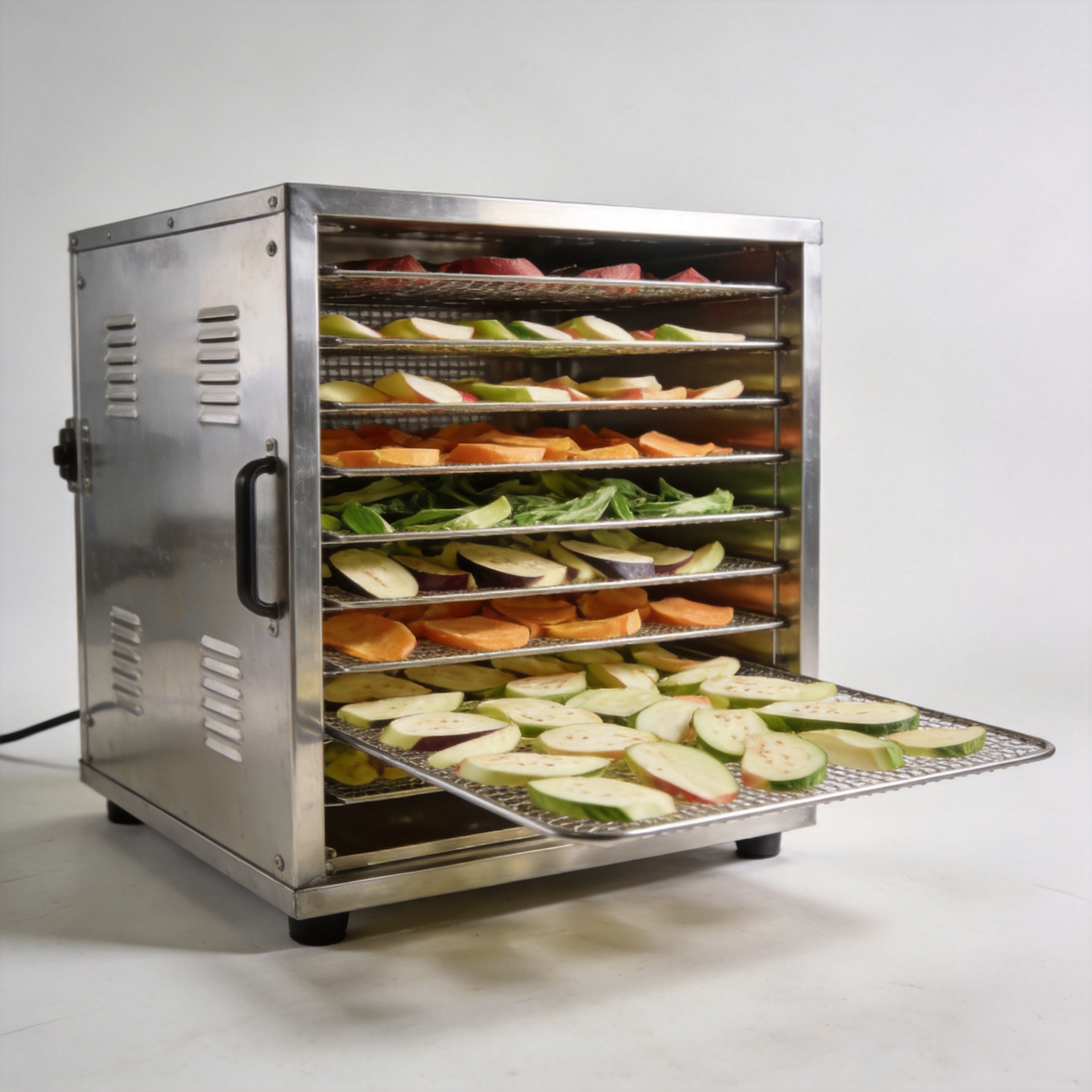
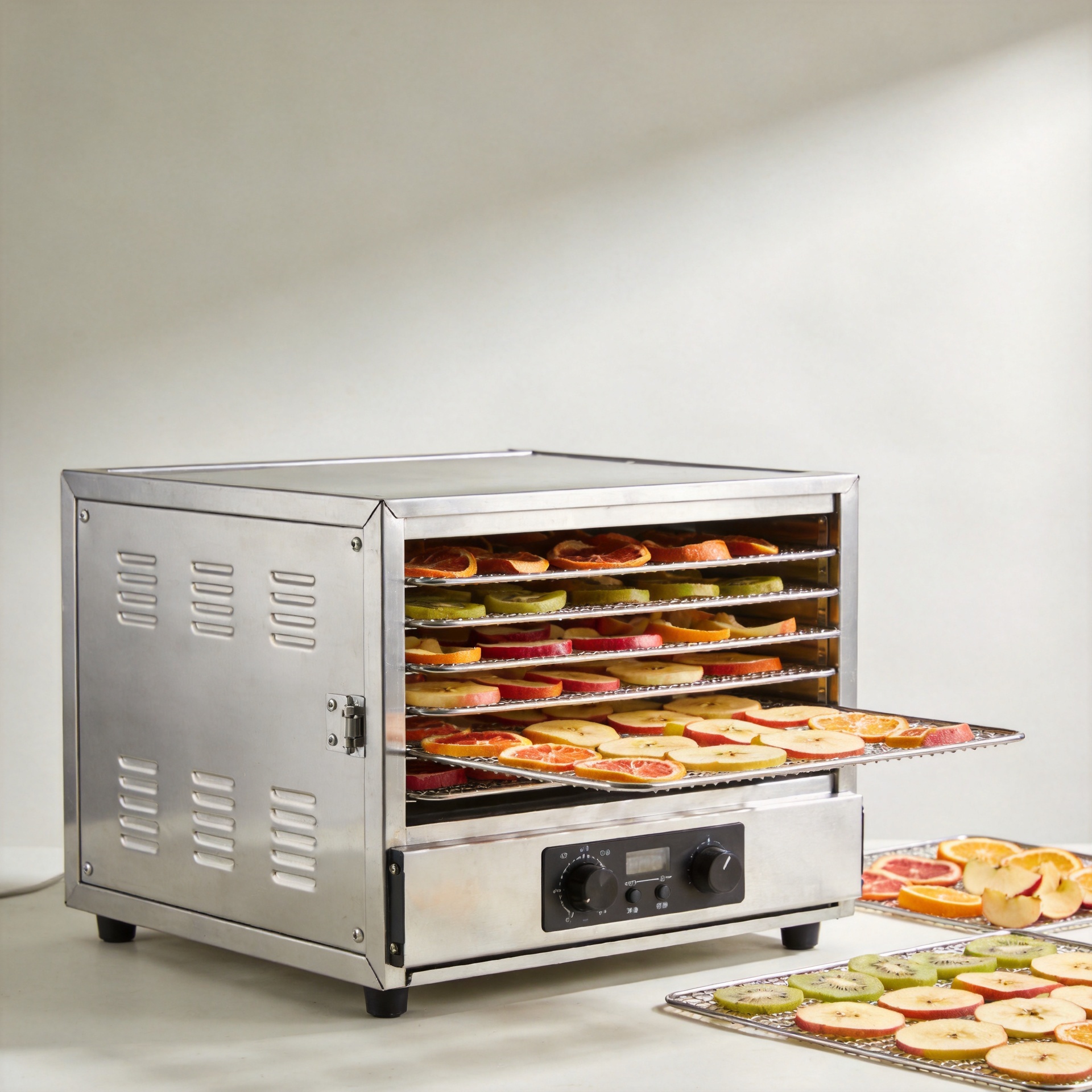
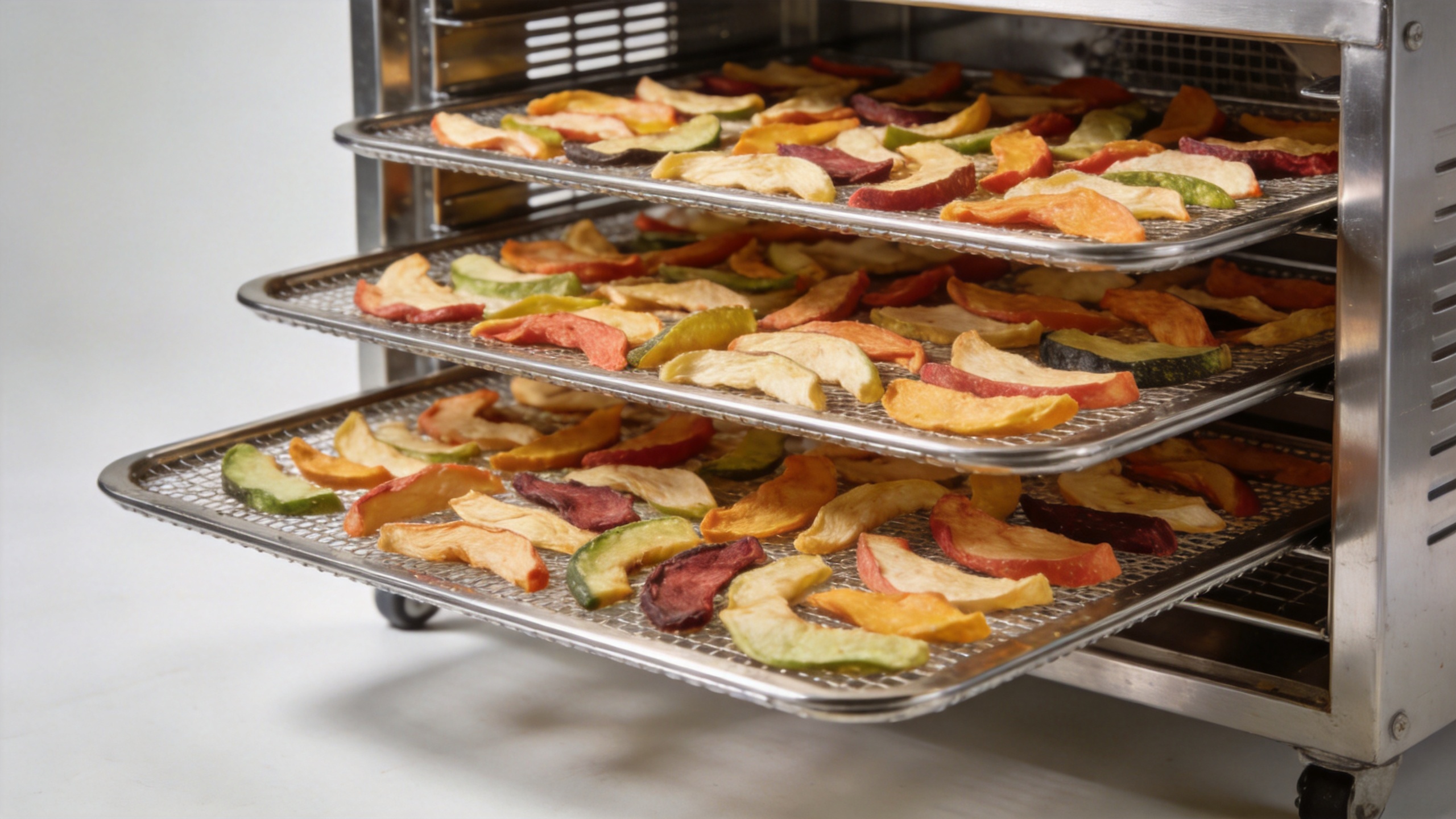
A cabinet or tray-based food dryer machine is often a sensible fit for varied SKUs, seasonal fruit, pilot runs and moderate volumes. It lets operators separate products by tray, adjust recipes between batches and inspect material closely. The trade-off is more manual loading, unloading and tray washing.
When the same product runs for long shifts, a continuous belt-oriented drying line can improve material flow and reduce handling. It needs a more stable upstream preparation process: consistent slice size, feed rate and loading thickness become essential. Do not select continuous equipment only because the stated capacity looks higher. Ask whether the washing, cutting, blanching, feeding, cooling and packaging steps can sustain that rate.
Evaluate airflow before comparing heater power
High heat cannot correct poor airflow distribution. In practice, uneven airflow produces the familiar problem of dry edges and wet centers, forcing extra time or manual tray rotation. During supplier evaluation, request a trial using the actual product or a close equivalent. Check the temperature variation across loading zones, the acceptable tray loading depth, the need for rotation, and the difference in final moisture between upper and lower positions.
Also define the measurement method before commissioning. Total moisture is useful, but water activity is another key indicator of product stability. A good purchase specification states the target product condition, sampling plan and acceptance range instead of relying only on a nominal drying time.
Build cleaning and changeover into the specification
For a multi-product facility, sanitation is a production variable. Sticky fruit, fibrous vegetables, spices and meat-based products create different cleaning burdens. Look for accessible corners, removable trays or belt sections, drainage where washing is used, and materials suited to the intended hygiene program. A machine that is difficult to clean can erase its apparent capacity advantage during frequent changeovers.
It is also worth planning spare trays, controls training and remote technical support before the equipment ships. Export buyers should confirm electrical standards, packaging requirements, documentation and the availability of consumable or replacement parts for their market.
A practical food dryer machine selection checklist
- List each food product, its cut size, starting moisture and required finished texture.
- Set the required daily output and decide whether production is batch-based or continuous.
- Specify temperature range, airflow uniformity, loading depth and residence-time controls.
- Define final moisture or water-activity targets and the method used to verify them.
- Review sanitation, changeover time, utilities, footprint and operator access.
- Run a product trial and compare yield, color, breakage and drying consistency—not only nameplate capacity.
Questions to ask before ordering a food dryer machine
Use the following questions to turn a food dryer machine quotation into a comparable technical proposal:
- Can the food dryer machine hold the proposed temperature at full load, rather than only when empty?
- How does the food dryer machine distribute air across every tray or belt zone?
- What loading depth gives the food dryer machine the stated capacity for your actual product?
- Can the food dryer machine run delicate herbs and denser vegetable pieces with separate validated recipes?
- Which food dryer machine components must be removed during product changeover and cleaning?
- How will the food dryer machine connect to upstream cutting, blanching or feeding equipment?
- What test report can the supplier provide from a food dryer machine trial using your material?
Ask suppliers to state the basis for every food dryer machine capacity figure: fresh input, finished output, loading density, target moisture and drying time. This prevents a food dryer machine comparison from mixing unlike production assumptions. A food dryer machine that is correctly sized for the slowest product step is usually more useful than a nominally larger unit with no verified process window.
For buyers evaluating several options, create one scorecard for each food dryer machine. Score the food dryer machine on heat stability, airflow uniformity, cleaning access, utilities, operator workload, product yield and service support. The same scorecard makes it easier to see whether a food dryer machine suits mixed batches today and whether it can support a more continuous line later.
Move from a general machine search to a workable line plan
The right food dryer machine is the one that fits the product’s moisture behavior and the factory’s operating rhythm. For fruit and vegetable processors, Hongle Machinery provides an industrial drying vegetable dryer and fruit drier machine as a starting point for discussing product trials, batch requirements and line integration. Share your material type, capacity target, available utilities and preferred finished condition to build a more useful equipment brief.