EN


How to Select an Industrial Fruit Washer for Commercial Processing
Choosing an industrial fruit washer is a line-design decision, not simply a matter of buying a tank with pumps. The right machine must remove field debris and loose contaminants while protecting product appearance, supporting your hygiene program, and feeding the next process at a predictable rate. For processors handling apples, citrus, berries, stone fruit, or mixed produce, the evaluation begins with the fruit itself and ends with the complete production line.
As a food-processing equipment buyer, start with the product flow you need to control. An industrial fruit washing machine should fit your incoming condition, sanitation plan, operators, utilities, and downstream equipment—not force your operation to adapt around an unsuitable wash method.
1. Define the fruit, soil load, and handling risk first
Every industrial fruit washer should be selected against the actual material entering the plant. Firm apples and citrus can tolerate more mechanical action than soft berries or ripe stone fruit. Ask your team to document fruit size range, surface texture, maturity, field soil, leaf load, wax or residue concerns, and the acceptable bruising or skin-mark threshold.
- Firm, round fruit: often benefits from controlled brushing or spray action after an initial rinse.
- Delicate fruit: usually needs gentle flotation, bubble agitation, or low-impact conveying to limit impact damage.
- High soil loads: may require staged pre-rinsing and debris separation before the main wash zone.
- Mixed lots: need adjustable water flow, conveyor speed, and handling settings rather than one fixed recipe.
Do not ask only, “How clean can the machine wash?” Ask, “What cleaning action can this fruit tolerate at our worst incoming condition?” This question prevents a common mismatch: selecting an aggressive industrial fruit washing machine for a delicate product that later suffers from scuffing, splits, or yield loss.
2. Match the washing method to the processing objective
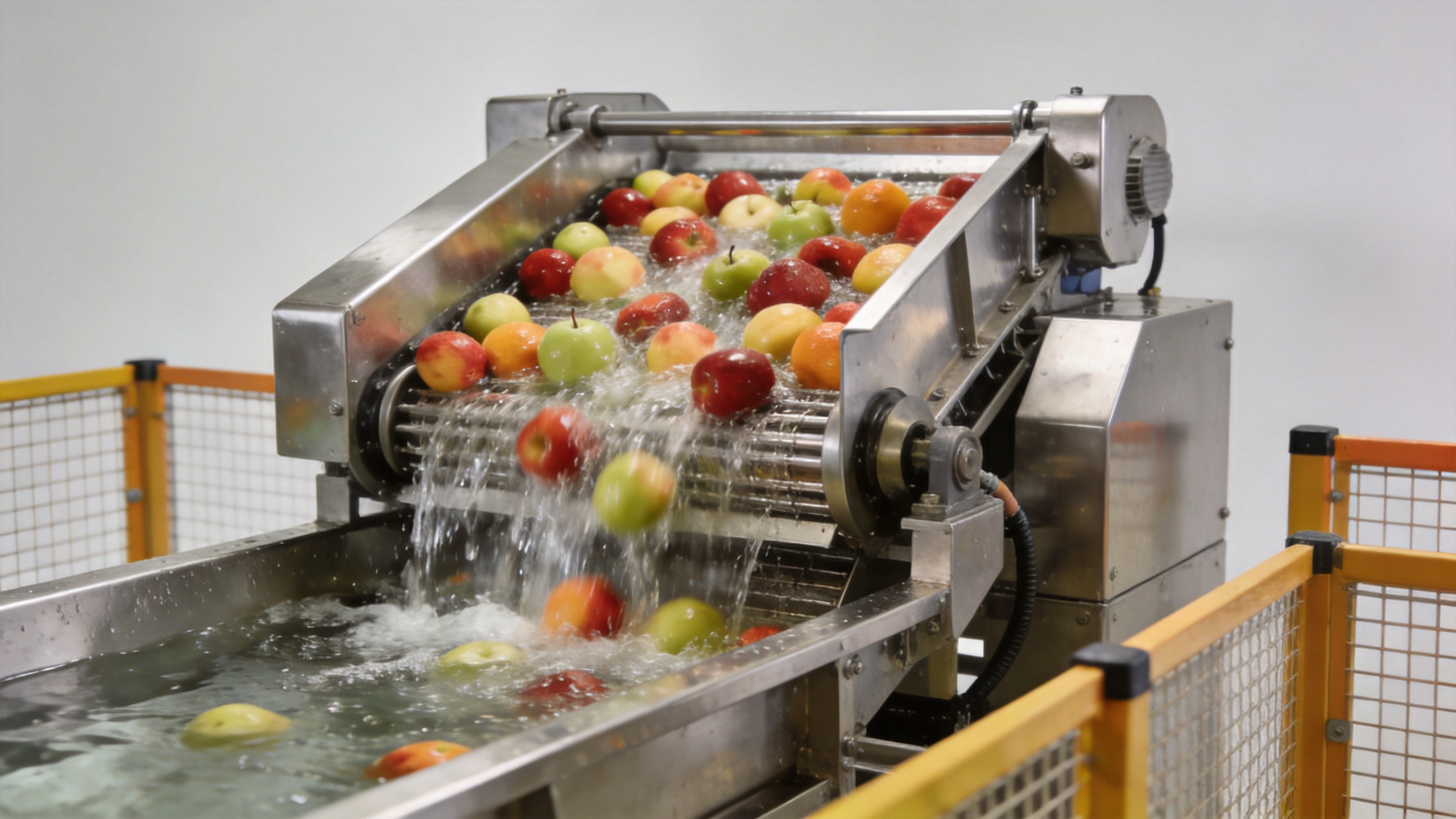
An industrial fruit washer can use sprays, immersion, bubble agitation, brushes, or a combination of methods. The preferred method depends on the product and on what must be removed. A staged process is often easier to validate than attempting to solve every cleaning task in one chamber.
| Method | Best considered for | Buyer questions |
|---|---|---|
| Spray washing | Surface rinsing and controlled water application | Are nozzle coverage, pressure, and drainage adjustable? |
| Bubble or vortex washing | Gentle lifting and movement of produce in water | Can agitation be tuned for delicate fruit and different load levels? |
| Brush-assisted washing | Firm fruit with attached soil or surface debris | What brush material, speed, and contact pressure are available? |
| Multi-stage washing | Variable incoming conditions or higher hygiene control needs | Where are pre-rinse, wash, rinse, and water-change points located? |
For facilities considering vortex-style handling, review the real equipment configuration and how it fits the fruit. The Vegetable and Fruit High Efficiency Commercial Stainless Steel Disinfection Vortex Fruit Washing Machine is one product option to evaluate against your handling, sanitation, and line-integration requirements. Confirm final suitability with a product trial using your own fruit and operating targets.
3. Size capacity by line balance, not headline throughput
A supplier may state a nominal capacity, but commercial processing depends on sustained throughput after loading, washing, inspection, drainage, and downstream transfer are considered. Specify the target in kilograms or pieces per hour, then calculate the peak rate, average rate, planned changeovers, and expected downtime. Your industrial fruit washer should not become a buffer that overfills, starves a sorter, or sends wet fruit faster than a dryer can handle.
During procurement, map the material flow from receiving through packing. Check infeed height, discharge direction, conveyor width, accumulation space, and the handoff to sorting, cutting, drying, juicing, or packaging. Also ask whether speed controls can be coordinated with upstream and downstream equipment. A commercially useful industrial fruit washing machine supports a stable line rhythm rather than a short burst of high flow.
4. Treat water management and hygiene as design requirements
Water is both the cleaning medium and a process-control point. FDA guidance for fresh fruits and vegetables notes that water quality should be adequate for its intended use. In practical purchasing terms, that means defining the incoming water source, filtration approach, make-up water, drainage, monitoring responsibilities, and cleaning access before you finalize an industrial fruit washer.
Where your food-safety plan uses a sanitizer or antimicrobial, set the chemical choice, concentration, contact time, monitoring method, and rinse requirement with your qualified food-safety team and local regulations. Do not assume that adding a chemical automatically solves cross-contamination risk. The wash tank, recirculation loop, solids removal, and changeover procedure must work together.
- How are leaves, sand, and floating debris removed before they recirculate?
- Can operators access screens, tanks, nozzles, and pipework for cleaning?
- Where are drain points, overflow points, and sample points located?
- Can the machine support your documented sanitation and verification routine?
5. Check construction, maintainability, and operator safety
For commercial use, evaluate the industrial fruit washer as a maintainable asset. Stainless-steel construction may be appropriate for wet food environments, but buyers should look beyond material labels. Inspect weld finishing, enclosed areas, access doors, removable components, electrical protection, guarding, and the ease of reaching wear parts. A machine that cleans quickly and safely is easier to keep in service and easier to validate between product runs.
Request a maintenance list that identifies consumables, lubrication points, pumps, seals, belts, brushes, and sensors. Clarify what spare parts should be kept on site, what technical documentation is supplied, and how remote support will work for your market. Zhengzhou HongLe Machinery Equipment Co., Ltd. serves food-processing equipment buyers across multiple export markets and provides remote video guidance, operating manuals, and spare-parts support; confirm the exact scope for the configuration you purchase.
6. Use a pre-purchase trial and acceptance checklist
A practical time to test an industrial fruit washing machine is before shipment. Provide representative fruit at normal and difficult incoming conditions. Observe cleaning, damage, water carryover, debris removal, operator steps, and cleaning time. If an on-site trial is not possible, agree on acceptance criteria, videos, and inspection points in writing.
- List fruit types, size range, maturity, and worst-case soil load.
- Set target throughput and identify the true line bottleneck.
- Define wash stages, water quality expectations, and sanitation controls.
- Verify utilities: water, drainage, electrical supply, compressed air, and floor space.
- Check infeed/discharge interfaces with sorting, drying, cutting, or packing equipment.
- Review cleaning access, guarding, maintenance tasks, documents, and spare parts.
- Approve trial criteria based on product quality and line performance—not appearance alone.
Make the selection decision with the whole line in view
A well-chosen industrial fruit washer protects product quality, supports a repeatable hygiene program, and keeps the rest of the line supplied at a manageable pace. Start with the fruit and its incoming condition, then compare washing action, capacity, water controls, sanitation access, and integration details. This approach gives purchasing teams a clearer basis for comparing an industrial fruit washing machine and for requesting a configuration that fits commercial processing rather than a generic specification.