EN
EN


Industrial Dehydrator Price Factors: Heating, Capacity, and Automation
When buyers request an industrial dehydrator quotation, the first number rarely tells the whole story. Two machines can look similar in a brochure yet differ substantially in thermal design, usable loading area, airflow control, controls, fabrication, and service scope. For a processor planning dried fruit, vegetables, herbs, meat snacks, or other food products, the practical question is not simply “What does an industrial dehydrator cost?” It is “Which configuration can deliver the required moisture result at a predictable cost per batch?”
Use this framework when comparing drying equipment for a new line, a capacity expansion, or a replacement project.
Start with the production requirement, not a tray count
An industrial dehydrator should be sized around the wet product entering the line, the target final moisture, the permitted drying time, and the number of shifts. Nominal tray quantity is useful, but it is not a complete capacity specification. Product thickness, loading density, sugar content, initial moisture, and whether material is laid in a single layer all influence what a chamber can process in practice.
Ask suppliers to state batch capacity in terms that match your product: kilograms of fresh input per batch, expected finished output, loading area, and anticipated cycle time. A larger cabinet or tunnel normally increases the price of an industrial dehydrator, but an oversized machine with long idle periods can tie up capital. A unit that is too small can create labor bottlenecks and force extra shifts.
- Define daily fresh-product throughput and peak-season demand.
- Document starting and target moisture levels for each priority product.
- Specify batch time, cleaning windows, and planned operating shifts.
- Request a loading assumption rather than accepting a generic capacity claim.
Heating system: the largest technical driver of price and operating cost
The heating package is often the most consequential line item in an industrial dehydrator proposal. Electric resistance heating, gas-fired heat, steam interfaces, heat-pump systems, and hybrid arrangements have different upfront costs, installation needs, maintenance profiles, and energy implications. The right option depends on local utility availability, product sensitivity, production hours, and the plant’s existing infrastructure.
Heat-pump-assisted drying is often considered where a controllable temperature and humidity environment is important. It can be a useful option for lower-temperature drying strategies, but a buyer should request an application-specific energy estimate rather than rely on a universal savings percentage. Similarly, a lower initial price for a heater does not automatically mean a lower lifetime cost if it requires more energy or produces uneven batches.
For every industrial dehydrator quote, ask for the rated heat source, installed power, heat-recovery or exhaust arrangement, temperature-control method, and the conditions used to estimate batch energy use. These details make competing proposals comparable.
In a request-for-quotation sheet, repeat the phrase industrial dehydrator only where it identifies the equipment scope, then pair it with a measurable question: What inlet and outlet conditions are assumed? Which utilities are included? How is exhaust controlled? This makes an industrial dehydrator proposal easier to audit across suppliers and prevents a heating option from being compared only on its purchase price.
Airflow and chamber design protect product consistency
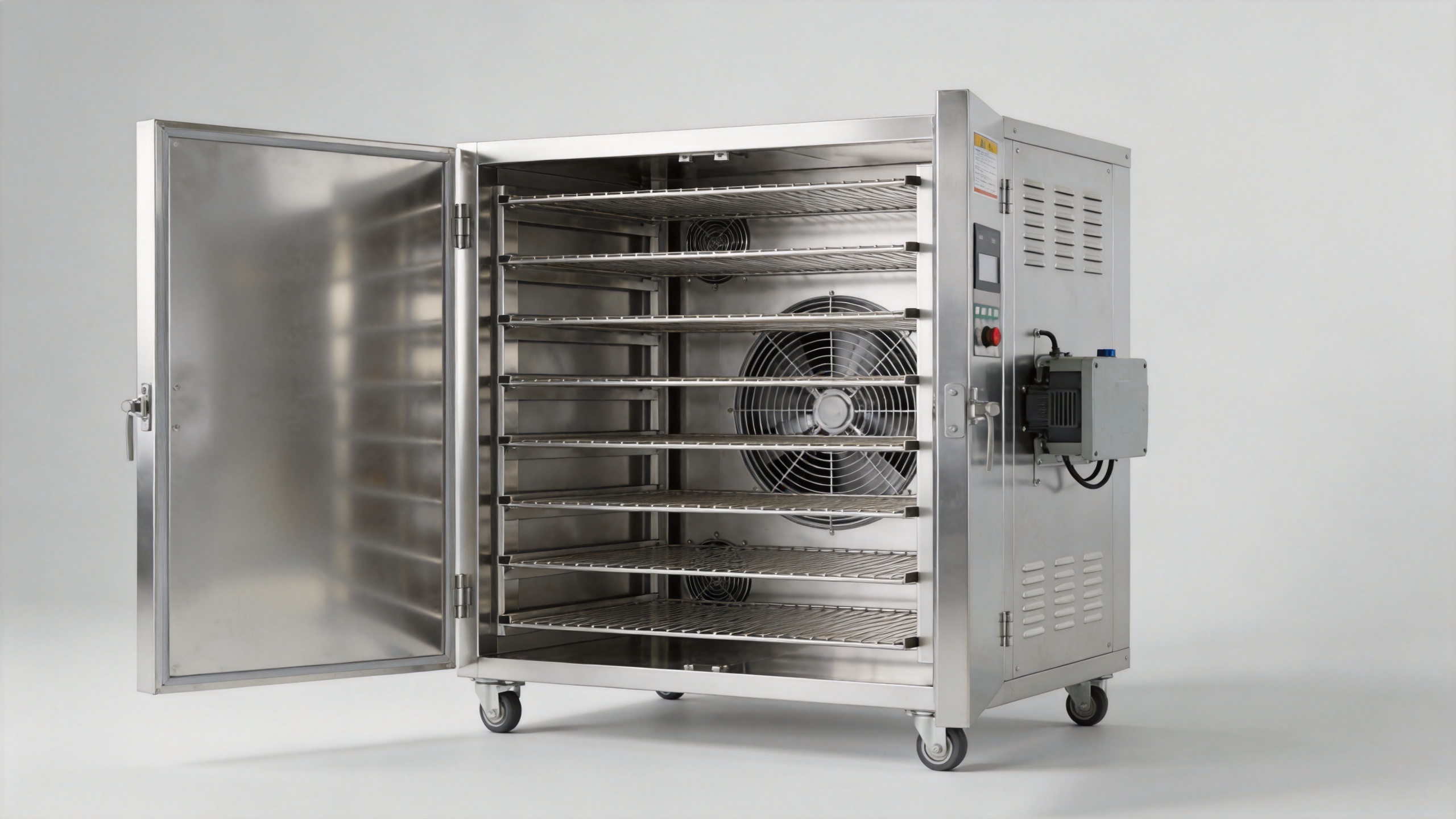
Heating alone does not dry product evenly. An industrial dehydrator also needs managed airflow so that trays near the fan, exhaust, and chamber edges do not receive materially different drying conditions. Poor air distribution can lead to uneven moisture, rework, longer cycles, or unnecessary product loss.
Evaluate fan layout, air direction, duct geometry, recirculation strategy, exhaust control, and whether the design supports adjustable airflow. For mixed loads, ask how the supplier recommends separating products with different moisture-release behavior. Buyers should also clarify the materials used in food-contact zones, access for cleaning, insulation quality, and drain or condensate management where relevant.
During technical review, request a chamber layout and identify the expected airflow path for every loading zone. A reliable industrial dehydrator specification should make clear how fan speed, damper position, and exhaust settings are controlled. This level of detail is especially useful when the same industrial dehydrator will dry products with different slice thicknesses or loading patterns.
These features may increase the purchase price of an industrial dehydrator, yet they can be more valuable than a lower-cost chamber if they reduce batch variation. Request a factory acceptance plan that explains how airflow and temperature uniformity will be checked before shipment.
Automation changes both the investment and the labor model
Automation can range from basic digital temperature control to recipe storage, humidity monitoring, alarms, data logging, automatic damper adjustment, loading assistance, and connected production reporting. A simple industrial dehydrator may suit a small processor with stable products and experienced operators. A higher level of automation may be justified when recipes change frequently, traceability matters, or staffing is limited.
Do not compare “automatic” labels alone. Ask which actions are automated, which still require operator intervention, and what information is stored for each batch. A well-defined control package can improve repeatability, but unnecessary options can add cost without helping the process. The appropriate automation level is the one that supports your actual operating discipline.
For a multi-shift plant, an industrial dehydrator with recipe access controls and batch logging may reduce handover errors. For a smaller operation, a simpler industrial dehydrator can be a sensible choice when operators can consistently document settings and verify final moisture. Define the workflow first, then price the controls that support it.
| Control level | Typical value | Buyer question |
|---|---|---|
| Basic | Setpoint temperature and timer | How are alarms and batch records handled? |
| Recipe-based | Repeatable multi-stage drying programs | Can operators lock or edit recipes by permission? |
| Advanced | Sensor feedback, logging, and connected reporting | Which signals are measured, exported, and supported after delivery? |
Include fabrication, logistics, and support in the real budget
The delivered cost of an industrial dehydrator includes more than the machine body. Stainless-steel grade, insulation, electrical components, safety devices, spare parts, export packing, freight, installation support, commissioning, and operator training can each affect the final budget. Buyers should request a quotation that separates equipment price from optional items and identifies what is excluded.
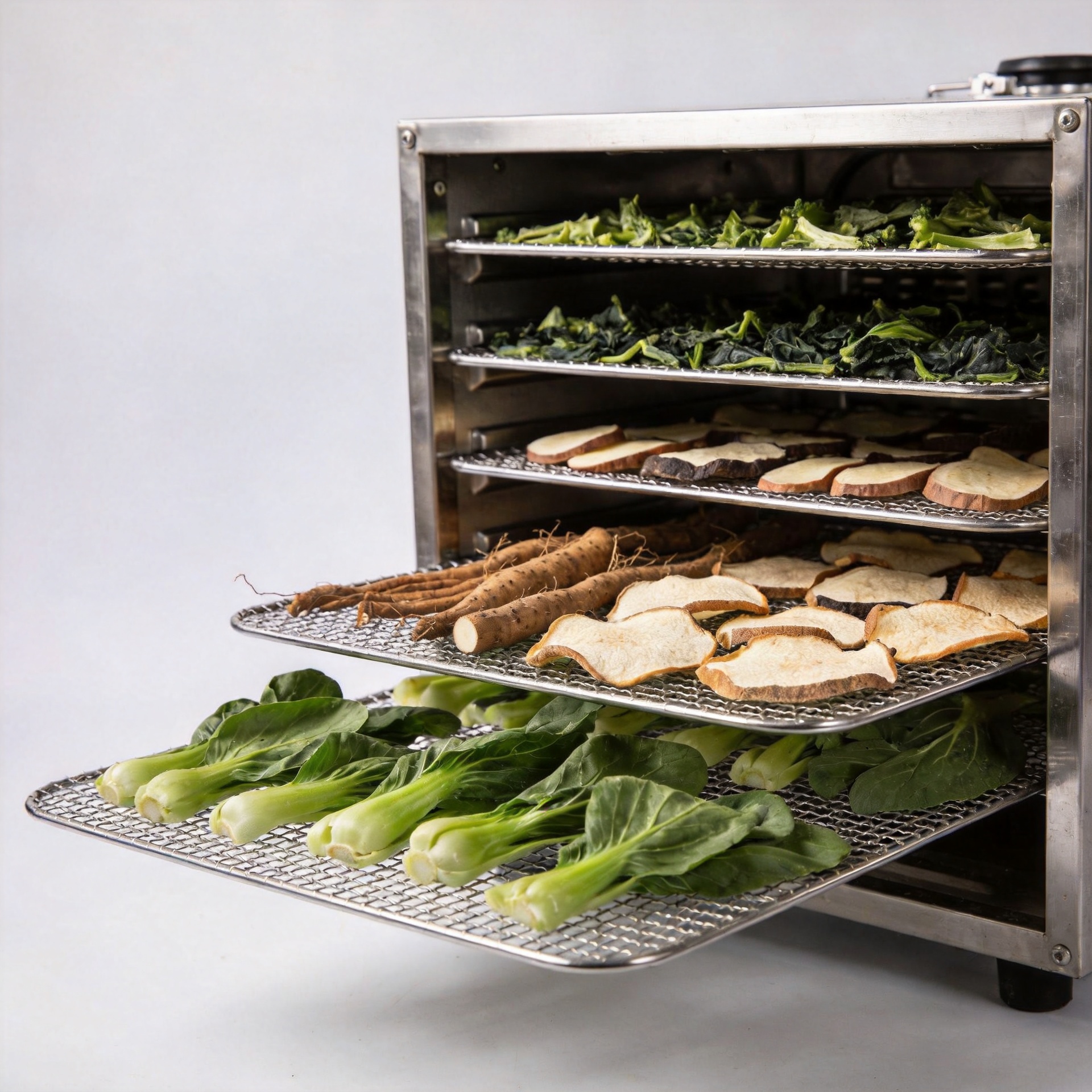
For teams evaluating a fruit and vegetable drying project, the Industrial Drying Vegetable Dryer Fruit Drier Machine Dehydrator Automatic can be used as a starting point for a product-specific discussion. Confirm the actual configuration, utilities, delivery scope, and suitability for your materials directly with the supplier; a product title alone is not a process guarantee.
A practical comparison checklist for an industrial dehydrator
- Match fresh-input capacity and finished-output targets to your production plan.
- Compare the heat source, installed load, and the assumptions behind energy estimates.
- Review airflow design and the proposed method for verifying drying uniformity.
- Specify required temperature, humidity, recipe, alarm, and data-recording functions.
- Check food-contact materials, cleaning access, safety features, and maintenance access.
- Separate machine price, accessories, freight, commissioning, and spare-parts costs.
- Ask for remote technical support, manuals, and clear acceptance criteria.
A disciplined comparison turns an industrial dehydrator quote into a production decision rather than a price-only purchase. The most suitable machine balances capacity, heat and airflow control, automation, and service support against your real throughput and quality targets. By requesting the same operating assumptions from every supplier, procurement teams can identify the configuration that is most likely to perform reliably after installation.