EN


Industrial Food Dehydrator: How Drying Systems Protect Product Quality
For a processor, a fruit and vegetable dryer machine is not simply a way to remove water. It is a process-control system that determines whether dried slices, granules, herbs, or vegetable pieces retain a marketable color, clean flavor, predictable texture, and stable shelf life. In day-to-day production, the most expensive problems are often not obvious at startup: uneven trays, a damp center in an otherwise crisp batch, excessive browning, or a product that takes on moisture again after packing.
From a production-floor perspective, the useful question is not “How fast can the machine dry?” It is “Can the fruit and vegetable dryer machine remove moisture consistently enough to protect the product specification?” The answer depends on the relationship between heat, airflow, loading, exhaust humidity, and the final moisture condition.
Why moisture removal is a quality-control task
Drying lowers the amount of water available for microbial growth and quality deterioration, but it must be controlled rather than rushed. FDA guidance on water activity explains that water activity affects food stability, and that the acceptable finished level must be maintained during storage. In practical terms, a batch can look dry while still carrying enough uneven moisture to create a storage or texture problem later.
That is why an industrial fruit and vegetable dryer machine should be evaluated as part of a complete quality loop: prepare raw material consistently, set a suitable drying profile, verify the endpoint, cool before packing, and protect the finished product from moisture pickup. The dryer is central to that loop, but it does not replace incoming-material control or packaging discipline.
Temperature: enough energy without unnecessary damage
Temperature drives evaporation, yet more heat is not automatically better. Excessive surface temperature can darken a light-colored product, reduce aroma, toughen the outer layer, or create case hardening—where the surface dries quickly and slows moisture movement from the center. A gentler profile may take longer, but it can give a more uniform result for heat-sensitive fruit and vegetable products.
I initially assumed a higher setpoint meant a better throughput number. That is not quite right: actual performance depends on slice thickness, sugar content, initial moisture, loading depth, and how well humid air leaves the chamber. A practical program often starts with a moderate removal phase and adjusts later stages to reach the required endpoint without over-drying the surface.
Food-specific process validation remains essential. For example, extension guidance commonly describes about 140°F (60°C) as a typical dehydration reference for many fruits and vegetables, but a commercial process should be validated for the actual product, pre-treatment, target texture, and applicable food-safety requirements.
Airflow: the reason one tray should not dry like another
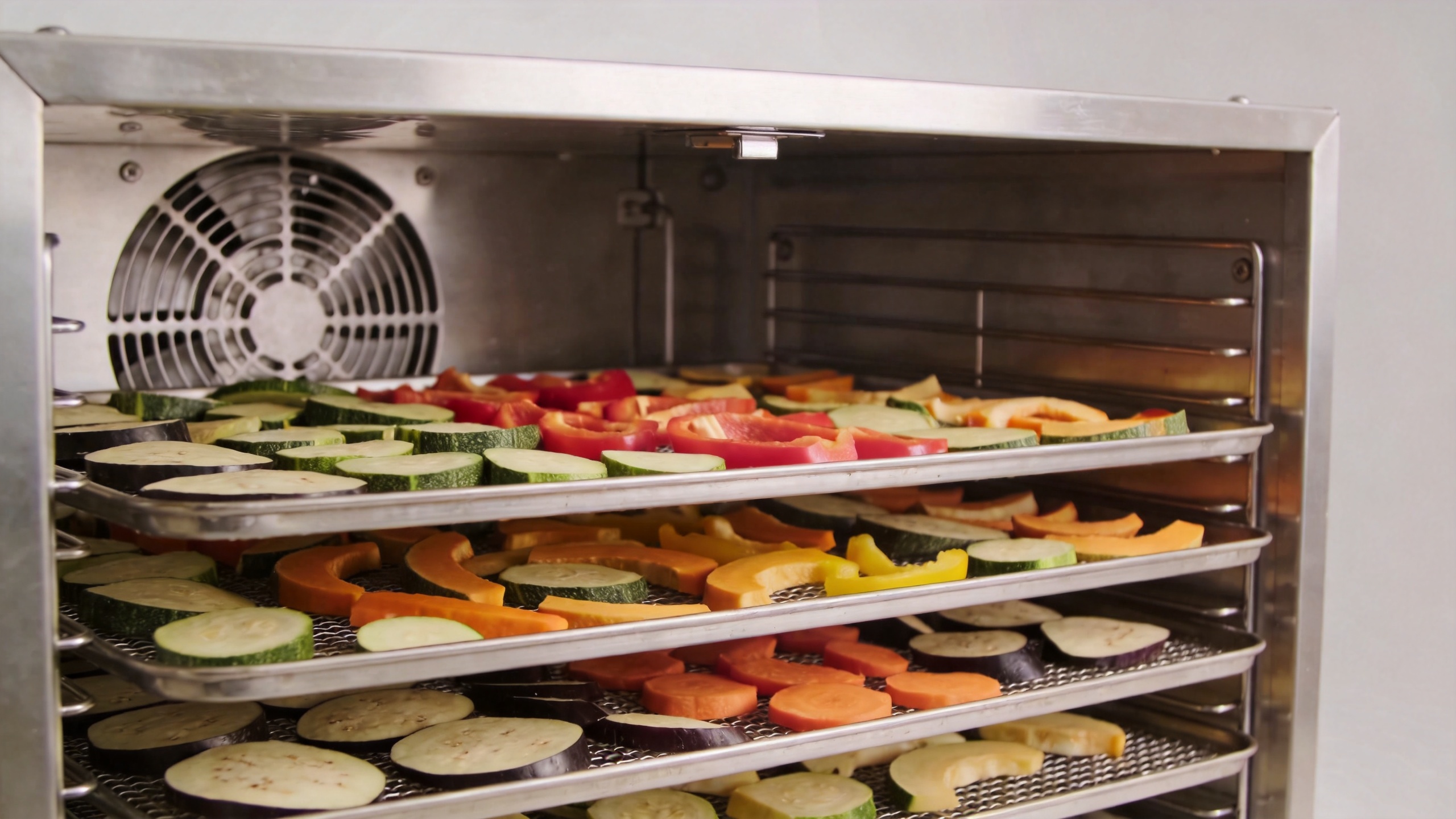
Heated air must reach every exposed surface and then carry released moisture away. FAO drying guidance notes that drying behavior is affected by material moisture, air temperature, humidity, and airflow conditions. As air passes through a loaded chamber, it absorbs moisture; its condition changes from one area to another. Without thoughtful airflow distribution, the first trays may dry faster than the last, or the top racks may behave differently from the lower racks.
When assessing a fruit and vegetable dryer machine, ask how the system manages air direction, recirculation, fresh-air intake, and exhaust. The goal is not maximum fan noise or velocity. It is repeatable air contact across the actual product load. Operators should also be able to follow sensible loading rules: consistent cut size, adequate space between pieces, and tray loading that does not block circulation.
- Stable air distribution helps reduce tray-to-tray variation.
- Controlled exhaust removes humid air instead of allowing it to accumulate around the product.
- Repeatable loading makes a validated recipe more transferable between shifts.
Moisture endpoint: measure the result, not just the clock
Time is a useful operating reference, but it is not a universal quality guarantee. Raw-material maturity, piece geometry, seasonal moisture differences, and batch loading can all change the drying curve. A reliable production team therefore checks an endpoint using the method appropriate to the product specification—such as moisture testing, water-activity verification, texture checks, or a validated combination of these controls.
FDA notes that many foods above a water activity of 0.95 can support bacteria, yeasts, and molds; however, no single number should be treated as a blanket safety promise for every dried product. Product formulation, packaging, storage conditions, and regulatory requirements still matter. The important operational lesson is to define an acceptable range, document it, and prevent the batch from drifting outside it.
Cooling is part of endpoint control as well. Packing a warm product can trap moisture or create condensation inside the package. Allow the product to cool under controlled conditions, then pack it in a moisture-protective format suited to the product and market.
Build a repeatable drying recipe for each product
A strong recipe is more than a temperature setting. It records the raw-material preparation, piece size, tray loading, staged temperature and airflow settings, approximate process duration, endpoint test, cooling procedure, and packaging handoff. This is particularly useful when a fruit and vegetable dryer machine is used for several product types, because apple slices, leafy vegetables, root crops, and high-sugar fruits do not release water in the same way.
- Define the finished product: color, texture, target moisture or water activity, and pack format.
- Standardize preparation: washing, cutting, blanching or pre-treatment where appropriate, and drain time.
- Set an initial profile based on product sensitivity and load condition rather than copying a generic time.
- Check representative trays during trial runs, including areas most likely to dry slowly.
- Record results and refine one factor at a time so the recipe becomes repeatable.
What to look for when selecting a drying system
For an awareness-stage equipment evaluation, begin with process fit rather than a headline capacity claim. Ask suppliers how the chamber manages airflow around a full load, what controls are available for temperature and exhaust, how operators access and clean contact areas, and how the system can be matched to your product form and expected batch rhythm. Spare-parts support, operator guidance, and practical commissioning assistance matter too—especially for export operations that cannot afford extended trial-and-error downtime.
For a product starting point, review the Industrial Drying Vegetable Dryer Fruit Drier Machine Dehydrator Automatic alongside your own material, tray-loading, and quality requirements. A supplier conversation becomes more useful when you can provide sample dimensions, starting moisture, desired finish, batch size, and destination-market expectations.
A quality-first conclusion
A suitable fruit and vegetable dryer machine should not be judged by drying speed alone. It supports controlled heat, well-managed airflow, consistent moisture removal, and a repeatable operating recipe. Treating dehydration as a measured quality process helps processors protect appearance, flavor, texture, and storage stability while building a more predictable production routine. Confirm final settings through product trials and documented quality checks before full-scale production.