EN
EN


Industrial Juicer Guide: Extractor Types for Fruit and Vegetable Processing
Choosing an industrial juicer is less about finding the fastest machine and more about matching an extraction method to the crop, product specification, and operating rhythm of the line. A café-style unit can make juice, but a fruit and vegetable processor needs an industrial juicer that can accept prepared feed continuously, manage pulp, and fit with washing, crushing, filtration, pasteurization, or filling equipment. This guide explains the main extractor types and the practical questions that make an industrial purchase decision clearer.
Start with the processing job, not the machine name
Before comparing an industrial juicer, define what enters and leaves the extraction stage. Apples, pineapple, tomato, carrot, ginger, berries, leafy vegetables, and citrus do not behave alike under pressure. Some need washing and sorting followed by crushing; fibrous materials may need cutting or milling; pulpy products may require a pulper or finisher after extraction. The desired output also matters: clear juice, cloudy juice, puree-like juice, or a recoverable pulp fraction each calls for a different process route.
For awareness-stage planning, map the full flow first: receiving, washing, inspection, size reduction, extraction, separation, heat treatment, and packing. That map prevents a common mistake—sizing an industrial juicer by its headline capacity while overlooking feed consistency, residue discharge, or downstream bottlenecks.
How the main industrial juicer types work
Screw press extractors
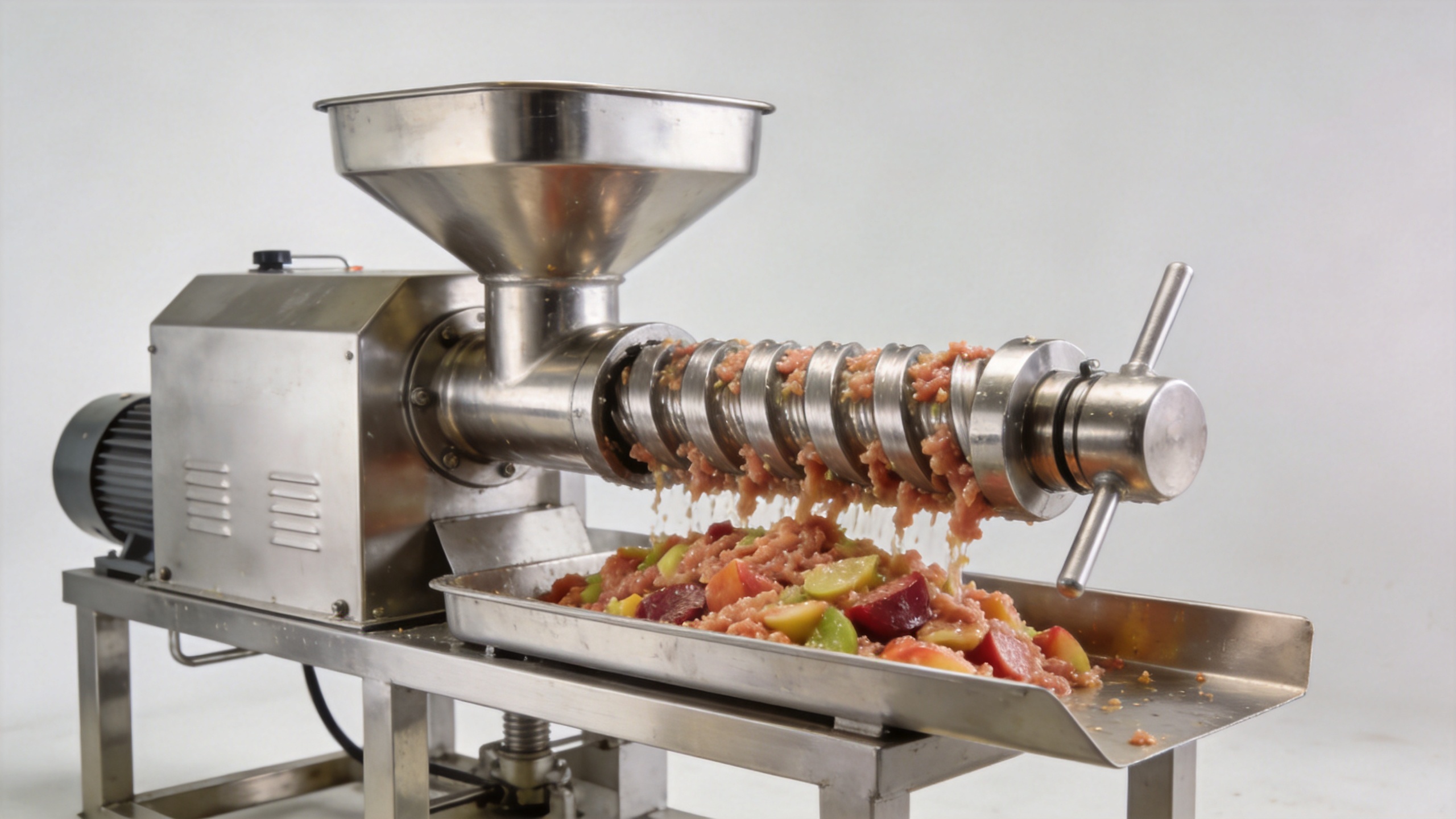
A screw press industrial juicer moves prepared fruit or vegetables through a chamber with a rotating screw. Progressive compression separates liquid from pomace, while a screen and outlet arrangement influence retention and discharge. This continuous approach is widely considered for apples, pineapple, tomato, ginger, berries, and many mixed fruit and vegetable streams. It is especially useful when a processor needs steady feeding and controllable pulp handling rather than repeated manual batches.
Published supplier specifications often show screw extractors in roughly the 0.5–2.5 t/h processing range, but that figure is only a starting point. Real output changes with moisture, particle size, ripeness, screen selection, press settings, and how uniformly the feed is prepared. Ask suppliers to explain capacity for your actual material, not a generic fruit category.
Hydraulic and cold-press systems
A hydraulic industrial juicer applies pressure in cycles or batches. It can be appropriate where gentle extraction, product positioning, or a smaller production pattern takes priority over continuous high-throughput operation. Cold-press language is common in the market, yet buyers should clarify the full operating sequence: loading method, press cycle time, cloth or bag handling if used, cleaning labor, and how the pressed material reaches the next step.
Centrifugal extractors
Centrifugal designs use high-speed rotation to separate liquid and solids. Depending on the material and line design, they may support fast processing and can be part of a broader separation system. However, a centrifugal industrial juicer should be assessed for product texture, foaming behavior, cleaning access, and the desired level of pulp in the finished juice. It is not automatically interchangeable with a screw press.
Fruit pulpers and finishers
A fruit pulper is often paired with an industrial juicer rather than treated as the same machine. Pulpers separate skins, seeds, coarse fibers, and unwanted particles from softer fruit material. In tomato, mango, berry, or stone-fruit applications, the pulping stage can be central to creating a uniform product stream. Evaluate it together with the extractor because screen size, feed condition, and product viscosity affect both units.
Match the extractor to your raw material
| Raw-material condition | What to evaluate in an industrial juicer | Process question |
|---|---|---|
| Hard fruits or root vegetables | Pre-crushing, screw strength, screen protection | Is size reduction consistent before extraction? |
| Fibrous produce such as ginger or pineapple | Feed control, anti-bridging design, residue discharge | Can the line prevent uneven feeding and wraparound? |
| Soft or pulpy fruit | Pulper/finisher integration, screen choice, pulp level | Is the required texture defined before equipment selection? |
| Mixed fruit and vegetable recipes | Changeover access, cleanability, recipe validation | Which material sets the limiting capacity and cleaning plan? |
The most suitable industrial juicer is therefore material-specific. A demonstration should use representative samples whenever possible. A supplier test with only easy-to-process fruit may not reveal how the same equipment performs with fibrous, starchy, or highly pulpy feed.
Capacity, yield, and line balance
Capacity is often the first number buyers request, but an industrial juicer should be evaluated as part of a balanced line. If washing delivers more material than extraction can accept, the feed may wait and quality can vary. If extraction outruns filtration or pasteurization, product handling becomes unstable. Define a target throughput in kilograms or tonnes per hour, then ask how it was measured: raw feed rate, juice output, or finished-pack volume are not the same number.
Yield deserves the same caution. Fruit variety, maturity, pre-treatment, screen selection, press adjustment, and pomace moisture can all change the result. Rather than accepting a single yield claim, request a test protocol, sample conditions, and a clear definition of what was measured. This makes an industrial juicer comparison more useful than a brochure-to-brochure comparison.
Hygienic design and daily operation
Wet food processing puts sanitation at the center of industrial juicer selection. Food-contact surfaces, accessible screens, removable parts, drainage, seals, and cleaning procedures should all be reviewed before purchase. SUS304/304 stainless steel is commonly specified for food-contact construction, but material grade alone does not prove that a machine is easy to clean. Ask where residue can collect, how screens are removed, whether wash-down reaches the product zone, and what consumables or wear parts require routine attention.
Also include operator safety and maintenance in the evaluation. A practical industrial juicer should have clear access points for inspection, a sensible cleaning sequence, and documented guidance for startup, shutdown, and screen changes. These details influence uptime as much as the extraction principle.
A practical procurement checklist
- Describe the raw material, including size, fiber level, ripeness, and expected seasonal variation.
- Define the finished product: clear juice, cloudy juice, puree, concentrate feed, or a mixed beverage base.
- Set target throughput and identify the slowest upstream and downstream stations.
- Compare the industrial juicer type with the required feeding, extraction, separation, and cleaning steps.
- Request test conditions and performance evidence for representative material, not only generic capacity figures.
- Review food-contact construction, sanitation access, spare parts, utilities, and operator training.
- Confirm how the equipment connects to washing, crushing, pulping, filtration, and packing equipment.
Where a screw press can fit in a fruit and vegetable line
For processors considering continuous extraction, a screw press can be a useful starting point after raw-material preparation. Hongle Machinery lists a Food-Grade Screw Press for Fruit & Vegetable Processing as a product option to review alongside your own feed material, target throughput, and line layout. The product page should be treated as a specification discussion point; final suitability should be confirmed through a technical review and, where possible, a material test.
Final takeaway
An industrial juicer is a process decision, not just an equipment purchase. Start with the material and the desired product, then compare screw press, hydraulic, centrifugal, and pulping options through throughput, yield measurement, cleaning, and line integration. When those factors are documented before quotation, buyers can choose an industrial juicer that supports a stable fruit and vegetable processing workflow rather than creating a new bottleneck.