EN


Industrial Microwave Dryer vs Vacuum Dryer for Chili Processing
For a chili processor, the vegetable dehydration process is not simply a matter of removing water. It is a decision about color, aroma, throughput, cleaning time, batch consistency, and how much process control the team can support. Industrial microwave drying and vacuum drying can both fit a modern chili line, but they create different operating conditions and different questions for procurement.
This comparison is written for processors evaluating a vacuum drying machine or a microwave-based route for sliced chili, flakes, or ingredients destined for further milling. The useful answer is rarely “one technology wins.” The more practical question is which route fits the raw material, target product, production rhythm, and validation plan.
Start with the chili product, not the machine label
A reliable vegetable dehydration process starts before the dryer. Chili variety, maturity, initial moisture, slice geometry, load depth, and the intended finish all affect drying behavior. A whole chili, a thick strip, and a thin ring do not present the same moisture path. Uniform cutting is especially important because uneven pieces reach different moisture endpoints under the same recipe.
For this reason, buyers should define a trial specification before comparing quotations: incoming material condition, cut range, desired final moisture or water-activity target, permitted color change, acceptable breakage, and the planned pack format. A stated capacity without these conditions is hard to compare meaningfully. In practice, the vegetable dehydration process must be validated with the processor’s own chili, not only a generic demonstration material.
How industrial microwave drying changes the process
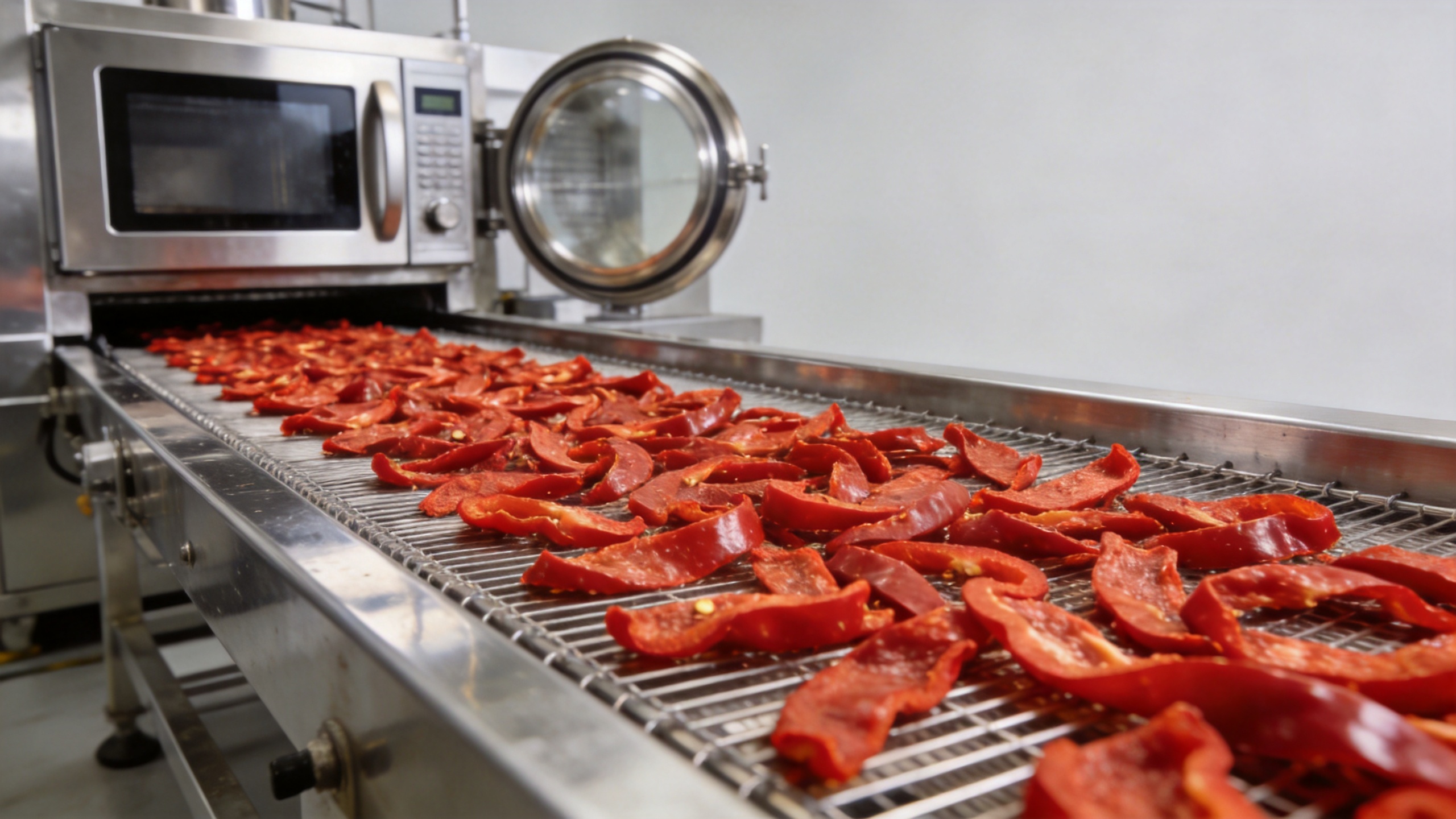
Industrial microwave drying heats water within the product using microwave energy. For chili processing, this can shorten the period in which the product is exposed to conventional surface heating. When the feed is even and the energy profile is properly controlled, microwave systems can support a compact, responsive drying stage.
The operating challenge is uniformity. Moisture differences between pieces, uneven loading, or poorly matched power settings can create variation from one part of the batch to another. Research previews on chili slices have reported stronger quality retention at lower microwave power settings such as 120 W and 240 W in the study conditions. That is a useful reminder to validate power rather than a universal recipe: industrial equipment scale, load density, chili variety, and airflow or vacuum conditions will change the result.
Microwave drying may suit processors that value rapid adjustment, compact floor use, or a responsive stage within a larger vegetable dehydration process. During supplier discussions, ask how the system manages feed distribution, how recipes are stored, what sensors or sampling points are available, and how the line handles product changeover.
How a vacuum drying machine changes the process
A vacuum drying machine lowers the pressure around the product so moisture can be removed under different thermal conditions from an atmospheric process. For a quality-sensitive chili product, this route can be attractive when the processor is focused on protecting appearance, aroma, or rehydration behavior while maintaining a controlled process environment.
Vacuum drying is not a shortcut around material preparation. Load arrangement, chamber loading discipline, seal checks, heat-transfer conditions, and unloading timing all influence the result. The batch-oriented nature of many vacuum systems can work well for specialty products, pilot runs, or processors that need defined validation lots. It can be less convenient when an operation requires uninterrupted high-volume flow unless upstream and downstream buffers are planned carefully.
Published research previews on vacuum microwave drying describe favorable retention of phenolics, bioactive compounds, and rehydration capacity compared with hot-air drying. For a buyer, the takeaway is not a assured outcome; it is a reason to include quality metrics in the trial protocol rather than judge a vacuum drying machine only by cycle time.
Microwave dryer vs vacuum dryer: the comparison that matters
| Selection point | Industrial microwave drying | Vacuum drying route |
|---|---|---|
| Process rhythm | Often suited to responsive, continuous or semi-continuous handling when feed control is stable. | Often organized around defined batches and chamber cycles. |
| Key control question | How evenly does energy reach different pieces and load zones? | How consistently are pressure, heating, loading, and cycle endpoints controlled? |
| Raw-material sensitivity | Needs disciplined cutting, load distribution, and recipe validation. | Needs disciplined loading and product-specific cycle development. |
| Quality discussion | Focus on overheating risk, color, aroma, and moisture uniformity across the load. | Focus on color, aroma, texture, rehydration, and repeatability between batches. |
| Production planning | Review feed preparation and downstream collection capacity. | Review chamber turnaround, buffer space, and batch traceability. |
| Trial evidence to request | Power profile, loading pattern, temperature or moisture checks, yield, and defect observations. | Pressure profile, heating profile, cycle time, endpoint checks, yield, and lot-to-lot comparison. |
Neither column substitutes for a plant trial. A processor producing several chili forms may even find that the vegetable dehydration process benefits from different routes for different product grades. The decision should follow the commercial product specification and production organization, not a single headline parameter.
Batch planning and validation are where many comparisons become real
Two systems can look similar in a video yet behave differently when the plant runs multiple lots. A common planning error is to compare only nominal hourly output. The practical output also includes washing and cutting consistency, loading and unloading time, cleaning, recipe changes, inspection holds, and the space needed to keep chili moving without delays.
Use a pilot plan that includes at least several representative lots. Record raw-material condition, piece size, load weight, drying settings, cycle or residence time, final quality checks, and cleaning/changeover time. The value of this record is that it shows whether the vegetable dehydration process is repeatable under normal plant conditions—not merely whether a single sample can be dried.
For buyers considering an integrated option, the available product page for an automatic industrial microwave drying system for chili food drying equipment can be used as a starting point for a technical discussion. Confirm the actual configuration, process route, utilities, and trial scope directly against your product specification.
A procurement checklist for chili drying equipment
- Define the input: Specify chili type, initial condition, piece geometry, and expected variability between deliveries.
- Define the output: Set the target moisture or water-activity range, color and aroma criteria, breakage limit, and intended use.
- Ask for a recipe-validation plan: Clarify what parameters can be adjusted and what data will be recorded during trials.
- Review the whole line: Check washing, cutting, feeding, drying, cooling, inspection, milling, and packaging interfaces.
- Test operational work: Include cleaning access, changeover steps, operator training, spare-parts planning, and fault-response expectations.
- Compare ownership conditions: Evaluate utilities, maintenance tasks, consumables, documentation, and remote technical support alongside the initial quotation.
Choosing the appropriate route
Choose an industrial microwave route when your team needs a responsive process and is prepared to control feed uniformity, loading, and power profiles. Consider a vacuum drying machine when product-quality priorities and defined batch control justify evaluating pressure-based drying conditions. If the decision is close, run matched trials with the same chili lot and compare outcomes against a written acceptance sheet.
The most useful equipment conversation begins with your real vegetable dehydration process: the chili you receive, the product you must ship, the batch schedule you can operate, and the quality evidence your customers expect. With those inputs documented, a supplier can help translate a drying concept into a testable production configuration.