EN


Industrial Microwave Drying for Chili: Key Process Questions to Ask
Choosing a chilli drying machine is not simply a choice between heat sources. For a food processor, the useful question is whether a drying method can handle the actual chili variety, incoming condition, production rhythm, and downstream packaging plan. Microwave-assisted systems can be part of that discussion, but their value depends on a process window that is defined before equipment configuration begins.
From a manufacturing perspective, the specification sheet is only the beginning. A sensible evaluation starts with the raw material, then the drying endpoint, then the controls needed to achieve a repeatable result. This is especially important when batches differ in size, maturity, initial moisture, skin thickness, or cut geometry.
Start With the Chili You Actually Receive
Before comparing a chilli drying machine, document how the peppers arrive at the plant. Are they whole, split, sliced, or deseeded? Are they a single variety or a seasonal blend? What is the normal batch size, and how much variation appears after washing, sorting, or cutting? These details influence bed depth, residence time, and how evenly energy reaches the product.
A useful trial sheet records incoming moisture, dimensions, loading weight per tray or conveyor area, visible defects, and the condition of the material after pre-treatment. If one batch contains thinner slices and another contains thicker pieces, a single setpoint may not produce the same endpoint. The right response is not to assume a larger machine fixes the issue; it is to agree on an operating range and define when a batch needs a different recipe.
Define the End Point Beyond a Single Moisture Number
Ask what the dried chili must do after it leaves the dryer. Whole dried pods, flakes, and material intended for milling can have different handling needs. A target moisture value is important, yet it should be paired with a validated water-activity specification, sampling plan, and shelf-life requirement. Water activity and total moisture are related but not interchangeable measures, so the product specification should identify which result is used for release.
For each product format, confirm the sampling location and sample size. A result from the surface of a loaded bed may not represent the center. It also helps to decide whether the acceptance standard includes texture, breakage, color, aroma, and later milling behavior. This turns the chilli drying machine discussion from a nominal capacity conversation into a repeatability conversation.
How Will Heating Be Controlled Across the Product Bed?
Industrial microwave drying can remove moisture quickly, but rapid energy input also makes distribution and control important. Published work on red chili drying notes that microwave-assisted methods can shorten drying time while uneven moisture loss and localized overheating remain risks that need to be managed through process parameters. That is why a supplier discussion should cover loading pattern, product movement, power control, dwell time, ventilation or vacuum conditions, and the measurement points used during a run.
For vacuum microwave drying, clarify what the vacuum stage is expected to accomplish for your product and how it will be coordinated with heating and moisture removal. Do not rely on a generic recipe. Ask for a trial using representative chili material and judge the result across several locations, not just the most attractive sample from the batch.
Questions to put on the trial protocol
- What loading depth and product mass will be used for each run?
- How are microwave power, time, and any intermittent stages adjusted?
- Where will moisture and temperature checks be taken?
- What signs trigger a recipe adjustment: darkening, scorching, uneven texture, or residual wet zones?
- How will the process accommodate different chili sizes or initial moisture levels?
Check Quality, Not Only Drying Speed
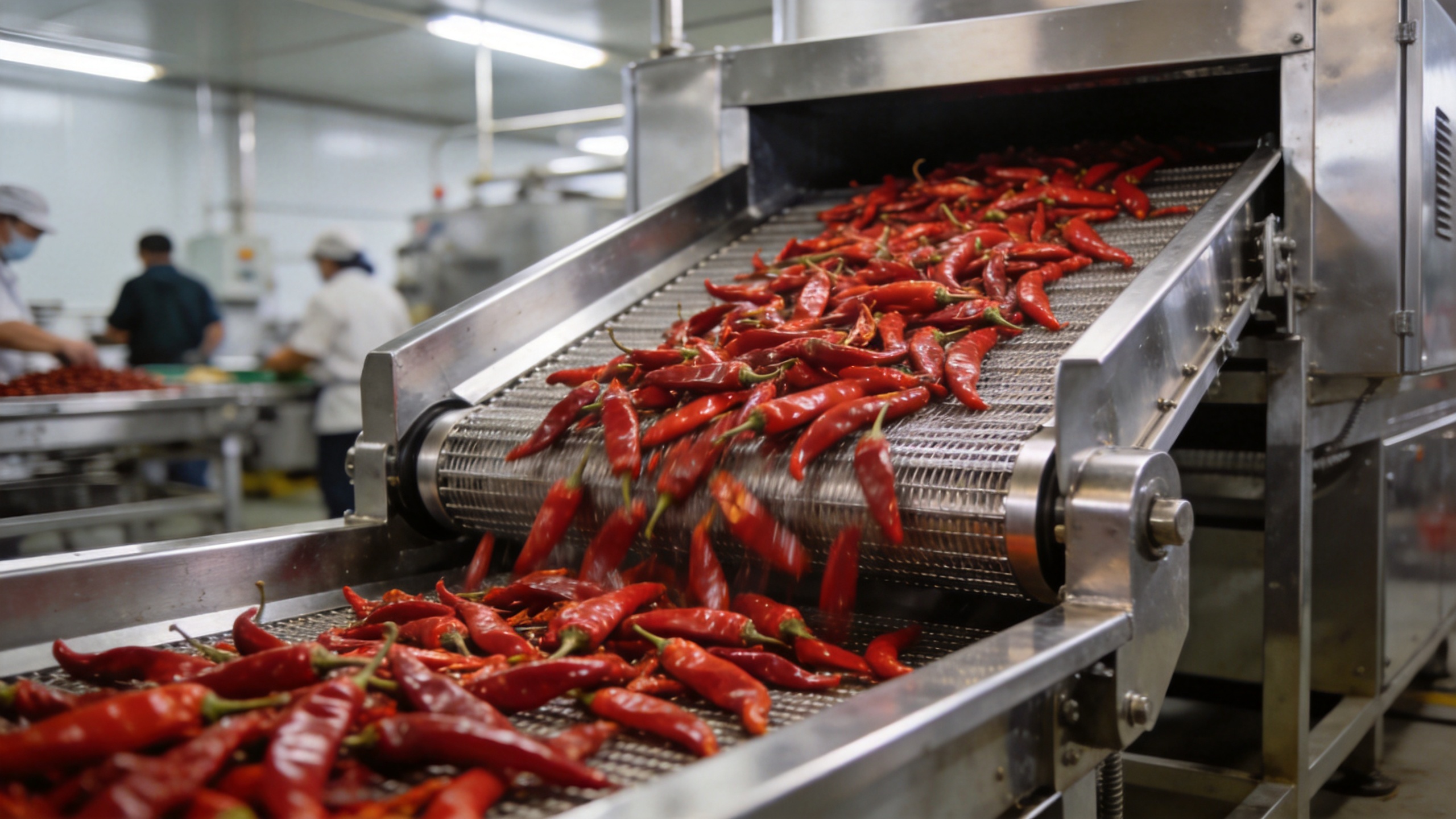
Speed can be useful, but it is not a stand-alone quality indicator. Chili buyers often care about visual color, heat profile, aroma, breakage, and cleanliness as much as they care about the drying endpoint. Research on red chili drying also shows that condition changes can affect color parameters and thermally sensitive pigments. In practical terms, this means your acceptance plan should include product appearance and uniformity checks alongside moisture or water-activity testing.
Build the checks into the line plan: retain samples from the beginning, middle, and end of a production run; compare them after cooling; and record results by lot. When the same issue appears repeatedly, the record can show whether it is linked to raw material, loading, recipe settings, or handoff conditions. This is more useful than making broad claims about one drying technology being suitable for every chili product.
Plan the Transfer From Drying to Packaging
A dryer does not operate in isolation. Dried chili can pick up moisture again if it is packed while warm or held too long in an uncontrolled area. Confirm the cooling method, transfer route, buffer time, foreign-material control, and packaging conditions before the equipment layout is finalized. If milling follows drying, align the moisture and temperature window with the mill's feeding requirements. If whole pods are packed, consider how handling affects breakage and presentation.
Many plants discover late in a project that throughput is constrained by cooling, inspection, or packing rather than the chilli drying machine itself. Mapping the steps from raw chili intake through finished packs makes these interfaces visible early.
Prepare a Focused Equipment Discussion
Once the process questions are clear, a supplier can respond with a configuration that is relevant to the product rather than a generic quotation. For example, the Automatic Industrial Microwave Drying System 220V Electric Vacuum Dryer for Chili Food Drying Equipment can be discussed against your confirmed material format, batch size, target endpoint, and line interfaces. The linked product page is a starting point for a technical conversation, not a substitute for product trials.
Bring representative material, a written quality specification, current production constraints, and the dimensions of the installation area to that conversation. If you export to several markets, also identify the documentation and after-sales support expectations that apply to your operation.
Trial Questions That Turn Process Needs Into Settings
Use a trial to connect the incoming product with the operating window. Record the loading depth, cut size, chosen residence time, sample locations, and results after cooling. For vacuum microwave drying, compare several representative lots rather than relying on a single visually acceptable run.
| Review area | Question for the trial |
|---|---|
| Loading | Does the selected bed depth produce a consistent endpoint across the load? |
| Raw-material variation | Which changes in size or initial moisture require an adjusted recipe? |
| Heating control | Where are the measurement points for identifying wet zones or excess heat? |
| Cooling and packing | How long can product wait before packing without taking on moisture again? |
| Lot release | Which moisture, water-activity, appearance, and handling checks must be recorded? |
| Acceptance | What evidence from the representative trial is required before configuration is approved? |
This matrix supports a clearer conversation about the chilli drying machine without treating equipment settings as fixed across every product. It also gives the operations team a practical basis for documenting vacuum microwave drying trials and selecting a repeatable recipe.
Final Checklist Before Selecting a Chilli Drying Machine
- Describe the chili varieties, cut sizes, incoming condition, and batch variation.
- Set a product-specific endpoint using moisture, water activity where applicable, and quality criteria.
- Run representative trials that test multiple locations across the product bed.
- Review uniformity, appearance, aroma, breakage, and handling after cooling.
- Map the connection between drying, cooling, inspection, and packaging.
- Ask for an operating and support plan that matches your capacity and site conditions.
A well-defined brief helps processors compare drying approaches on the factors that matter in daily production. Whether you are assessing conventional heating or vacuum microwave drying, the strongest decision comes from verified trials and clear acceptance criteria.