EN


Industrial Potato Cutter RFQ Template: Capacity, Cut Size and Production Line Integration
A heavy duty potato slicer should be quoted against a process, not a vague machine name. This template helps a food processor explain the raw potato, required cut, throughput, sanitation routine, and line connections so every supplier prices the same scope. It is useful for a new line, a bottleneck replacement, or a capacity expansion.
A professional french fry cutter may make sticks, slices, cubes, or wedges, but a reliable proposal depends on more than the desired shape. It depends on product size variation, blade changes, operator access, cleaning time, and the capacity of the equipment before and after the cutter. Use this RFQ to turn those variables into clear supplier questions.
Start with the production decision
Do not ask only for a heavy duty potato slicer. State whether the heavy duty potato slicer feeds a blancher, fryer, dewatering unit, freezer, or packaging system. A standalone demonstration can look convincing while the installed industrial cutter creates a transfer, buffer, or control problem at the next station.
Request a proposal for the complete cutting machine configuration: infeed, cutting head, discharge arrangement, guards, controls, utilities, tooling, and commissioning boundary. Ask the supplier to list every assumption that affects price, speed, yield, or responsibility.
RFQ section 1: Describe raw potatoes and infeed conditions
The supplier needs to know what reaches the proposed cutter, not merely what you want to sell. Describe whether potatoes are washed, peeled, chilled, or ambient; give typical and maximum diameter and length; and mention variety, seasonal variation, and defect level if those affect the process. If several sources supply the factory, tell the supplier whether the equipment must handle that variability.
- Cutting station raw-material condition: washed, unwashed, peeled, pre-cut, chilled, or ambient.
- Proposed unit infeed size: typical, minimum, and maximum potato dimensions.
- Industrial cutter upstream controls: washing, destoning, sorting, inspection, and any manual removal step.
- Cutting system feed pattern: continuous conveyor feed or batch loading.
- Machine yield criteria: trim, breakage, off-spec pieces, and how each will be measured.
Ask which raw-material conditions could reduce speed or cut consistency. That answer should become part of the acceptance-test conditions for the cutting equipment.
RFQ section 2: Define the cut and blade-change requirement
The cut specification is the core of a professional french fry cutter inquiry. Name the format—straight sticks, crinkle cuts, slices, cubes, wedges, or another profile—and state the nominal dimensions. Include the permitted variation, broken-piece limit, visual standard, and the number of product formats required per shift.
| RFQ item | What to state | Decision value |
|---|---|---|
| Industrial potato cutter target cut | Shape plus width, thickness, or cube size | Determines cutting head and blade set |
| Cutting-system tolerance | Accepted dimensional and appearance variation | Creates a measurable test standard |
| Equipment formats | Number of styles and changeover frequency | Defines tooling and labor needs |
| Future use | Likely seasonal or future formats | Tests the value of modular tooling |
Vendor listings can show broad cut ranges, including examples around 3–20 mm, but do not copy a range unless it matches your product. Ask for the exact blade assemblies proposed for the industrial cutting unit, the changeover time, the tools required, and the safe removal and reinstallation procedure.
RFQ section 3: Specify capacity as an operating window
For each proposed equipment quote, give target, minimum, and peak throughput in kg/h or lb/h. State whether the figure refers to raw input, cut output, or saleable yield after sorting. Also specify the planned run time per shift, the cleaning intervals, and the duty cycle.
- Target capacity: (to be specified) kg/h or lb/h.
- Minimum and peak operating capacity: (to be specified) / (to be specified).
- Test material and target cut: (to be specified).
- Continuous trial duration: (to be specified).
- Upstream and downstream nominal capacities: (to be specified).
Industrial examples range from several hundred kilograms per hour to multi-tonne systems, but no figure is transferable without the cut, potato condition, and line design. Require the supplier to explain the test method, measurement point, and exceptions behind the proposed cutting solution capacity.
RFQ section 4: Map every production-line interface
Draw a simple flow: receiving → washing → peeling → inspection → cutting → rinsing or blanching → frying or other treatment → cooling → packaging. Mark where the machine proposal starts and ends. Then ask for inlet and outlet elevations, discharge direction, conveyor coordination, buffer requirements, footprint, access clearance, power, air, water, drainage, and control signals.
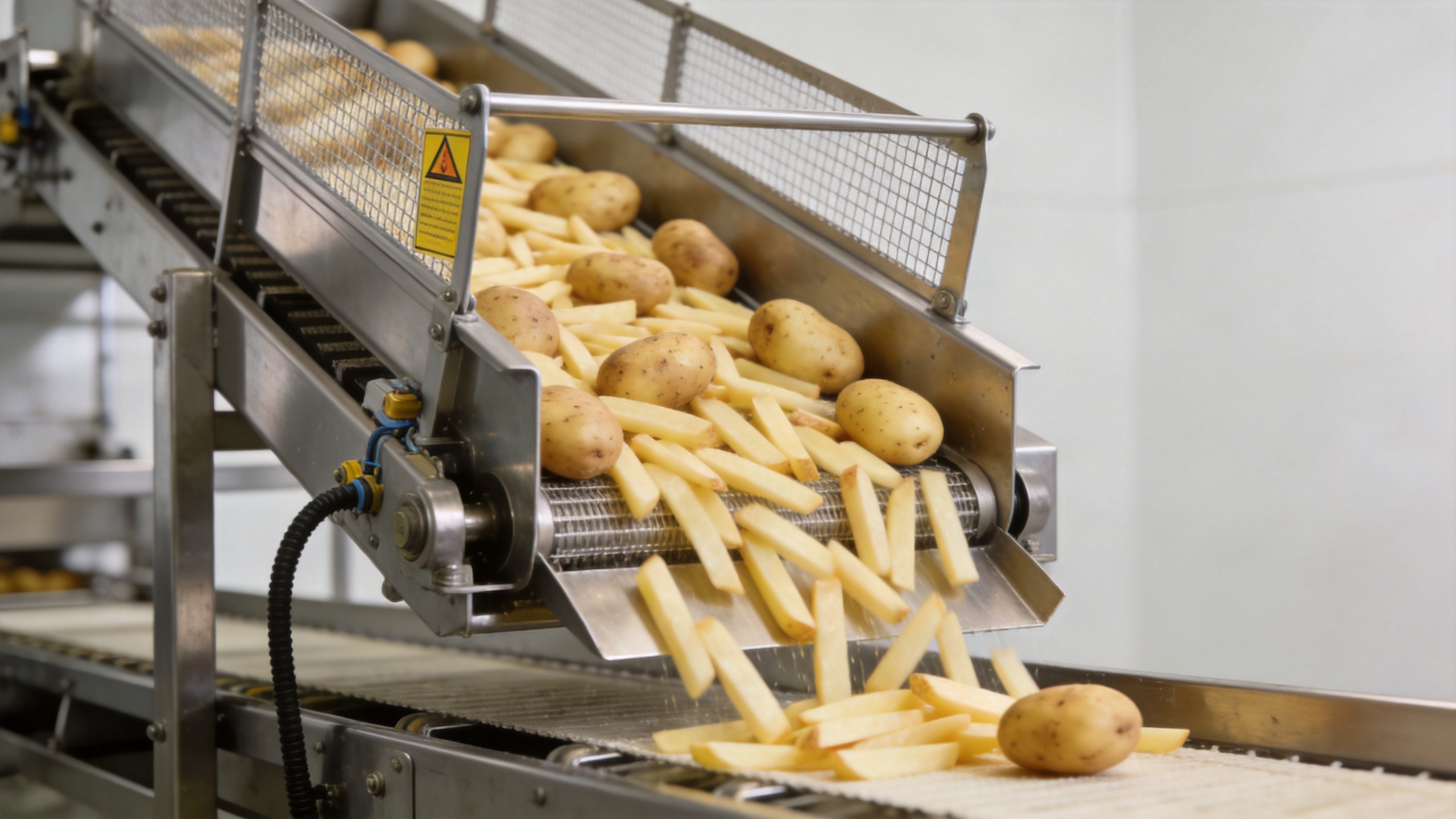
For PLC or HMI integration, identify run/stop, fault, emergency-stop, speed-reference, and product-change signals required from the selected cutter. Confirm who designs each interface, who supplies the drawings, and who verifies operation during commissioning.
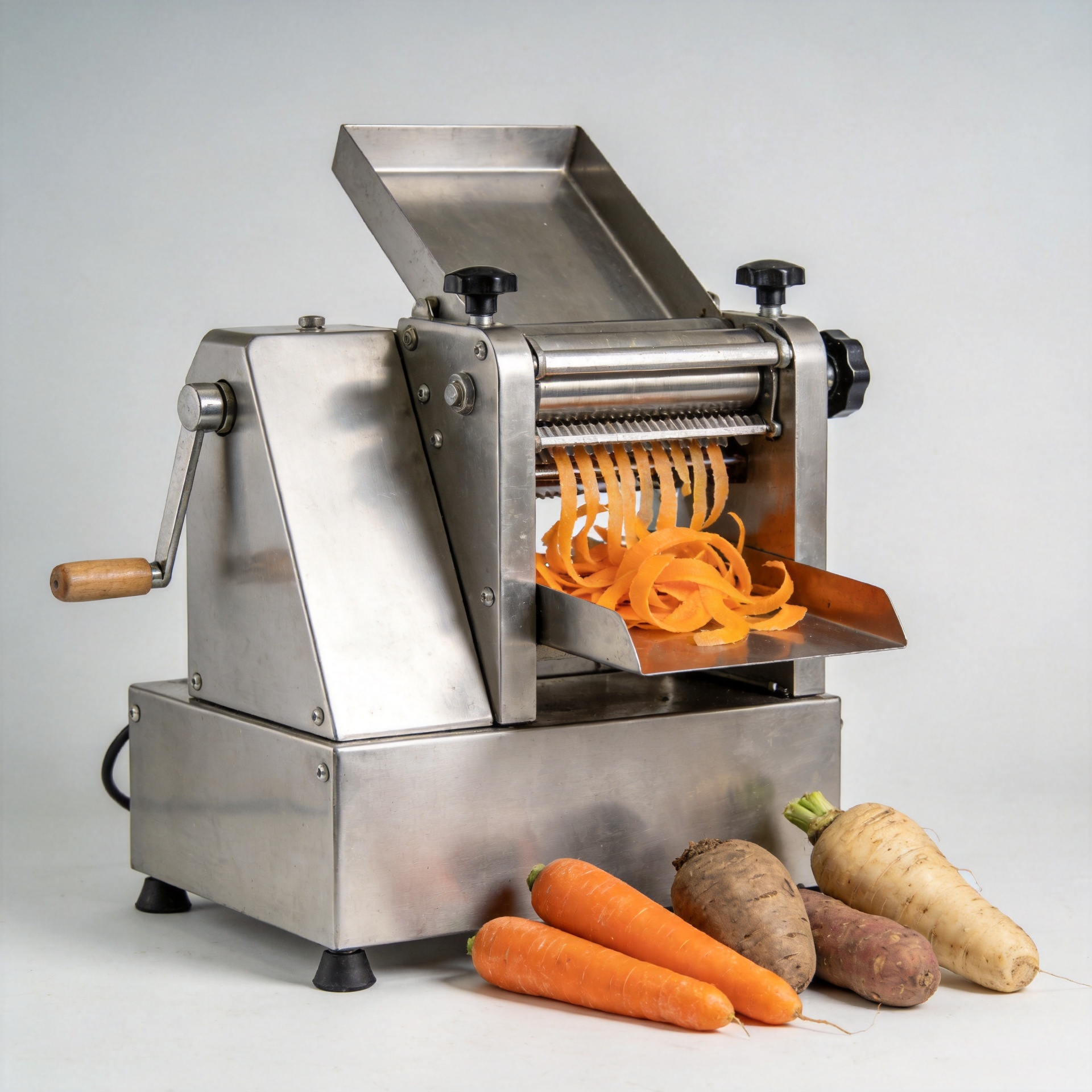
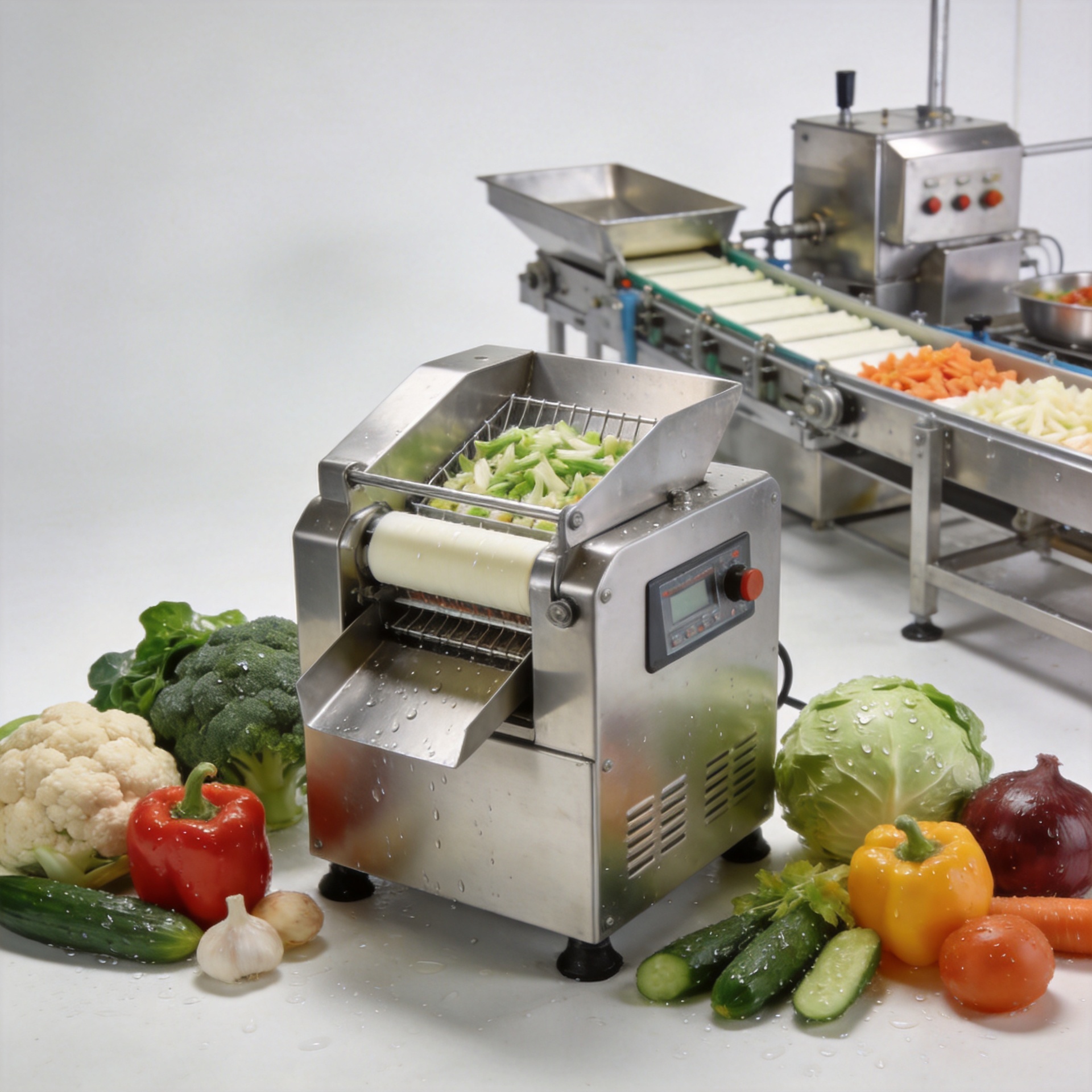
A related product category can be reviewed here: Commercial Industrial Electric Vegetable Cutter Dicing Machine for Potato Fruit & Green Onion. Confirm final suitability for your material, target cut, and interface scope before selection.
RFQ section 5: Include sanitation, safety, and maintenance
Ask how the production cutter supports cleaning, blade replacement, and safe access. Food-contact equipment should be assessed for suitable materials, smooth and accessible surfaces, drainage, guards, and the cleaning method used by your site. Do not assume a feature or certification that the supplier has not confirmed.
- Food-contact materials and fabrication details.
- Cleaning method, access panels, drainage, and tools.
- Blade-change sequence, guarding, interlocks, and lockout points.
- Recommended spares, wear parts, and supply process.
- Operator training, manuals, commissioning, and support boundaries.
Copy-and-send RFQ text
Subject: RFQ – industrial potato cutting equipment / heavy duty potato slicer
We are evaluating a heavy duty potato slicer for (new line, expansion, or replacement) at (project location).
Raw material: (raw-material condition, size range, variability, and washing/peeling status).
Required cut: (cut format), (nominal dimensions), (accepted tolerances), (formats per shift), and (changeover frequency).
Capacity: target (to be specified), minimum (to be specified), peak (to be specified) kg/h. State whether capacity is raw input, cut output, or saleable yield and provide test conditions.
Integration: upstream (to be specified), downstream (to be specified), elevations (to be specified), footprint (to be specified), utilities (to be specified), drainage (to be specified), and required controls (to be specified).
Response: include model, configuration, tooling, layout, utilities, delivery scope, exclusions, lead time, warranty, commissioning scope, spare parts, and acceptance-test proposal.
Compare quotes with an acceptance test
Compare every response against the same material, cut, operating window, interface list, sanitation routine, and acceptance method. A suitable equipment proposal makes its assumptions explicit and can prove them under agreed conditions.
Hongle Machinery supports food-machinery buyers with production-line planning, remote technical guidance, operating documentation, and spare-parts coordination. Submit the completed RFQ, layout, and product samples so the proposed cutting solution can be evaluated for your factory conditions.