EN
EN


Industrial Soap Making Machine: A Complete Guide to Choosing the Right Equipment
As a technical consultant who has helped factories across Africa, Southeast Asia, and South America evaluate industrial processing equipment, I've found that soap making machine selection trips up buyers more than almost any other category — not because the machines are complicated, but because the wrong evaluation framework leads to costly mismatches. This guide walks you through a systematic decision process for choosing a soap making machine: from understanding machine types and production capacity, to the criteria that actually determine long-term ROI.
Types of Industrial Soap Making Machines
The term "soap making machine" covers a wide spectrum of equipment. Before comparing suppliers or requesting quotes, clarify which segment of the soap making machine market fits your operation:
- Bar soap machines: The most common category for industrial production — covering laundry bars, bath soaps, and medicated bars. A bar soap making machine typically processes soap with 40–80% fatty acid content.
- Liquid soap production lines: Include mixing tanks, homogenizers, and filling systems. The equipment profile is significantly different from bar soap lines.
- Semi-automatic vs. fully automatic soap making machine: Semi-automatic lines require operator involvement at key stages; fully automatic soap making machine configurations link mixer, plodder, cutter, and stamping in a single continuous flow. Automation level is directly tied to your labor cost structure and batch consistency requirements.
For new operations, many buyers assume they need a fully automatic soap making machine — but after reviewing actual monthly output targets, a well-configured semi-automatic line often covers the requirement at significantly lower capital cost, with easier local maintenance.
Matching Soap Making Machine Capacity to Your Production Goals
Capacity specification is the first technical question to answer when selecting a soap making machine — and the most common source of misalignment. Industry data suggests three standard tiers for bar soap making machine configurations:
- Small-scale (50–200 kg/h): Suitable for startup factories or contract manufacturers serving local markets. A 50 kg/batch soap making machine is a common entry point for new operations.
- Medium-scale (300–500 kg/h): Fits growing manufacturers with stable regional distribution. This tier typically justifies the move to a more automated soap making machine setup.
- Large-scale (1,000–2,000 kg/h): Designed for export-volume producers or large FMCG manufacturers. Infrastructure requirements (power, floor space, utilities) scale significantly at this capacity tier.
If your monthly output is in a growth phase, size your soap making machine slightly above your current need — but only if the equipment can run at partial load efficiently. Oversized machinery running at 30% utilization tends to create more problems than it solves. If your production volume fluctuates significantly, a modular soap making machine setup often makes more sense than a single high-capacity line.
The Five Core Stages of an Industrial Bar Soap Making Machine Line
Understanding the production sequence helps you evaluate whether a supplier's soap making machine offering actually matches your process requirements — or whether gaps exist in their line:
- Mixing (Soap Mixer): Blends raw materials, fragrances, and additives. Key selection criteria: mixing uniformity, batch size, and compatibility with your formula viscosity range.
- Refining (Three-Roll Mill): Homogenizes the soap mass and removes air pockets. Often skipped in low-cost setups, but critical for smooth, consistent bar texture.
- Plodding (Extruder/Plodder): Compresses the refined soap mass into a continuous bar log. Screw design and temperature control at this stage directly affect bar density.
- Cutting: Divides the continuous bar log into individual soap pieces at preset lengths. A well-engineered soap cutting machine should handle both automatic and manual length adjustment with minimal downtime between format changes. Hongle Machinery's Industrial Bar Soap Cutting Machine supports custom size adjustment for both automatic and manual operation modes, designed for soap making plant environments.
- Stamping: Presses branding, shape, and surface detail onto each bar. Die design, press force, and cycle speed are the key variables at this stage.
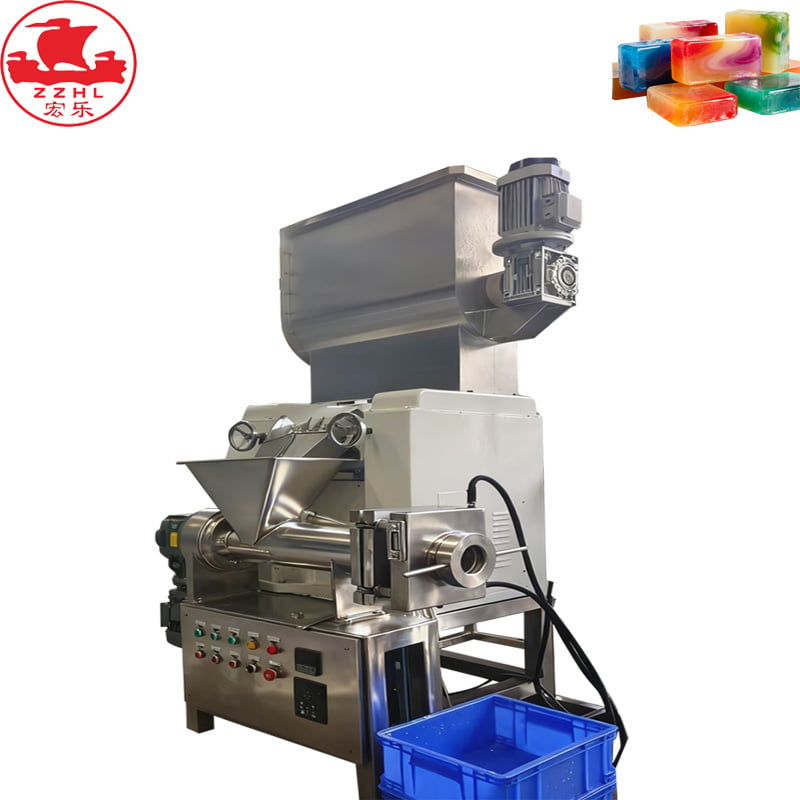 An industrial bar soap cutting machine supports both automatic and manual length adjustment, enabling quick format changes between soap bar sizes.
A common gap in supplier quotes: the soap making machine line is described as "complete," but the three-roll mill or the stamping machine is treated as optional. Clarify this explicitly before signing a purchase order.
Evaluation Criteria Beyond the Price Tag
The first time most buyers go through a soap making machine procurement, price gets most of the attention. By the second purchase cycle, the evaluation criteria tend to shift substantially:
- Formula compatibility: Does the soap making machine support your specific soap base — cold process, hot process, or a hybrid formula? Some machines are optimized for specific fatty acid content ranges. Mismatch here is one of the highest-impact problems in post-installation quality failures.
- Certification and compliance: CE certification is the standard reference point for European and many export markets. For certain markets — including parts of Africa and Southeast Asia — local electrical standards (voltage, phase configuration) matter just as much as product certification.
- Spare parts availability: A soap making machine that performs well for two years and then requires a six-week wait for a replacement bearing is a different cost calculation than the purchase price suggests. Before committing to a supplier, ask specifically about local distributors or minimum spare parts inventory.
- Remote installation support: Cross-border buyers frequently cite installation and commissioning complexity as an underestimated challenge. The question isn't just whether the supplier offers on-site support — it's whether that support is realistically deliverable in your geography, and what the response timeline looks like if something goes wrong six months after installation.
- Material construction: Food-grade stainless steel contact surfaces are standard for personal care soap production; for laundry soap, requirements may differ. Confirm material specs against your production hygiene requirements before ordering any soap making machine.
Why Supplier Capability Matters as Much as Machine Specs
From experience, the highest-risk period for a soap making machine purchase isn't the buying decision — it's the 90 days after the machine arrives. Suppliers with strong export delivery experience typically have documented installation protocols, multilingual manuals, and established channels for remote troubleshooting. Those without that infrastructure tend to leave buyers working through problems independently.
Zhengzhou HongLe Machinery has delivered food and industrial processing equipment — including soap making machine configurations — across Africa, Europe, Asia, and the Americas. Beyond individual machines, their team can support full production line planning, from saponification through to finished product packaging, which reduces the integration burden for buyers assembling a complete new soap making machine line rather than replacing a single piece of equipment.
If your current evaluation is at the "which soap making machine fits my capacity" stage, the capacity tiers above give you a starting framework. For buyers further along who need to match a specific machine configuration to formula type and plant layout, a direct conversation with an equipment supplier who has handled similar project scope is usually the fastest path to an accurate specification.
Making the Decision: A Practical Checklist
Before finalizing any soap making machine purchase, confirm you have clear answers to the following:
- Target monthly production volume (kg) and expected growth over 3 years
- Soap type (bar/liquid) and formula characteristics (fatty acid content, process method)
- Required automation level and available operator headcount
- Power supply specifications at your facility (voltage, phase, frequency)
- Space constraints and material flow layout
- Certification requirements for your target market
- Spare parts access and after-sales support terms
A well-matched soap making machine — sized right, formula-compatible, and properly supported post-installation — is a straightforward investment. The challenge is mostly in the evaluation rigor upfront. The criteria above should give you a structured basis for comparing options and asking the right questions before committing to a soap making machine purchase.