EN
EN


Industrial Vegetable Dryer: Questions to Ask Before Requesting a Quote
Requesting a quote for a fruit and vegetable dryer machine should be more than asking for a price and a delivery date. For a food processor, distributor, or project buyer, the useful comparison is not “Which machine costs less?” but “Which proposal can dry my actual material to an agreed result, at a defined throughput and operating cost?” A clear request for quotation (RFQ) gives suppliers the same process information and makes their answers easier to compare.
This checklist is designed for decision-stage buyers evaluating a food dehydrator or drying line. Use it before contacting suppliers, then ask each bidder to answer the same questions in writing. It can help reveal where a headline quotation leaves out utilities, handling equipment, commissioning support, or the assumptions behind capacity.
1. What material will the fruit and vegetable dryer machine process?
Start with the product rather than the dryer model. State whether you are drying slices, dices, flakes, whole pieces, powder ingredients, or mixed vegetables. Share the raw material name, cut size, approximate initial moisture, desired final moisture or water-activity target, daily production schedule, and any season-to-season variation.
Why be this specific? A supplier cannot responsibly size a fruit and vegetable dryer machine from “500 kg per hour” alone. Wet onion slices, leafy vegetables, apple rings, and dense root vegetables release water differently and can behave very differently on a belt. The FDA notes that water activity affects food stability and changes with temperature; therefore, ask the supplier to define the finished-product test method and acceptance target, not merely promise that the product will be “dry.”
- What product form and cut dimensions were used for the proposed design?
- What inlet and outlet moisture basis is assumed?
- What color, texture, shrinkage, and breakage criteria can the line reasonably target?
- Can the supplier recommend a pilot trial or sample test before final configuration?
2. How is capacity defined in the quotation?
Capacity is one of the most misunderstood lines in a quotation. Ask whether the stated number is fresh feed per hour, dried finished product per hour, or water-removal capacity per hour. Then request the moisture assumptions, running hours, loading thickness, and expected yield used to calculate it. These details turn an advertised capacity into a comparable operating proposal.
For example, when comparing an onion dryer machine, ask the supplier to state the slice thickness, initial and final moisture assumptions, belt loading, residence time, and the method used to prevent uneven drying. If two suppliers quote the same “kg/h,” but one refers to wet input and the other to finished output, the prices cannot be compared fairly.
| Question to ask | Why it matters |
|---|---|
| Is capacity based on wet input, dry output, or evaporated water? | It prevents two different performance measures from being treated as the same. |
| What product conditions support the stated capacity? | It connects capacity to cut size, moisture, loading, and drying time. |
| What is the expected production yield? | It supports finished-goods and revenue planning. |
| What happens at partial load? | It clarifies flexibility during off-season or smaller orders. |
3. What energy and utility assumptions sit behind the price?
A lower purchase price can be outweighed by operating cost if the heat source, airflow, insulation, and control strategy do not match your site. Ask for installed power, normal operating power, heat-source type, estimated heat or fuel consumption, compressed-air demand if applicable, exhaust requirements, and the assumed ambient conditions. Request the supplier’s calculation basis in the quotation rather than relying on a headline motor rating.
For a fruit and vegetable dryer machine, include the number of operating hours per day and the local electricity or fuel price in your own comparison sheet. Ask what conditions could make actual consumption differ from the estimate, such as wetter raw materials, colder intake air, heavier belt loading, or frequent startup and shutdown. A transparent answer is more useful than an unrealistically low energy claim.
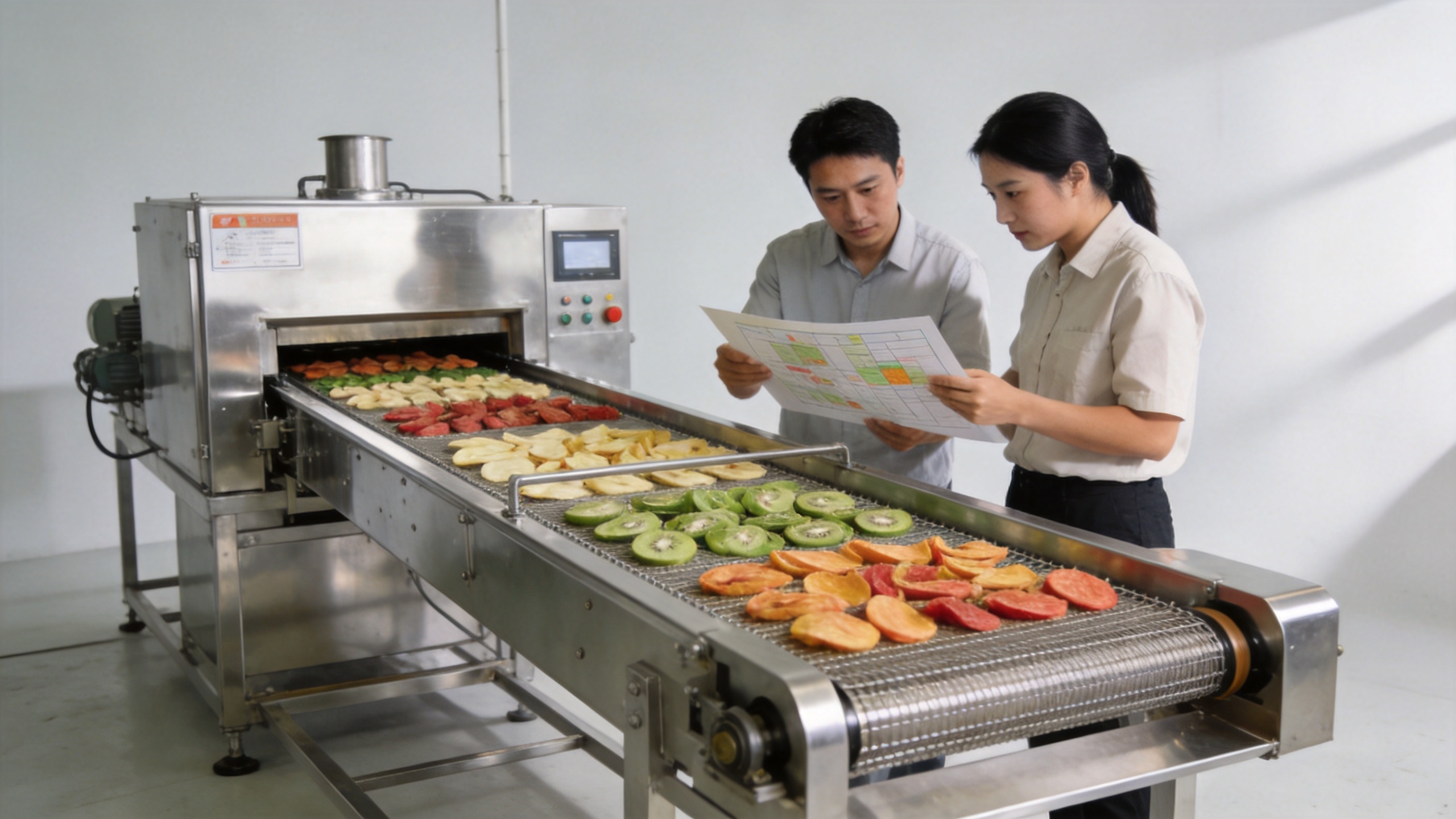
4. Which automation, cleaning, and food-contact details are included?
Ask exactly what the quoted system contains: feeding equipment, spreading device, conveyor sections, drying chambers, discharge, cooling, controls, electrical cabinet, sensors, and safety guards. If you need upstream washing, cutting, or blanching, identify whether those systems are inside or outside the supplier’s scope.
Food-contact materials and cleanability deserve the same level of detail. Ask which surfaces touch the product, how belts and trays are cleaned, where product can accumulate, and what daily cleaning time is expected. For an onion dryer machine, also ask how the proposal manages fine fragments and odor-bearing exhaust, because these practical considerations affect housekeeping and worker comfort even when they are not shown in a simple layout drawing.
- Which functions are automatic, and which require an operator?
- Which temperatures, airflow settings, belt speeds, and alarms can be recorded?
- What safety interlocks, emergency stops, and access protections are included?
- Which food-contact material grades and surface finishes are specified in the offer?
5. What evidence supports performance before you pay the balance?
Turn the quotation into an acceptance plan. Ask the supplier to provide a layout, process flow, utility list, electrical load list, and a clear factory acceptance test (FAT) or pre-shipment inspection scope. The document should state the product—or a mutually agreed substitute—used for testing, the target throughput, the final quality measurements, the test duration, and who pays for samples or third-party inspection.
This question is especially important when the equipment is customized. It keeps both parties focused on measurable evidence rather than broad claims. If you need a product-specific configuration, ask whether the supplier can conduct a sample trial and include the results with the technical proposal.
6. What are the delivery, installation, and after-sales boundaries?
A quotation should identify the delivery term, package list, production lead time, drawing-approval milestones, installation responsibility, commissioning scope, training, spare parts, warranty conditions, and remote-support channels. Ask what site preparation is required before installation: floor loading, clear height, ventilation, drainage, electrical connection, and heat-source connection.
When assessing a supplier, it can also be useful to review a relevant product page such as this industrial vegetable dryer and fruit dehydrator machine. Treat the page as a starting point for discussion, then request a configuration and scope that match your own material and site conditions.
7. A practical RFQ checklist to send every supplier
- Material name, cut size, initial moisture, target final moisture or water activity, and quality expectations.
- Required wet-feed rate, finished-output target, operating hours, and production days.
- Preferred heat source, available power supply, site conditions, and local utility costs.
- Requested equipment scope, including feed, drying, discharge, cooling, controls, and auxiliary equipment.
- Food-contact material, cleaning approach, safety requirements, and applicable local compliance needs.
- Capacity-calculation basis, energy-calculation basis, layout, and utility list.
- FAT, inspection, commissioning, training, warranty, spare-parts, and remote-support terms.
Ask for a like-for-like supplier response sheet
For each fruit and vegetable dryer machine proposal, ask the supplier to complete one response sheet with the same fields: material, moisture range, capacity basis, residence time, heat source, installed load, expected operating consumption, included equipment, exclusions, test plan, and service scope. This turns each fruit and vegetable dryer machine quote into a document your engineering, production, and purchasing teams can review side by side.
Before selecting a fruit and vegetable dryer machine, return incomplete proposals for clarification instead of filling gaps with assumptions. A supplier that can explain how the fruit and vegetable dryer machine was configured for your product gives you a stronger basis for a technical and commercial decision.
Make quotations comparable before making a decision
A strong RFQ for a fruit and vegetable dryer machine asks suppliers to disclose the assumptions behind their proposal. When every supplier responds to the same material, capacity, energy, automation, and acceptance questions, you can compare total project value rather than only purchase price. That approach makes it easier to identify a suitable configuration, plan the site requirements, and reduce surprises after the order is placed.