EN
EN


Kaju Peeling Machine: A Procurement Guide for Cashew Processors
Buying a kaju peeling machine is not simply a choice between manual and automatic equipment. For a cashew processor, peeling sits between conditioning and grading, so a weak purchase decision can show up later as broken kernels, uneven appearance, difficult cleaning, or a bottleneck at packing. This guide gives procurement teams a practical way to evaluate a kaju peeling machine for a new line, an expansion, or a replacement project.
The most useful starting point is your own operating profile: kernel grades, incoming moisture and conditioning method, desired finished grades, available labor, shift plan, and target export markets. A supplier’s brochure can begin the conversation, but it cannot replace a trial with representative kernels and a written acceptance plan.
Start with the job the peeling stage must perform
A kaju peeling machine removes the testa or skin from kernels after the upstream process has prepared them for peeling. That description sounds simple, but actual results depend on how consistently kernels arrive at the machine. Variation in kernel size, conditioning, drying, cooling, or handling can change both peeling behavior and the amount of follow-up sorting required.
For this reason, map the entire handoff before asking for quotations. Record the upstream output, how kernels are fed, where peeled kernels are collected, how rejected material is handled, and how the next grading or packing step receives product. A machine that looks efficient in isolation may still create an awkward transfer point for the line.
For processors planning an integrated project, it may be useful to review an industrial cashew nut shelling, peeling, packing, and processing machine line as a reference for discussing line-level scope with a supplier. The final configuration should still be confirmed against your own process flow.
Evaluate capacity as verified throughput, not a headline number
Capacity is usually the first number buyers compare, yet it is also one of the easiest numbers to misunderstand. A stated rate may refer to a particular kernel grade, a defined feed condition, a short test run, or the broader line rather than the peeling unit alone. It should be treated as a condition-dependent planning figure, not as an assured output for every factory.
Ask each supplier to define the basis of the capacity claim in writing:
- What kernel grade mix and conditioning condition were used?
- Is the figure based on infeed, peeled output, or saleable output after sorting?
- How much manual feeding, inspection, or rework is assumed?
- What operating hours and routine cleaning intervals are included?
- What happens when the kernel mix changes or the line runs continuously?
A kaju peeling machine should be sized around the slowest credible part of the system, not the highest claimed number in a quotation. If downstream graders or packers cannot absorb the output, the apparent capacity margin becomes inventory, extra handling, and potential damage.
Protect kernel appearance and yield with a representative trial
Procurement teams often focus on whether the skin is removed, but quality has several dimensions. Look separately at peel removal, broken-kernel level, surface appearance, the amount of rework, and consistency across the grades you actually sell. A kaju peeling machine that performs well on one sample may need different settings or feeding conditions for another grade.
Send a representative sample where practical and agree on how the trial will be documented. Define the feed condition, run duration, sampling method, categories for unpeeled or damaged kernels, and the people responsible for judging the result. Do not rely only on a short demonstration video; it may not reflect your raw-material mix or sustained operation.
This is also where a kaju polish machine discussion can be helpful. If your sales specification requires a particular finished appearance, clarify whether polishing is a separate operation, what it changes, and whether it adds handling or inspection requirements. Keep the processes distinct in the quotation so no one assumes that one machine solves two different quality tasks.
Specify hygienic design and cleanability before ordering
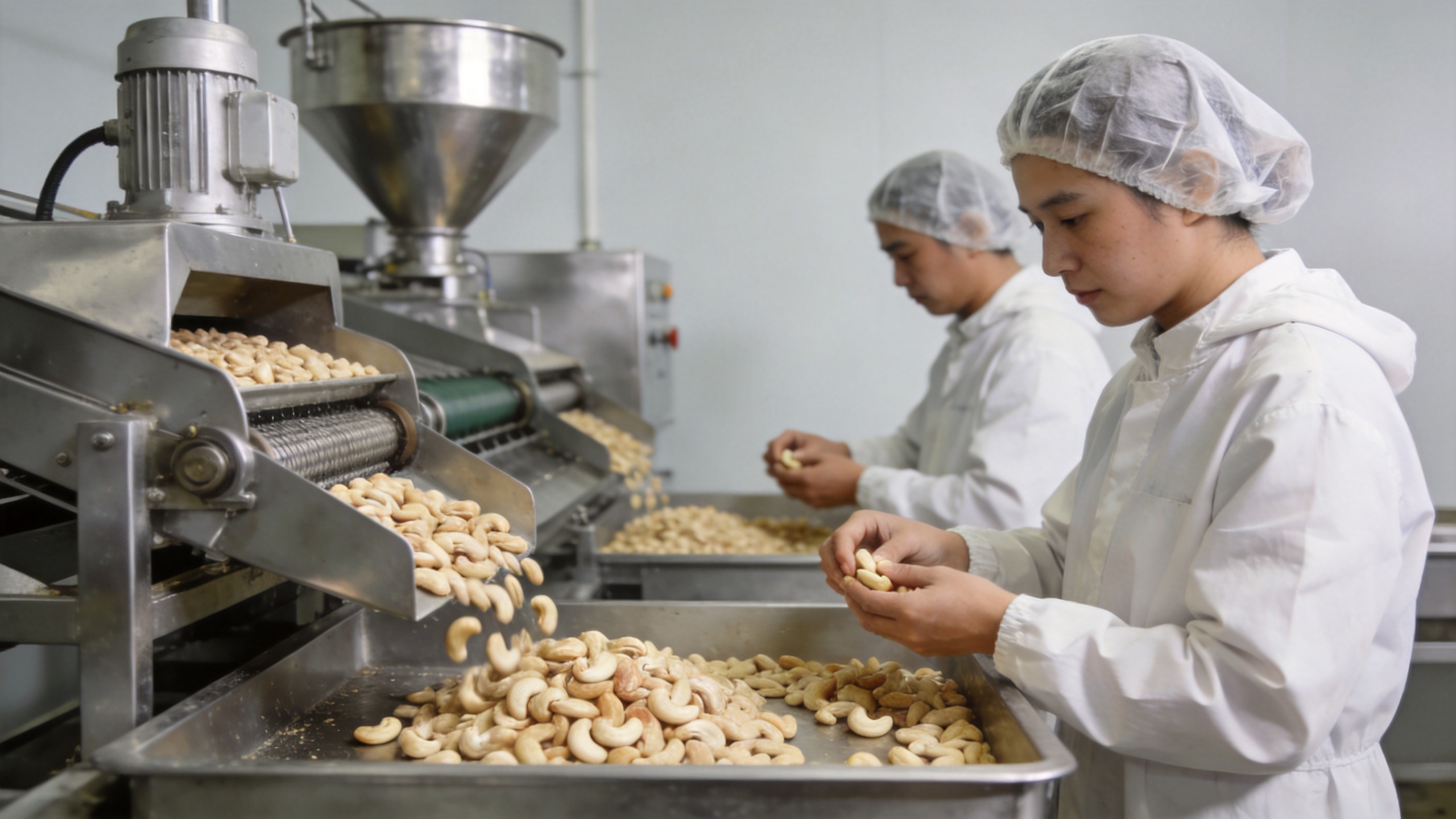
Cashew kernels are food products, so equipment design must support the hygiene and traceability practices of the plant. Food-safety guidance for cashew processing commonly emphasizes cleanliness, contamination control, pest prevention, and traceability. Those needs translate into equipment questions rather than generic promises.
- Which product-contact areas can be accessed for inspection and cleaning?
- How are skins, dust, and product fragments collected and removed?
- What cleaning procedure and cleaning frequency does the supplier recommend?
- Which materials, finishes, and electrical protections are specified for the planned plant environment?
- What records, manuals, and spare-parts identification will support your traceability process?
Ask for drawings and cleaning instructions early. A kaju peeling machine that is difficult to open, inspect, or clean can impose costs every shift. Where export requirements or customer audits apply, align the request with the standards your business already follows instead of assuming a generic certification statement covers the need.
Compare the total ownership cost, not only the purchase price
The lowest initial offer is not automatically the lowest-cost option. With a kaju peeling machine, the real comparison includes energy use, wear parts, expected replacement intervals, labor around feeding and sorting, cleaning time, commissioning support, and the cost of a stoppage when a critical component is unavailable.
Build a side-by-side comparison sheet with the same headings for every vendor. Include delivery scope, installation boundaries, spare-parts list, electrical requirements, training, remote support, warranty terms, response expectations, and exclusions. This approach makes it easier to identify a quotation that appears inexpensive only because it leaves essential work outside the scope.
For buyers in export markets, clarify packaging, shipment preparation, documentation, and the route for obtaining service support. Those items are especially important when the machine is part of a wider automation project and site access is limited.
Use a supplier acceptance checklist
Before placing an order for a kaju peeling machine, convert the evaluation into acceptance points that both sides can understand. A good checklist is concrete enough to prevent surprises without pretending that every operating condition is identical.
- Process fit: Confirm the upstream conditioning method, kernel grades, feed arrangement, and downstream handoff.
- Trial plan: Agree on representative samples, test conditions, measurement method, and review criteria.
- Scope clarity: List what is included in the machine, controls, auxiliaries, installation, training, and commissioning.
- Quality controls: Define how peel removal, breakage, rework, and visual quality will be evaluated.
- Hygiene: Review access, cleaning instructions, waste handling, and documents needed for plant procedures.
- Support readiness: Confirm manuals, recommended spares, warranty, service channels, and escalation contacts.
- Commercial terms: Match payment milestones to drawings, test evidence, shipment, installation support, and agreed acceptance.
Make the final decision around your line, not a generic ranking
There is no universally suitable kaju peeling machine for every processor. The right choice is the one that matches your product mix, process discipline, staffing plan, quality target, and support capability. A smaller, well-supported unit that fits the line can be a better investment than a higher-rated model that creates rework or maintenance dependency.
Use supplier discussions to obtain clear evidence: process drawings, a defined scope, a representative trial, hygiene information, and support commitments. When those items are documented before purchase, your team can compare proposals on the factors that most affect stable production rather than on price or headline capacity alone.