EN


Mango Processing Machine: Planning a Pulping Line from Receiving to Extraction
A mango processing machine is rarely a single unit. For a processor preparing mango pulp, puree, or juice base, it is better understood as a connected line that protects fruit quality from receiving through extraction. The practical objective is simple: move clean, properly prepared fruit to the pulp section at a steady rate while keeping peel, seed, fiber, wash water, and product flow under control.
This overview helps project teams prepare for early process discussions. It follows the material path from receiving to extraction and highlights the questions that shape a workable line. The exact arrangement, capacities, hygienic design, and downstream treatment must be confirmed against the fruit variety, ripeness window, target product, utility conditions, and destination-market requirements.
Start the mango processing machine plan with the product and intake profile
Before comparing equipment, define what will enter and what must leave the line. Is the output a coarse pulp, a refined puree, a juice base, or a product intended for further concentration or filling? The answer changes the preferred screen configuration, extraction approach, buffer capacity, and downstream interfaces.
At receiving, record the expected daily tonnage, delivery pattern, fruit size range, maturity variation, and the proportion of damaged fruit likely to arrive. A line sized only for average throughput can become unstable when seasonal deliveries arrive in short peaks. The receiving area therefore needs enough staging space and a transfer rhythm that prevents fruit from waiting too long in unsuitable conditions.
- Define nominal and peak fruit input, not only annual output.
- Agree on how rejects, leaves, sand, and crates will be handled.
- Confirm whether manual sorting, mechanical sorting, or both are required.
- Map the cleaning-water supply, drainage route, and floor-wash access early.
These details help a supplier turn a general mango processing machine request into a realistic material-flow proposal rather than a disconnected list of equipment.
Build a stable front end: receiving, washing, and inspection
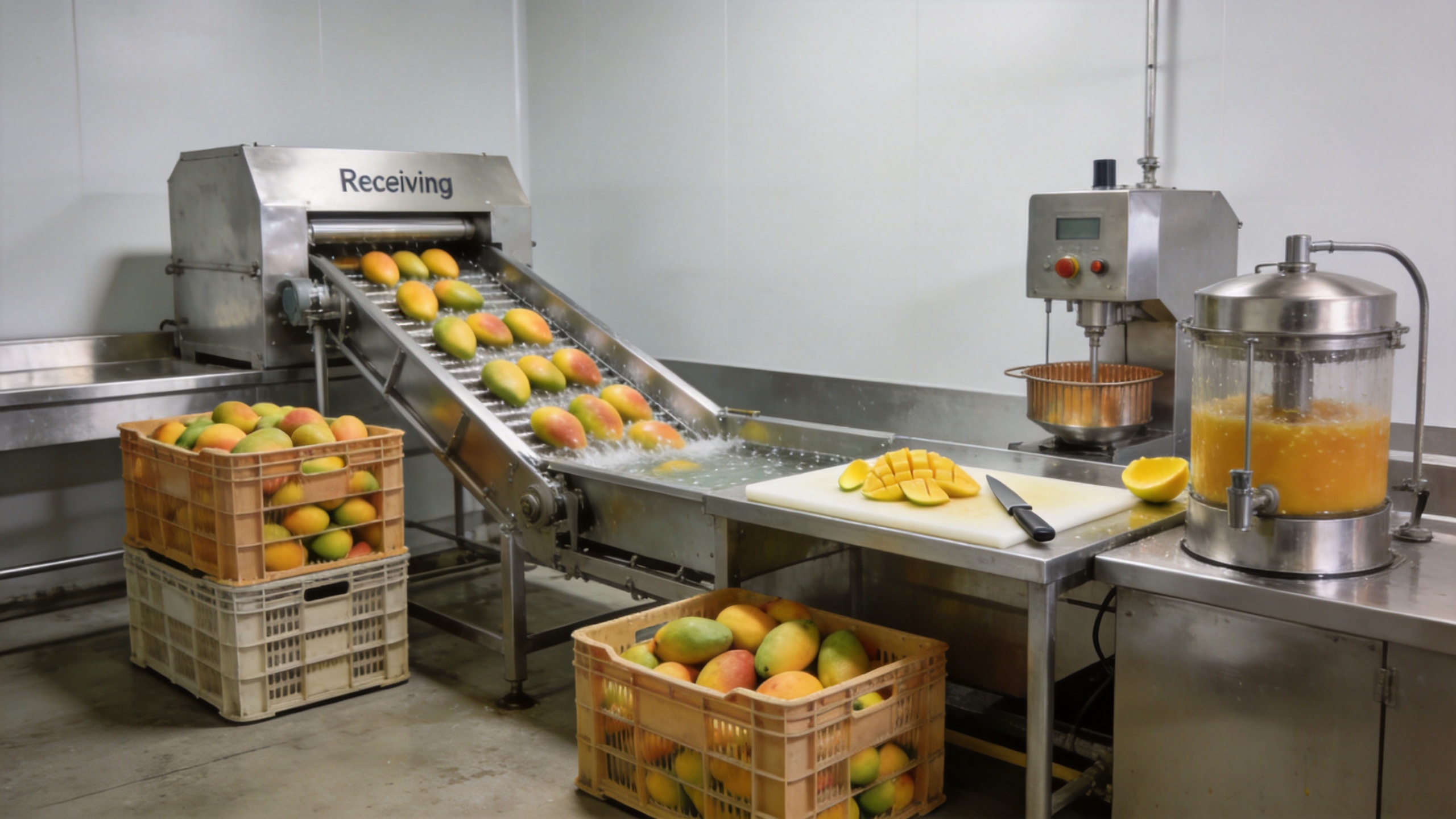
The front end of a fruit pulping line protects every later stage. A receiving hopper or unloading arrangement should feed the line smoothly without excessive drop height or fruit damage. Conveying then moves the mangoes through washing and inspection at a pace that operators can manage.
Washing is not just a visual-cleanliness step. It is where the project team must consider soil removal, water renewal, access for cleaning, and the separation of incoming fruit areas from cleaner product-contact zones. Inspection after washing gives operators a practical point to remove severely bruised, spoiled, or foreign material before it reaches cutting, destoning, or pulping equipment.
For mixed-lot processing, include a controllable buffer between washing and preparation. It gives the line a short operating cushion when fruit arrival or manual inspection varies. The goal is not to store fruit in process; it is to avoid starving or overfeeding the next machine.
Prepare the fruit for clean destoning and pulping
Mangoes bring a large stone, peel, and fibrous flesh to the process, so preparation must support the extraction method. Depending on the process concept, the line may include sorting, cutting or crushing, softening, and a controlled feed into the pulping section. The correct sequence depends on fruit condition and the desired texture, not on a generic layout.
A key planning question is where to separate non-pulp material. If peel, seed, and coarse fiber are not managed consistently, they can overload screens, reduce pulp consistency, and create unstable product flow. In early discussions, specify the intended pulp texture, acceptable fiber level, and how the plant will collect and remove by-products.
Teams should also consider access around the fruit-preparation area. Mango residues can be sticky and fibrous, so cleanability, drainage, removable guards, and safe maintenance clearance are operational requirements—not finishing details.
Choose the fruit pulper machine around product flow, not just capacity
The fruit pulper machine is the core separation stage in many mango lines. Its role is to separate usable pulp from seeds, peel, and coarse material while keeping the flow stable enough for later refining or extraction. A quoted hourly capacity is useful, but it is not sufficient for selection.
Ask how the fruit pulper machine will be fed, what screen or rotor options are available, how product-contact parts are accessed, and how the unit connects to upstream preparation and downstream tanks. A pulper that runs well in isolation can still become a bottleneck if feeding is uneven or if by-product discharge interferes with the layout.
| Planning point | Why it matters | Question to clarify |
|---|---|---|
| Feed consistency | Reduces surging and uneven separation | What buffer or feed-control method will be used? |
| Screen selection | Influences texture and fiber carryover | Which product specification is the screen chosen for? |
| By-product outlet | Supports continuous removal of peel and stones | Where will reject material go without crossing clean routes? |
| Cleaning access | Supports sanitation and changeover | Which components can be opened or removed for inspection? |
Connect extraction, transfer, and product stabilization as one process
After pulping, the process may include refining, blending, deaeration, heat treatment, holding, or transfer to the next production area. Published work on mango pulp notes that pasteurization is used to target heat-resistant enzymes such as pectin methylesterase and peroxidase. That is a useful reminder that the extraction section should be planned with downstream stabilization in mind, while final time-and-temperature conditions are validated for the actual product and process.
Use closed, cleanable transfer paths where the process design calls for them, and size intermediate tanks to absorb normal operating variation without creating excessive hold time. The matched Food-Grade Screw Press for Fruit & Vegetable Processing can be reviewed as a related mechanical separation option when the material balance and product specification justify a press stage. The final configuration should be verified against the intended mango product rather than inferred from a product title alone.
For projects serving juice markets, food-safety planning should be incorporated from the layout stage. For example, U.S. juice processors must evaluate applicable Juice HACCP requirements. The exact obligations depend on the product and destination, so the project team should confirm its control plan, validation approach, traceability records, and sanitation procedures with qualified food-safety personnel.
Use a process brief to make supplier discussions productive
The fastest way to improve a line proposal is to provide a concise process brief. It allows a supplier to review the interfaces between receiving, fruit preparation, pulping, extraction, and downstream treatment instead of quoting isolated machines.
- State the fruit type, ripeness range, and expected inlet tonnage.
- Describe the desired pulp, puree, or juice-base specification.
- Identify peak-season operating hours and target line availability.
- Share available utilities, floor space, drainage, and cleaning expectations.
- List the destination market and any required food-safety or documentation standards.
- Request a flow diagram showing product, waste, cleaning, and operator paths.
With this information, a mango processing machine proposal can be evaluated as a complete pulping workflow. The result is a clearer path from fruit receiving to extraction, fewer late-stage layout conflicts, and a stronger basis for deciding what equipment belongs in the line.
Line-planning questions to document before finalizing equipment
Use the following review points to turn a preliminary mango processing machine concept into a supplier-ready brief. For each stage, note who owns the decision, what acceptance criteria apply, and how the mango processing machine will be cleaned, inspected, and connected. This keeps the mango processing machine layout tied to actual production needs.
- Receiving: Will the mango processing machine accept peak deliveries without damaging fruit or blocking inspection?
- Washing: Does the mango processing machine arrangement separate incoming dirt from clean product routes?
- Preparation: Can the mango processing machine feed be controlled when fruit size and ripeness change?
- Pulping: Is the fruit pulper machine specified for the required texture, fiber level, and waste discharge?
- Interface: Does the fruit pulper machine receive fruit evenly and pass pulp at a stable rate?
- Cleaning: Can the fruit pulper machine be opened, drained, and inspected within the plant sanitation routine?
A review team can also walk the line in sequence: mango processing machine receiving, mango processing machine washing, mango processing machine preparation, fruit pulper machine separation, and the transfer equipment after the fruit pulper machine. This simple walkthrough reveals where an operator needs access, where a mango processing machine needs a buffer, and where a fruit pulper machine needs room for by-product removal.
During quotation review, compare the stated mango processing machine capacity with the fruit pulper machine capacity, feed conditions, cleaning access, utilities, and downstream holding volume. A mango processing machine line performs more reliably when the fruit pulper machine is matched to upstream flow rather than selected alone. Documenting these points early helps the mango processing machine proposal stay practical through installation and commissioning.