EN


Mushroom Washing Machine Guide: Protecting Delicate Produce During Cleaning
Mushrooms look sturdy until a wash process proves otherwise. Their exposed gills, thin skins, and variable moisture make them easy to bruise, tear, or waterlog. For a processor, a commercial vegetable washing machine is therefore not simply a dirt-removal station. It is a controlled handling step that must balance clean surfaces, throughput, drainage, and product appearance.
This guide explains how to assess a commercial vegetable washing machine for mushrooms and similarly delicate produce. The key is to treat water movement, loading, dwell time, transfer points, and post-wash drainage as one connected process rather than isolated settings.
Why mushrooms need a tailored washing approach
A commercial vegetable washing machine that works well for firm root vegetables can be too forceful for mushrooms. The cap can scuff when pieces collide, stems can break at abrupt transfers, and excessive contact time can leave product carrying unnecessary surface moisture. These outcomes reduce visual quality and may complicate downstream packing.
Water itself is not the enemy. Food-safety guidance for mushrooms notes that water is sufficient for washing; the operational question is how clean water reaches crevices without creating harsh impact or extended soaking. In practice, the right commercial vegetable washing machine combines gentle removal of substrate with stable, repeatable product flow.
Start with product condition and load consistency
Before selecting settings, classify the incoming mushrooms. Are they whole or sliced? Are cap sizes relatively consistent? Is loose substrate light and dry, or is soil lodged near stems? A commercial vegetable washing machine cannot compensate for an inconsistent feed that overloads one side of the wash zone and leaves another side nearly empty.
- Use shallow, even loading. A single controlled layer reduces product-on-product impact.
- Separate fragile grades where practical. Small buttons and larger open-cap mushrooms may not tolerate the same movement.
- Remove obvious damaged product first. Soft or broken pieces can increase debris in recirculated water and complicate inspection.
- Run trial batches. Check caps, stems, residue removal, and drained weight before committing to a production setting.
These checks make the commercial vegetable washing machine easier to tune because the process team is evaluating a stable product condition rather than reacting to changing loads.
Control water movement before increasing wash time
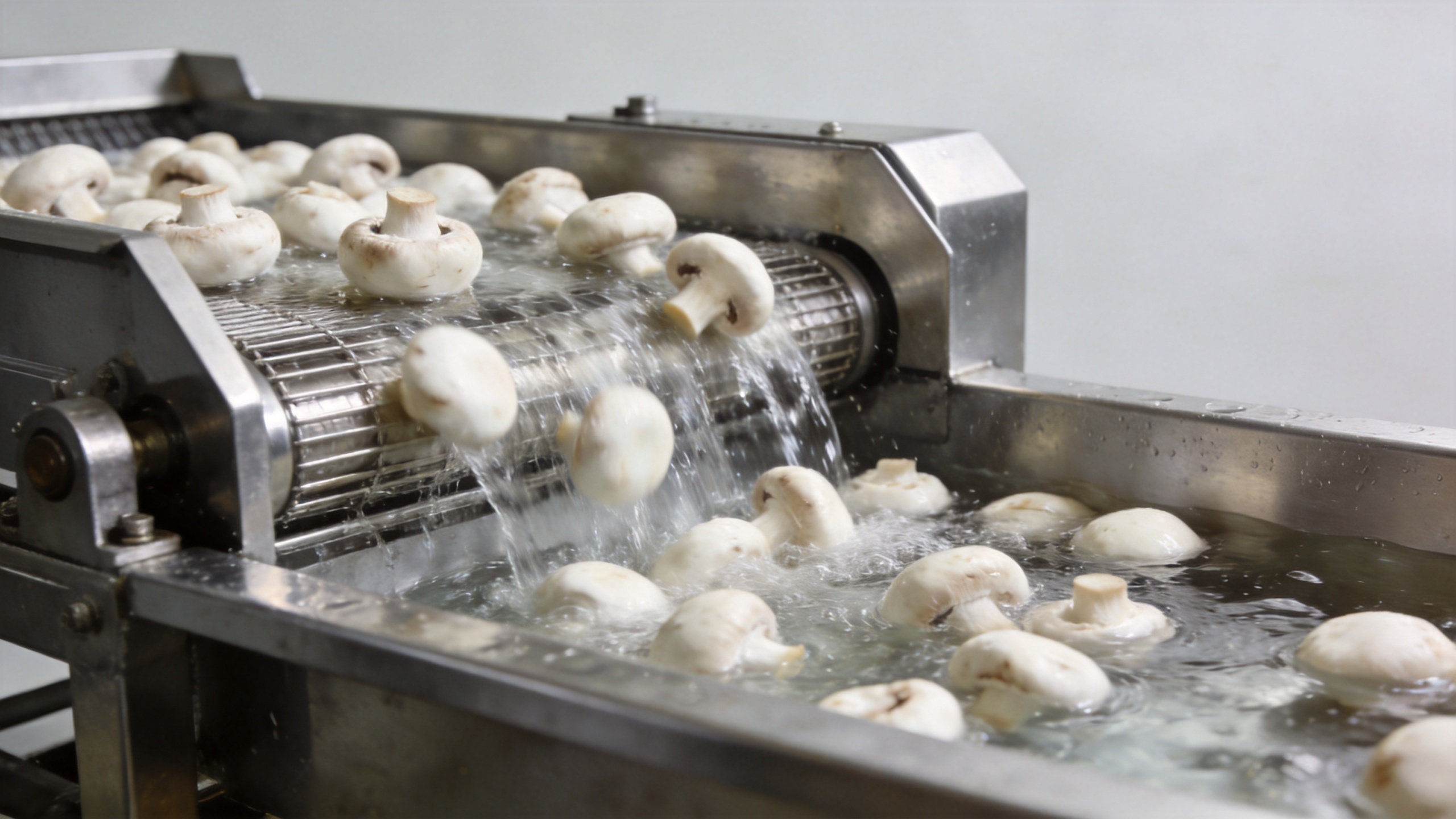
For delicate produce, the most useful question is not “How much force can the machine generate?” but “What is the mildest movement that releases the soil?” A commercial vegetable washing machine may use bubbles, water circulation, sprays, or a vortex-style action. Each approach should be assessed for how it moves the mushroom through the water and how often it drives product into guides, walls, or other pieces.
Begin with low-intensity water movement and short exposure. Increase only one variable at a time: flow, air input, spray coverage, or dwell time. If cleanliness is still inadequate, investigate feed preparation and water condition before simply making the commercial vegetable washing machine more aggressive. Longer or stronger washing is not automatically better when caps are easily marked.
Watch the transfer points
Damage often appears outside the wash chamber. The entrance chute, belt handoff, dewatering section, and collection bin can all create drops or pinch points. During a trial, follow a marked sample through the entire commercial vegetable washing machine line. If marks occur after washing, changing the wash setting will not fix the root cause.
Make drainage part of the cleaning design
Freshly washed mushrooms need controlled water removal, not rough handling. A commercial vegetable washing machine should feed a gentle drainage stage with adequate time for free water to leave the surface. Product that reaches packaging wet may show reduced visual appeal and can make pack weights less consistent.
For commissioning, weigh a representative sample before washing, after washing, and after the intended drain interval. Compare cap breakage, visible residue, and surface moisture at each point. This simple record gives operators a repeatable way to decide whether the commercial vegetable washing machine is balancing cleanliness and handling rather than relying on visual impressions alone.
Review the process as a sequence: wash, drain, inspect, then pack. Avoid stacking wet mushrooms deeply while they wait. If a dewatering function is included, validate it with the actual mushroom variety and packaging format; a setting suitable for sturdier vegetables may be unsuitable for delicate caps.
Keep wash water under control
Water management protects both process reliability and product quality. A commercial vegetable washing machine needs a defined routine for removing debris, refreshing water, and monitoring the conditions required by the facility’s food-safety program. Targeted produce-wash guidance also highlights that organic load and pH can affect treatment performance, so processors should validate their approach against local regulations, approved chemistry labels, and their own hazard controls.
For mushrooms, avoid assuming that more additives or longer immersion automatically delivers a better result. Use the commercial vegetable washing machine with potable water and documented sanitation procedures appropriate to the operation. Record what is checked, how often it is checked, and what triggers corrective action.
A practical purchase and commissioning checklist
| Question | Why it matters for mushrooms |
|---|---|
| Can wash intensity be adjusted in small steps? | A commercial vegetable washing machine needs room for gentle trials rather than all-or-nothing action. |
| Are infeed and discharge heights controlled? | Lower-impact transfers help protect caps and stems. |
| Can operators access screens and cleaning areas? | Easy debris removal supports consistent water management. |
| Can the line be trialed with your product? | Actual mushroom condition provides the most relevant test of handling quality. |
| Does the downstream layout allow drainage and inspection? | A commercial vegetable washing machine performs reliably as part of a complete handling line. |
When reviewing equipment, ask suppliers to discuss the process rather than promise a universal setting. Hongle Machinery supplies food-processing equipment, including fruit and vegetable washing solutions. For a product-specific discussion, review the vegetable and mushroom washing machine solution alongside your capacity, product condition, and drainage requirements.
Final takeaway
A suitable commercial vegetable washing machine for mushrooms is not defined by maximum turbulence. It should remove soil consistently while limiting collisions, avoiding unnecessary soaking, maintaining manageable water conditions, and delivering product to a calm drainage stage. Begin with a gentle trial, inspect the full route from infeed to packing, document the setting, and adjust based on evidence from the mushrooms in front of you.