EN


Onion Dryer Machine: How to Choose Capacity and Airflow for Dehydration
Buying an onion dryer machine is not mainly a question of selecting the largest listed throughput. For a processor of flakes, slices, granules, or powder feedstock, the practical decision is whether the dryer can remove the required water at a stable rate while keeping airflow even across every tray or belt zone. A machine that looks oversized on paper can still become the bottleneck if the loading depth, exhaust path, or upstream slicing rate is mismatched.
As a technical adviser for industrial equipment selection, I recommend starting with the product and process conditions, then checking the airflow path, and only then comparing machine size and price. This is particularly important for onion dehydration because incoming moisture, slice thickness, and seasonal raw-material variation all affect the real drying load.
Start with water removal, not the nameplate capacity
Ask suppliers whether the quoted capacity means fresh onion loaded per batch, fresh onion processed per hour, or finished dehydrated product per hour. These are not interchangeable figures. Begin with your planned daily fresh-onion intake, operating hours, incoming moisture range, target final moisture, and acceptable changeover time. The resulting water-removal duty is the basis for selecting an onion dryer machine.
For example, a line intended for one long production shift needs reserve time for loading, unloading, cleaning, and adjustment. The nominal capacity may be tested under continuous, ideal conditions; actual output depends on how consistently the slicer feeds the dryer, how evenly product is spread, and whether the exhaust can carry away moisture. In other words, choose useful capacity for your operating day, rather than simply buying the highest number on a quotation.
- Batch operations: calculate kilograms of fresh onion per batch and the number of batches that can realistically be completed.
- Continuous lines: match belt width, bed depth, residence time, and upstream preparation speed.
- Variable supply: leave a sensible operating margin if bulb size, solids, or inbound volume changes across seasons.
Why slice geometry changes the capacity decision
The same onion dryer machine will not process every onion format in the same way. Thin, uniform slices expose more surface area and generally dry more predictably than irregular pieces or deep beds. If your product mix includes rings, flakes, diced onion, or a pre-drying step for powder production, define the thickest material and the most demanding batch before specifying the dryer.
Research summarized in Onion dehydration: a review discusses onion drying with air temperatures commonly in the 50–80°C range. It also reports that drying rate is influenced by temperature, air velocity, and air humidity. Those figures are useful design context, not a universal recipe: the final profile should be verified with your onion variety, cut size, loading depth, and quality target.
A useful supplier discussion should therefore include sample material, proposed tray loading or belt-bed depth, expected residence time, and the method used to confirm final moisture. If those points are absent, the proposed capacity has not yet been tied to your process.
Choose airflow for uniformity, not fan size alone
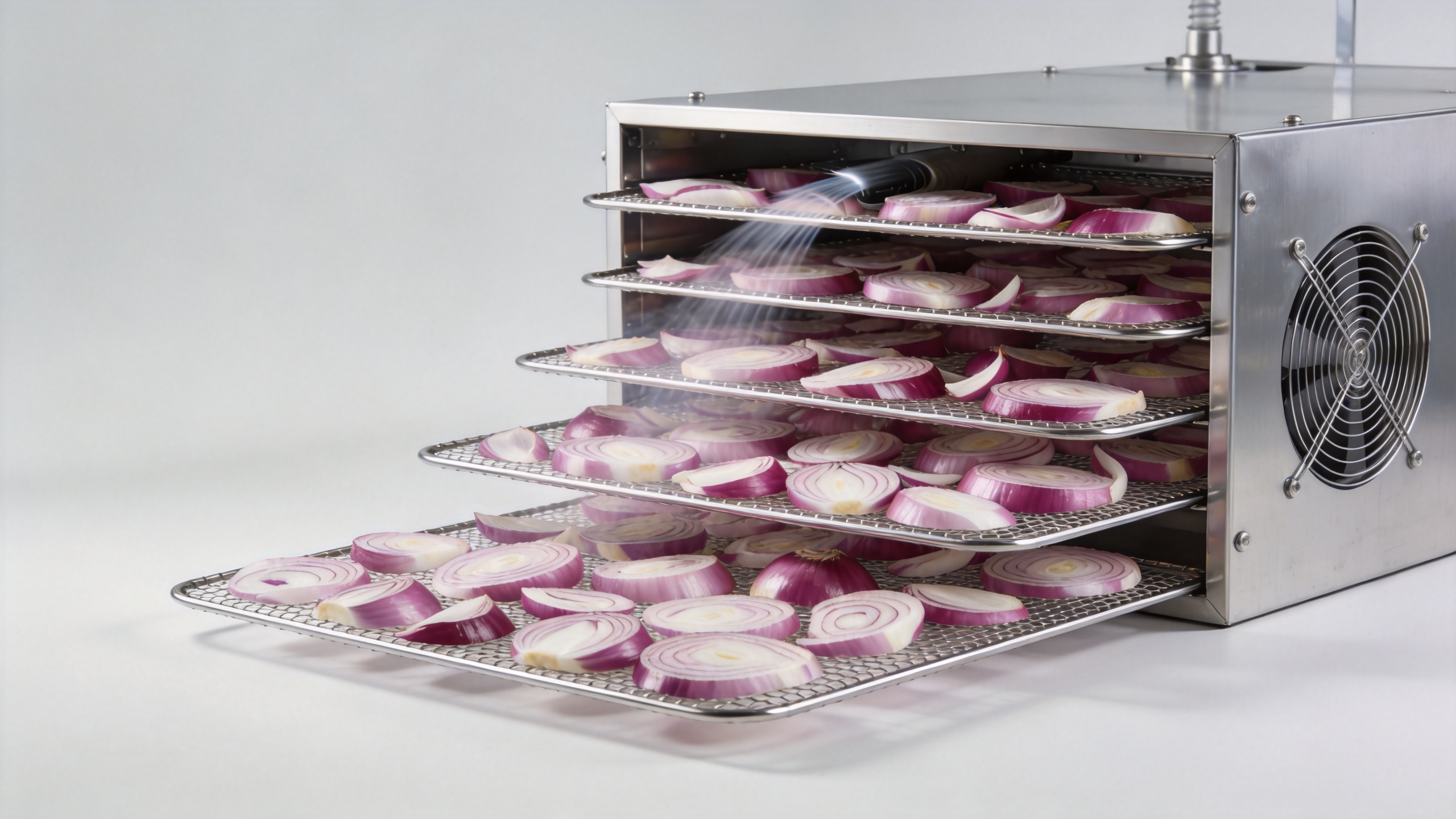
Airflow is often presented as a fan motor rating or a total air-volume figure. Neither tells the whole story. For an onion dryer machine, what matters is the air velocity and temperature that reach the product, the pressure available to overcome the bed resistance, and the distribution pattern from inlet to outlet.
The same review describes sliced-onion studies using air velocities in ranges such as 0.6–1.5 m/s and notes that increased air velocity can raise drying rate, while wetter drying air reduces it. But adding airflow indefinitely is not the answer. Excess velocity can create uneven movement, carry light fragments, increase fan energy, or dry exposed surfaces faster than material in denser zones. A well-designed plenum, balanced ducts, and controllable exhaust are usually more valuable than simply selecting a larger fan.
| Airflow question | What to verify | Why it matters |
|---|---|---|
| Distribution | Inlet layout, baffles, and airflow direction through trays or belt zones | Helps prevent wet pockets and uneven color. |
| Pressure | Fan static-pressure allowance at the planned bed depth | Shows whether air can pass through loaded product, not just an empty chamber. |
| Exhaust control | Damper, humidity monitoring, and fresh-air/recirculation strategy | Supports removal of moisture-laden air instead of recirculating it excessively. |
| Adjustability | Variable fan speed or zone control where appropriate | Lets operators respond to product and loading changes. |
Use a staged drying profile when quality requires it
Onions may not benefit from one fixed temperature and one fixed airflow setting from start to finish. At the beginning, the product presents a heavier moisture load; later, the process becomes more sensitive to final moisture consistency, color, aroma, and breakage. Research summarized in the onion-dehydration review includes multi-stage drying approaches, which reinforces a practical selection point: ask whether the dryer allows zones, adjustable temperature, or controlled airflow rather than assuming one condition suits the whole cycle.
This does not mean every plant needs a complex multi-zone system. If your production is stable and the product range is narrow, a simpler configuration can be easier to operate and maintain. The right choice depends on the quality tolerance, the degree of automation available, and how often the product format changes.
Match the dryer to the rest of the onion line
Capacity is only credible when it connects to washing, peeling, slicing, conveying, cooling, inspection, and packing. A dryer can have adequate heat and airflow yet sit idle because the slicer cannot maintain an even feed, or because operators must repeatedly stop the line to clear product buildup. Before finalizing an onion dryer machine, map the target hourly flow across the complete line.
For processors evaluating a broader vegetable-dehydration setup, the Industrial Drying Vegetable Dryer Fruit Drier Machine Dehydrator Automatic can be reviewed as a product-category starting point. Confirm the final configuration, utility conditions, controls, and performance expectations with the supplier against your actual onion samples; a product title alone is not a performance specification.
A practical acceptance checklist for an onion dryer machine
- Define fresh-onion intake, target finished output, working hours, and planned downtime.
- Document slice thickness, product format, incoming moisture range, and final moisture specification.
- Request a capacity calculation that separates fresh feed, water removed, and finished output.
- Review airflow direction, fan static pressure, zone layout, exhaust path, and adjustment controls.
- Agree on a sample test and a measured acceptance method for moisture uniformity, color, and throughput.
- Check cleaning access, wear parts, operator training, and remote technical support before signing.
Questions to put on every quotation
Use the same questions when comparing proposals for an onion dryer machine. Can the onion dryer machine demonstrate performance with your specified slice thickness and load? Does the onion dryer machine have documented airflow direction and exhaust control? Can the onion dryer machine be adjusted when the bed depth changes?
Also confirm how the onion dryer machine connects with washing and slicing equipment, which utilities the onion dryer machine requires, and how the onion dryer machine will be tested at acceptance. These questions keep an onion dryer machine comparison focused on usable dehydration performance.
Conclusion: select for stable dehydration, not maximum headline output
A suitable onion dryer machine is one that matches your real water-removal duty and distributes conditioned air consistently through the product bed. Start with material and production targets, validate airflow at the loaded bed, and make sure the dryer fits the pace of the whole line. That approach gives you a stronger basis for comparing configurations than headline capacity alone.