EN
EN


Peanut Butter Production Line: Complete Buyer's Guide for Food Factories
When I was responsible for sourcing a peanut butter production line for a mid-size food manufacturer, the first thing I learned was this: the supplier's equipment list tells you what they sell — it rarely tells you what you actually need. The peanut butter market was valued at USD 5.70 billion globally in 2021, and demand from food factories in Africa, Southeast Asia, and beyond has only grown since. That growth has brought more equipment suppliers and more configuration options — but also more ways to make an expensive mistake.
This guide is written from a procurement standpoint. It won't push you toward any single brand or setup. Instead, it walks you through the key decisions that determine whether a peanut butter production line works for your factory — or costs you twice as much to fix over the first two years of operation.
What a Complete Peanut Butter Production Line Actually Includes
A full peanut butter production line converts raw peanuts into finished, packaged product through a series of linked machines. The standard process flow looks like this:
- Roasting — A continuous roaster heats raw peanuts to develop flavor and reduce moisture
- Cooling — Conveyor cooling brings the roasted peanuts to processing temperature
- Peeling (Red Skin Removal) — Dry pneumatic or roller peeling removes the inner skin
- Grinding — One or two-stage grinding produces the butter base; finer grinding requires two passes
- Mixing — An agitated mixer incorporates stabilizers, salt, sugar, or other additives
- Vacuum Degassing — Removes trapped air bubbles to improve product texture and shelf stability
- Filling & Sealing — Automatic or semi-automatic filling into jars, pouches, or buckets
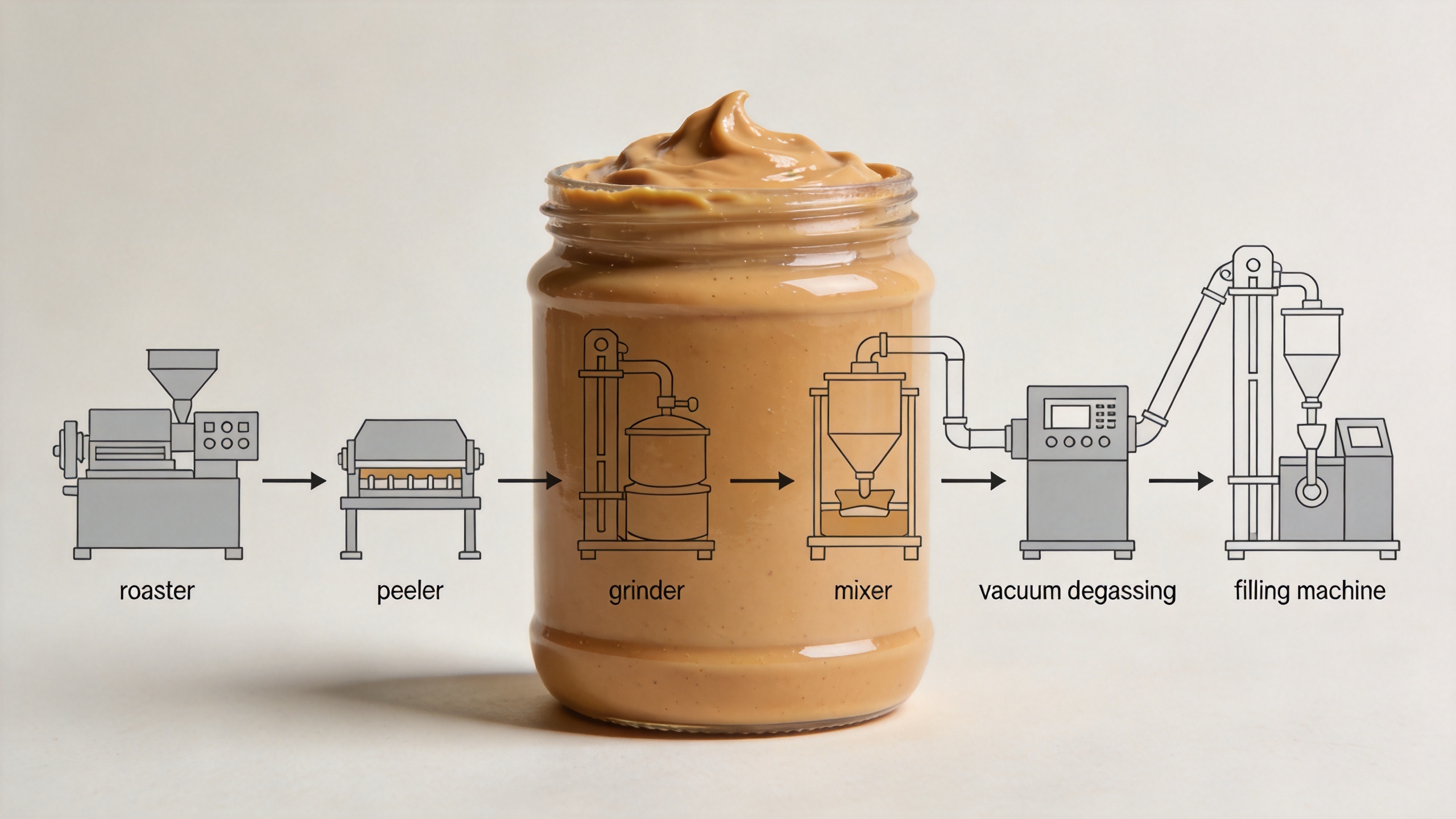
Not every peanut butter production line includes all seven stages out of the box. If a supplier quotes you "a peanut butter machine," clarify whether the vacuum degassing unit is included — it's one of the stages buyers most often skip initially and then wish they hadn't when product shelf stability becomes an issue.
Step 1: Define Your Production Capacity Before Anything Else
The most common mistake I see is buyers anchoring on price before defining capacity. A peanut butter production line can range from small-scale systems at 50–100 kg/h all the way to industrial lines exceeding 1,000 kg/h. Getting the capacity wrong — either too low or unnecessarily high — affects your economics from day one.
Here's a practical reference table for peanut butter production line sizing:
| Scale | Capacity | Typical Use Case | Approx. Price Range (USD) |
|---|---|---|---|
| Small / Entry | 50–100 kg/h | Local brand launch, market testing | $5,000–$8,000 |
| Small–Medium | 100–200 kg/h | Regional distribution, growing SME | $20,000–$40,000 |
| Medium–Industrial | 500 kg/h | Contract manufacturing, export volume | $50,000+ |
| Industrial | 1,000+ kg/h | Large-scale factory, multi-shift operation | Custom quote |
The capacity figures listed by suppliers are measured under ideal conditions — continuous raw material feed, consistent peanut moisture, no changeover time. In practice, batch changeovers, cleaning cycles, and equipment warm-up time all reduce effective output. A peanut butter production line rated at 200 kg/h may deliver 160–170 kg/h in practice. That gap matters when you're building production schedules to fulfill firm orders.
Step 2: Manual, Semi-Automatic, or Fully Automatic?
The automation level decision is tightly tied to labor cost in your region and your target product volume — not just to what looks most impressive in a supplier video.
A manual or semi-automatic peanut butter production line at 50–100 kg/h makes sense if you're testing a local market, labor costs are low, and you want flexibility for small custom batches. A fully automatic line at 500 kg/h or above is designed for consistent volume output, lower per-unit labor cost, and strict hygiene compliance. The tradeoff: it requires trained operators, a more stable raw material supply, and a longer return-on-investment window.
If your factory is in an early growth phase, there's nothing wrong with starting at a smaller scale — as long as the peanut butter production line you buy can be upgraded or paired with additional units later. Ask suppliers specifically about modularity before you commit.
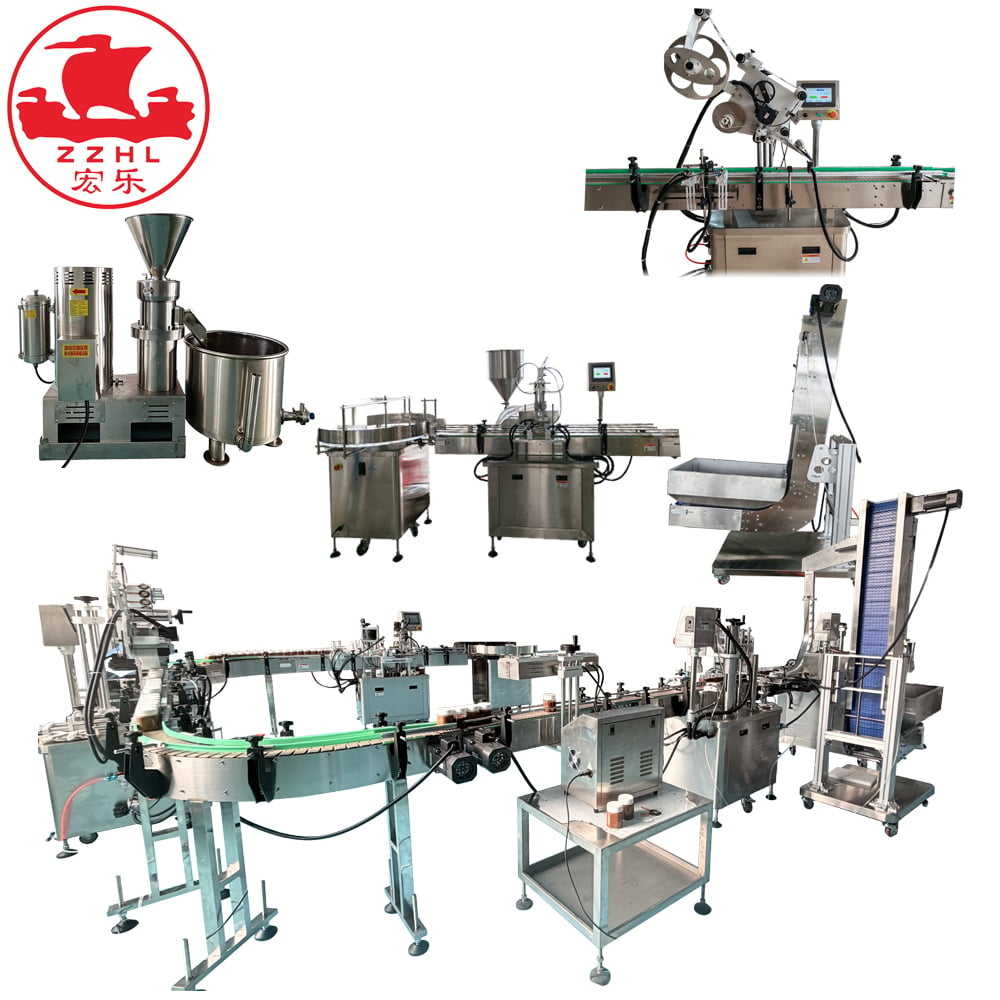 Equipment scale ranges from manual 50–100 kg/h setups to fully automatic industrial lines exceeding 500 kg/h.
Step 3: Plan Your Budget Around Total Cost, Not Just Equipment Price
I've seen buyers negotiate hard on machine price and then be surprised by the operating cost structure. For peanut butter production, raw materials (primarily peanuts, stabilizers, packaging) typically account for 70–80% of operating expenditure. The equipment purchase is a one-time capital cost; what determines your long-term margin is how efficiently the peanut butter production line runs and how much you spend maintaining it.
A well-specified line with good technical support can achieve gross margins in the range of 30–40%, with net profit margins of 12–18% — but those figures assume the equipment runs reliably. Downtime caused by a mismatch between line components, or by the unavailability of spare parts, erodes margin faster than most buyers anticipate going in.
Step 4: What Overseas Buyers Frequently Get Wrong
If your factory is in Africa, Southeast Asia, or another region where local engineering service is limited, the after-sales question deserves more weight than the equipment spec sheet. Specifically:
- Spare parts lead time: Ask the supplier how they handle replacement parts — express shipping, regional warehouses, or on-site stocking recommendations. A worn-out grinding disc that takes 8 weeks to arrive is a production crisis.
- Remote technical support: Video-guided commissioning has become a baseline expectation from established suppliers. Verify that they've done it before — ideally for buyers in a market similar to yours.
- Certification requirements: If you're producing for export — particularly to the EU or regulated African markets — confirm that the equipment supports the hygiene standards required (stainless steel food contact surfaces, washdown-safe motors, certifications your market requires). This is easier to specify before purchase than to retrofit after.
Production line compatibility is another area buyers often discover too late. If you're adding a peanut butter production line to an existing facility with a specific electrical standard, water supply configuration, or limited floor space, share those constraints with the supplier in writing before signing. The mismatch between a supplier's standard configuration and a buyer's actual facility conditions remains one of the most common post-purchase frustrations.
Key Questions to Ask Any Supplier Before Buying
- What is the actual tested output (kg/h) of the peanut butter production line under your standard operating conditions?
- Is vacuum degassing included in the quoted line, or is it an optional add-on?
- What is the lead time for critical wear parts (grinding discs, seals, heating elements)?
- Can you provide a reference from a buyer in a similar market or operating environment?
- What commissioning support do you offer for overseas installations?
- What is the warranty period and what does it cover?
A supplier who struggles to answer these questions clearly is worth being cautious about — regardless of what the price looks like on paper.
Final Considerations
Choosing a peanut butter production line isn't just a procurement decision — it's a production infrastructure decision. Most of what this article covers is most relevant to buyers building small-to-medium scale operations for regional distribution or export. If your situation involves larger scale, highly regulated export channels, or specialized product formulations, your selection criteria will need to go deeper in some areas.
Take the time to define your capacity needs, understand your automation requirements, and ask hard questions about after-sales support before committing. The right peanut butter production line for your factory is the one that runs reliably, at the right volume, with the service infrastructure to keep it running — not necessarily the one with the lowest upfront cost.