EN


Peanut Butter Production Line Equipment: From Roasting to Vacuum Packing
Commercial peanut butter machines are rarely selected as one isolated grinder. A dependable line is a connected process: peanuts are cleaned, roasted, cooled, ground, blended, prepared for filling, and packed. Each handoff affects the next one. For a processor planning a new line or replacing manual work, the most useful question is not simply “Which machine makes peanut butter?” but “Which equipment sequence keeps product quality and production flow under control?”
From an industrial equipment advisory perspective, the practical priority is to map the material flow before comparing individual specifications. Throughput, peanut condition, recipe, desired texture, container type, and cleaning routine all influence how peanut butter machines should work together.
Start with a line map, not a single machine
A commercial peanut butter line commonly links roasting, cooling, grinding, mixing or holding, filling, and packaging. The exact layout changes with the factory’s capacity and product range, but the logic remains the same: each stage should supply the next without creating long waits, excessive handling, or difficult-to-clean bottlenecks.
For example, a grinder cannot deliver stable output if roasted peanuts arrive at inconsistent temperatures or with uneven roast development. Likewise, a filling station may become the constraint if the paste is not conditioned for consistent flow. This is why peanut butter machines should be planned as a process chain rather than as a list of separate purchases.
Roasting equipment sets the flavor and grinding starting point
Roasting is where the line establishes much of the final product’s aroma, color, and moisture condition. Batch or continuous roasting equipment may be appropriate depending on production rhythm, available space, and the level of process control required. The key is not to assume that a larger roaster automatically improves the line. Roast uniformity, discharge timing, and the ability to repeat a selected profile matter just as much.
When peanut kernels leave the roaster, they need a controlled transition to cooling and subsequent handling. If material reaches the grinder too hot or too unevenly conditioned, texture and flow can become harder to manage. In practice, the roaster, cooler, and conveying arrangement deserve to be assessed as one operating section.
Cooling, peeling, and conveying protect line continuity
Cooling reduces the temperature of roasted peanuts before downstream processing. Depending on the product specification, the line may also include skin removal, sorting, or inspection before grinding. These steps are easy to underestimate because they do not create the paste directly. Yet they can determine whether the grinder receives a consistent feed and whether operators must stop the line to deal with avoidable material variation.
Conveying equipment should match the factory’s layout and cleaning expectations. A short, well-designed transfer path is often easier to operate than a complicated arrangement with unnecessary elevation changes. If production volume varies substantially, it is sensible to examine buffer capacity and the controls that coordinate feed rates between roasting and grinding.
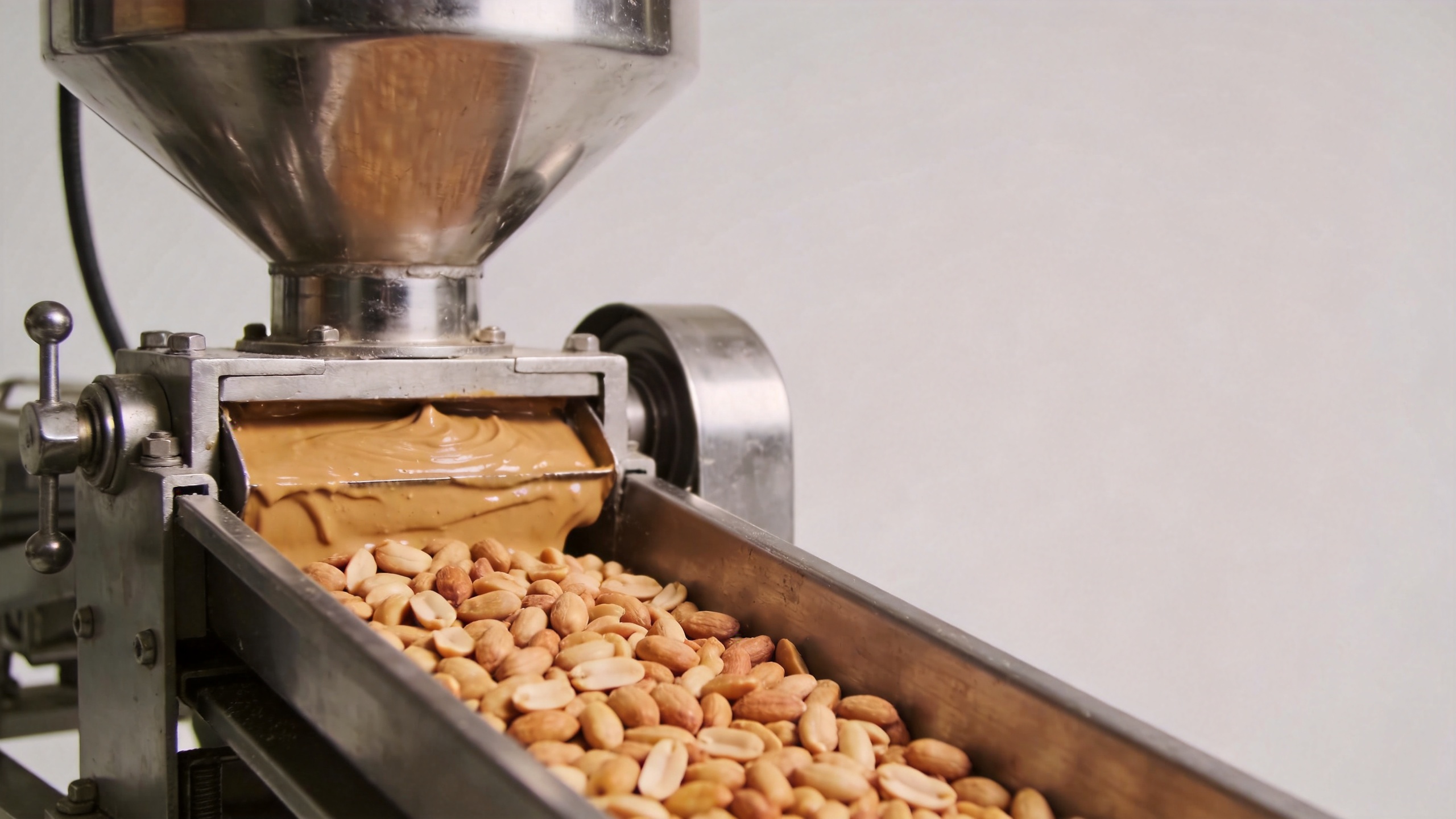
Grinding is the core of peanut butter machines
The grinding section turns roasted peanuts into peanut paste. Commercial peanut butter machines can be configured around the required production rate, texture, and recipe. Smooth and crunchy products may require different handling logic, and any added ingredients should be introduced only where the process can keep them evenly distributed.
A quoted output rate is a useful planning reference, not a complete production guarantee. Actual performance depends on factors such as peanut condition, recipe viscosity, target fineness, and the rest of the line’s feeding and filling rhythm. When comparing equipment, ask how the grinder integrates with upstream feed and downstream mixing rather than evaluating capacity in isolation.
For factories seeking a matched equipment option, the product page for an automatic peanut butter production machine for nut factories can serve as a starting point for discussing a production-line configuration. The final selection should still be verified against the planned process and package format.
Mixing and holding make the paste ready for filling
After grinding, the paste may require controlled mixing, blending, or holding before filling. This is the point where a factory can manage recipe additions and work toward a consistent batch. The right tank and transfer arrangement depends on the product formulation and the time the paste will remain in the system.
Food-contact construction, access for cleaning, and transfer stability are all relevant considerations. A practical line plan also allows operators to inspect the process without introducing unnecessary open handling. When the line will support more than one nut butter or different jar sizes, changeover and sanitation time should be considered early rather than added as an afterthought.
Vacuum packing and filling are part of product protection
Filling and vacuum packing close the production loop. Packaging equipment must work with the selected container, closure, production speed, and product flow characteristics. Vacuum-related processing can be considered where the product and packaging plan call for reduced air exposure or more consistent filling behavior; its benefit should be evaluated for the actual formulation and pack style rather than assumed as a universal requirement.
It helps to review the packaging section using real operating questions: What is the intended container? How will the product be transferred to the filler? What cleaning access is needed? Where will filled packs be inspected and packed for dispatch? A line that fits these answers is more likely to operate predictably than one assembled around a nominal machine capacity.
A practical checklist for production planning
- Define the expected output range and whether it is steady or seasonal.
- Specify the peanut preparation, roast profile, texture target, and recipe before choosing the grinding section.
- Match roasting, cooling, conveying, grinding, mixing, filling, and packing rates.
- Review food-contact materials, cleaning access, and changeover needs for the intended products.
- Confirm the package format and vacuum-packing requirement before finalizing the filler.
- Plan utilities, floor space, operator access, maintenance clearance, and export installation support as part of the proposal.
How to compare peanut butter machines by production stage
Use this stage-by-stage comparison before requesting a quotation for peanut butter machines:
| Line stage | What to review | How peanut butter machines fit |
|---|---|---|
| Roasting | Profile consistency and discharge timing | Peanut butter machines need evenly prepared feed. |
| Cooling | Material temperature and transfer time | Peanut butter machines perform more predictably with a stable handoff. |
| Grinding | Texture target and recipe behavior | Peanut butter machines should match the required paste quality. |
| Mixing | Batch consistency and sanitation access | Peanut butter machines must connect to the holding process. |
| Filling | Container, closure, and flow control | Peanut butter machines should not overload the filler. |
| Vacuum packing | Pack format and product-protection objective | Peanut butter machines need compatible packaging timing. |
In a commercial project, peanut butter machines should be evaluated as a linked set of functions. Comparing peanut butter machines by stage helps identify a missing conveyor, an undersized buffer, or a filler that cannot keep pace. It also makes supplier discussions more precise: instead of asking whether peanut butter machines are “good,” the buyer can ask whether the proposed peanut butter machines match the documented material flow.
For small or growing operations, peanut butter machines may be installed in phases. For a high-volume line, peanut butter machines are usually specified around coordinated automation, cleaning access, and packaging rhythm. In both cases, the right peanut butter machines are the ones that support the chosen process rather than force the process to fit a generic layout.
Build the line around the flow you need
Well-planned peanut butter machines help a factory move from roasted kernels to packed product through a controlled sequence. The most effective line is not necessarily the most complex one. It is the one whose roasting, grinding, paste handling, and vacuum-packing sections are sized and connected for the actual product, output target, and operating conditions.
Before committing to equipment, share the intended capacity, recipe, container type, and available floor plan with the supplier. That information makes it easier to evaluate a complete line arrangement and identify where configuration or support will matter after installation.