EN


Screw Press Juicer vs. Citrus Juicer: How to Match Extraction Equipment to Raw Materials
Choosing between citrus juicers and a screw press is less about picking a “better” machine and more about controlling what happens to the fruit. For a processing plant, raw-material shape, peel contact, fiber level, pulp specification, cleaning routine, and downstream separation all affect the right choice. A machine that performs well with oranges can be a poor first-stage extractor for pineapple pulp; likewise, a press that handles fibrous mash can introduce avoidable citrus peel contact when a clean not-from-concentrate product is the goal.
This guide takes a production-line view of citrus juicers. It compares dedicated citrus extraction with screw pressing so procurement teams can match equipment to feedstock and target output rather than relying on a generic yield claim.
Start With the Material, Not the Machine Category
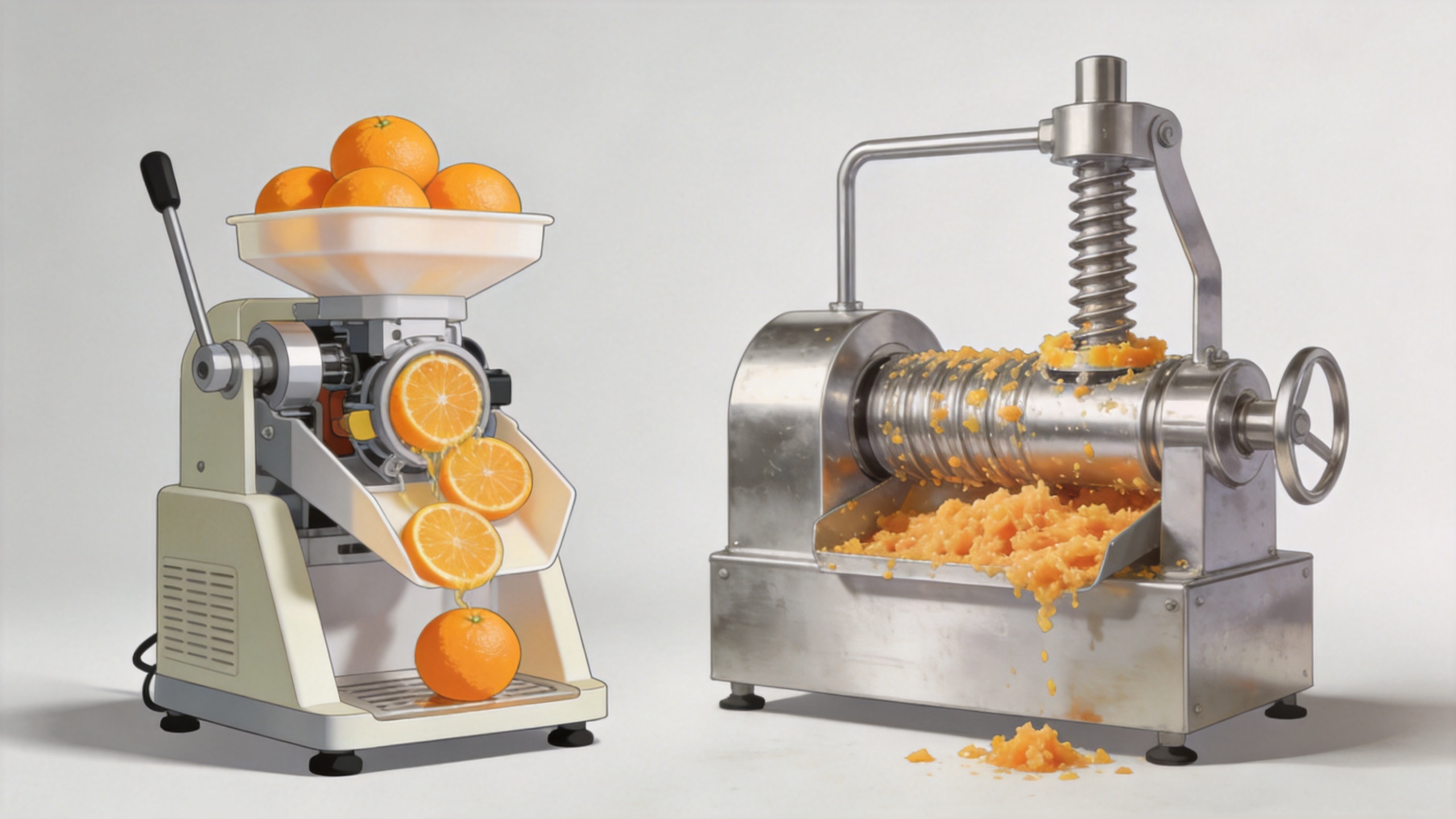
The first decision is whether the incoming material is whole citrus, peeled citrus, prepared fruit mash, or a high-fiber fruit-and-vegetable blend. Dedicated citrus juicers are designed around the anatomy of oranges, lemons, grapefruit, and similar fruit: juice sacs, peel oil glands, rag, seeds, and pulp must be managed as separate process streams. A screw press works differently. It conveys crushed or prepared material through a screen while compression and back-pressure express liquid from the solids.
That distinction matters. Whole citrus contains peel oils and bitter components that can influence flavor when peel is heavily damaged or held in contact with juice. For whole fruit destined for a clean citrus beverage, purpose-built citrus juicers usually provide better control over where juice, peel, core material, and oil-related streams go. For pulpy mango, pineapple, tomato, berries, grape pomace, or mixed vegetable material, screw pressing can be a more natural fit because the feed is already a mash and liquid recovery from fiber is part of the task.
When Dedicated Citrus Juicers Are the Better Match
Choose dedicated citrus juicers when your process starts with whole or halved citrus and the product specification places a high value on flavor cleanliness, controlled pulp, and separation of peel-derived material. Citrus-specific extractors are built to expose and squeeze juice-bearing sections while keeping the peel and core under separate control. This makes them especially relevant for orange juice, grapefruit juice, lemon juice, and lime juice lines where peel oil management is a routine operating concern.
In practical terms, dedicated citrus equipment is often the safer choice when:
- Fruit size sorting and feeding can be managed consistently.
- The plant needs a defined pulp level rather than a broad mash-based output.
- Peel oil, rag, seeds, and juice need separate downstream handling.
- The finished beverage is sensitive to bitterness, excess oil, or variable pulp texture.
- The line includes finishing, clarification, oil recovery, or other citrus-specific stages.
These citrus juicers do not remove the need for process control. Cup or fruit-size matching, extraction pressure, screen selection, and washing discipline still affect yield and product quality. But the equipment architecture starts from the right raw material: intact citrus fruit.
Where a Screw Press Creates More Value
A screw press is usually strongest after preparation has turned fruit or vegetables into crushable, pulpy material. It can support juice recovery from fibrous material, reduce moisture in by-products, or serve as a continuous recovery stage before finishing and separation. The output is often a juice-and-pulp stream rather than a finished beverage, so downstream equipment should be considered at the same time.
For example, a processor working with apple mash, pineapple pulp, grape pomace, tomato residues, leafy vegetables, or mixed produce waste may prioritize continuous dewatering and recovery from solids. In those cases, screw speed, screen opening, feed consistency, and back-pressure are central settings. More compression is not automatically better: excessive pressure may change pulp texture, raise solids in the liquid stream, or make cleaning harder.
If your line needs a screw-based extraction or dewatering stage for prepared fruit and vegetable material, review the confirmed Food-Grade Screw Press 80% Juice Yield 0.5-1T/H SUS304 for Fruit & Vegetable Processing alongside your actual feedstock trials. The product name identifies a screw-press option for fruit and vegetable processing; final suitability should be validated against your material, target capacity, and downstream process requirements.
Whole Citrus in a Screw Press: Understand the Trade-Off
A screw press can process citrus-derived material, but it should not be treated as a direct substitute for dedicated citrus juicers when whole fruit quality control is the priority. Whole-fruit pressing can express juice together with peel-related oil and finely damaged peel material. If the intended product is a premium, low-bitterness citrus juice, that can increase the burden on separation and quality control.
There are still valid use cases. A screw press may fit a line handling pre-peeled citrus, post-extraction pulp, processing residues, or a product designed to retain more fiber and pulp. It can also be part of a broader recovery system where peel oil and solids are deliberately processed downstream. The key is to define the target output first: clarified juice, pulpy juice, puree base, peel oil stream, animal-feed by-product, or wastewater-load reduction all imply different settings and auxiliary equipment.
Compare Output, Cleaning, and Line Integration
| Selection factor | Dedicated citrus juicers | Screw press |
|---|---|---|
| Recommended starting material | Whole or halved citrus | Crushed, pulpy, fibrous, or prepared material |
| Primary process goal | Controlled citrus juice extraction with stream separation | Continuous liquid recovery and dewatering from solids |
| Peel-management need | Central design consideration | Requires upstream preparation or downstream controls for citrus |
| Pulp behavior | Can be managed as part of a citrus-specific flow | Depends heavily on screen, compression, and finisher setup |
| Cleaning focus | Fruit-contact zones, extractors, finishers, and oil-related areas | Screw, screen, discharge zone, and retained fibrous solids |
| Line fit | Citrus extraction, finishing, clarification, oil recovery | Crushing, pulping, dewatering, by-product recovery, or finishing support |
Cleaning should be evaluated as a production issue, not an afterthought. Citrus juicers require routines that control fruit residue and oil-bearing material. Screw presses require access to screens, screws, discharge zones, and compacted fiber. Ask suppliers how changeovers, screen removal, rinse cycles, and inspection access work with your actual sanitation schedule.
A Procurement Checklist for Citrus and Fruit-Processing Lines
- Map the feedstock: whole, peeled, sliced, crushed, frozen-thawed, pulpy, or fibrous.
- Define the product: clear juice, pulpy juice, puree, concentrate feed, oil stream, or recovered liquid from residues.
- Set quality limits: acceptable pulp, oil, bitterness, solids, and oxidation risk.
- Confirm the downstream train: finishing, screening, clarification, pasteurization, evaporation, or by-product handling.
- Run representative trials: test seasonal variation, fruit size, maturity, and fiber content instead of approving from water tests alone.
- Review cleaning and maintenance: estimate labor, access, wear parts, and downtime before comparing purchase price.
Ten Quick Checks Before You Specify Citrus Juicers
- For citrus juicers, document the fruit-size range before choosing cups or feed handling.
- For citrus juicers, define the permitted pulp level in the finished juice.
- For citrus juicers, identify how peel oil will be separated or controlled.
- For citrus juicers, test seasonal differences in peel strength and maturity.
- For citrus juicers, confirm access for cleaning fruit-contact parts.
- For citrus juicers, match the output to your finisher or clarification stage.
- For citrus juicers, plan peel, rag, seed, and wastewater handling.
- For citrus juicers, review throughput using representative fruit rather than water.
- For citrus juicers, check how changeovers affect sanitation time.
- For citrus juicers, compare total line fit, not extractor price alone.
The Practical Decision
Use citrus juicers when whole citrus must be converted into a controlled juice stream with careful peel and oil management. Use a screw press when the material is already prepared, pulpy, fibrous, or part of a recovery and dewatering process. In many fruit-processing plants, the most practical answer is often not one machine replacing the other; it is a sequence in which each machine handles the material at the stage where it adds the most control.
For equipment planning, begin with a sample of the real material and a flow diagram of the desired output. That approach helps match the extractor, finisher, separation stage, and cleaning routine to the line you actually need to operate.