EN


Small Freeze Drying Machine vs Industrial Model for Food Businesses
For a food business, choosing a small freeze drying machine is not simply a question of buying the smallest unit that fits the room. The right small freeze drying machine must match the product, batch rhythm, quality target, utilities, sanitation plan, and growth path. A pilot unit can be useful, but an industrial line becomes necessary when repeatability and throughput begin to drive revenue.
Freeze drying removes water from frozen material under vacuum. That basic principle makes process control important: product temperature, vacuum performance, condenser capacity, loading pattern, and recipe control all influence the finished food. In food-process research, condenser surfaces are often discussed in the roughly −60 to −80 °C range depending on the material; that is a process reference, not a universal purchasing specification.
Start with the job your small freeze drying machine must do
A small freeze drying machine can be the right choice for recipe development, premium test batches, seasonal products, new-market validation, or low-volume specialty foods. It is usually easier to place, simpler to commission, and less demanding on utilities than a production-scale system. The limitation is that a small freeze drying machine often requires more operator attention per kilogram of product.
Before comparing quotations, define the food format: sliced fruit, vegetable pieces, powders, cooked meals, pet treats, herbs, or ingredients. Then document the wet load per batch, desired finished moisture, target batch time, planned shifts, packaging format, and expected weekly demand. This turns “small” into a measurable operating requirement rather than a vague preference.
Small freeze drying machine or industrial model: compare the operating model
| Decision factor | Small freeze drying machine | Industrial food model |
|---|---|---|
| Best fit | Trials, small lots, product launch | Regular commercial production |
| Capacity planning | Tray load per batch | Validated throughput across shifts |
| Labor impact | More hands-on loading and checks | Designed around repeatable workflows |
| Integration | Often stand-alone | Can be planned with preparation and packing |
| Scale-up risk | May require frequent batch additions | Higher initial commitment, better production headroom |
The comparison should not stop at chamber volume. A small freeze drying machine may look economical until the team calculates loading labor, cycle time, rejected batches, packaging wait time, and the cost of running many small batches. Conversely, an industrial system can be oversized if demand is uncertain or the product recipe has not yet been stabilized.
Check the specifications that affect food quality
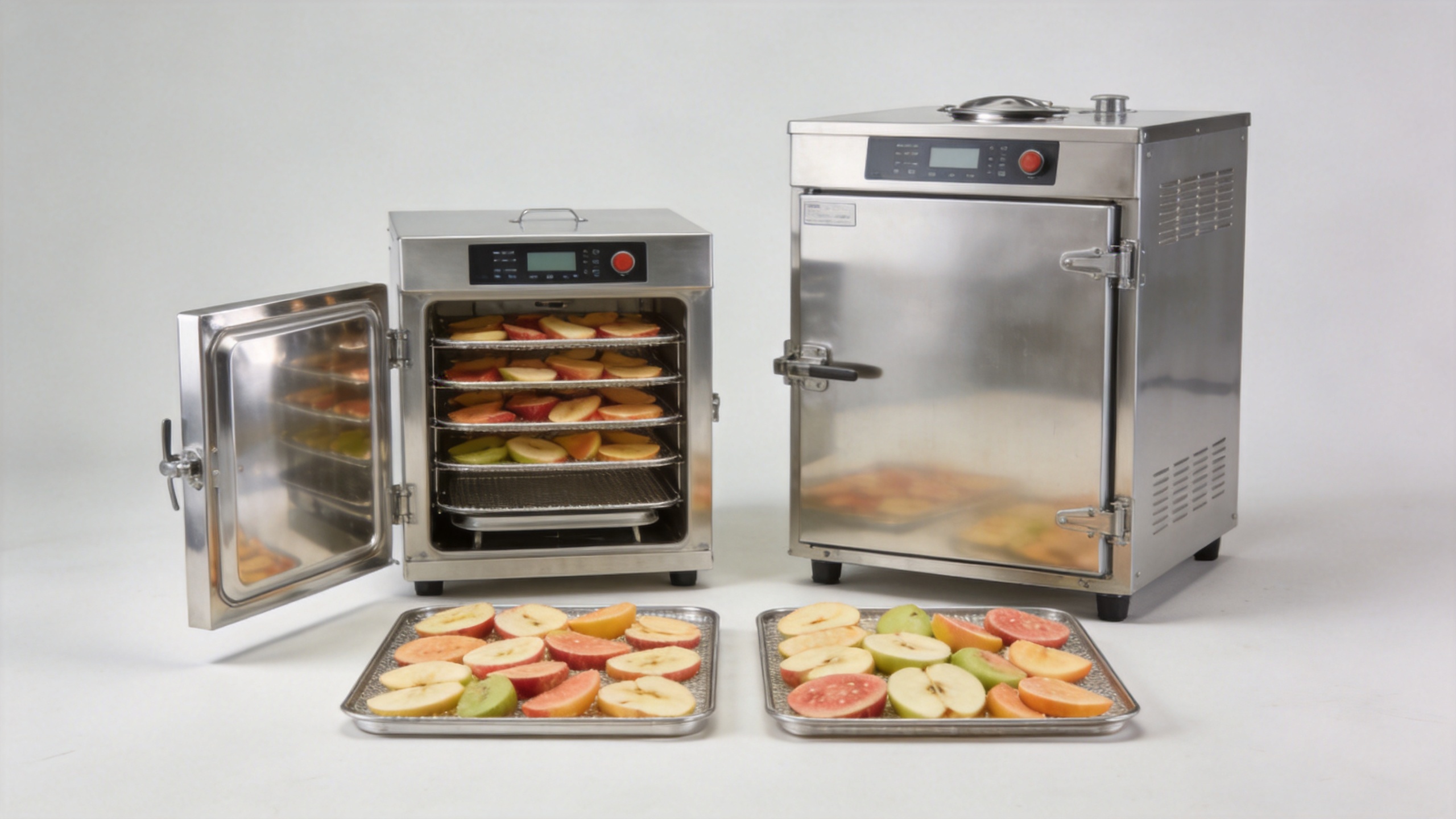
When evaluating a small freeze drying machine, ask suppliers to explain how the system supports your actual product rather than only providing a catalog number. Key questions include usable shelf area, permissible product depth, condenser capacity, vacuum-pump configuration, control and recipe functions, defrost method, data recording, and cleaning access. For sticky, sugary, fatty, or highly variable foods, recipe development and loading discipline matter as much as nominal capacity.
Request a clear explanation of the freezing, primary-drying, and final-drying stages. A food product can look dry on the surface while still performing poorly in storage if the cycle is not validated. The small freeze drying machine should therefore be evaluated with representative product samples and your intended package, not with an empty-chamber demonstration alone.
Plan the surrounding production line, not just the dryer
Food businesses often discover that the small freeze drying machine is only one constraint. Upstream washing, cutting, blanching, cooking, or pre-freezing can set the real batch schedule. Downstream sorting, metal detection where applicable, moisture verification, packaging, and storage also need capacity. An industrial dryer normally makes more sense when these stations already run at a predictable pace and the dryer has become the bottleneck.
If your wider project includes fruit or vegetable preparation, review equipment as a line. Hongle Machinery supplies food-processing equipment and has an industrial drying vegetable dryer and fruit drier machine that may be relevant when comparing complementary dehydration workflows. Confirm the technical fit directly with the supplier; the product name alone does not establish freeze-drying capacity or performance.
Use a procurement checklist before selecting a small freeze drying machine
- Calculate required kilograms of wet product and finished product per week.
- Map the longest acceptable cycle time and the number of batches per shift.
- Verify electrical supply, vacuum-pump service, ventilation, drainage, and installation space.
- Ask for food-contact material, cleaning, documentation, spare-parts, and remote-support details.
- Run a representative sample test and record yield, appearance, texture, moisture, and packaging behavior.
- Compare total operating cost, not only the purchase price of a small freeze drying machine.
For export projects, service planning deserves early attention. Confirm the commissioning scope, operator training, manuals, remote troubleshooting route, and spare-parts lead time. These questions can be decisive for buyers operating across Africa, Europe, Asia, North America, South America, and other markets where local technical support may vary.
When to move from a small freeze drying machine to industrial capacity
Move beyond a small freeze drying machine when demand requires repeated overtime batches, product quality varies because loading is inconsistent, the team cannot maintain packaging flow, or the cost per finished kilogram no longer supports the business plan. An industrial model is not automatically better; it is better when its usable capacity, controls, hygiene design, and service plan solve a documented production problem.
The most practical choice is the one that lets your food business produce consistent, safe, well-packaged product at the pace you can sell. Use a small freeze drying machine for controlled market entry and recipe learning. Choose industrial capacity when the evidence shows that reliable, repeatable volume—not experimentation—is now the priority.