EN
EN


Vegetable Dryer Machine Guide for Leafy Vegetables, Roots, and Slices
Choosing a vegetable dryer machine starts with the crop, not the catalogue. Leafy vegetables bruise easily, roots release moisture slowly, and sliced products need consistent thickness before they enter the dryer. For a food processor, the practical goal is to remove moisture evenly while protecting colour, texture, and usable yield. This guide explains the basic drying process and the questions worth answering before you compare equipment.
What a Vegetable Dryer Machine Does
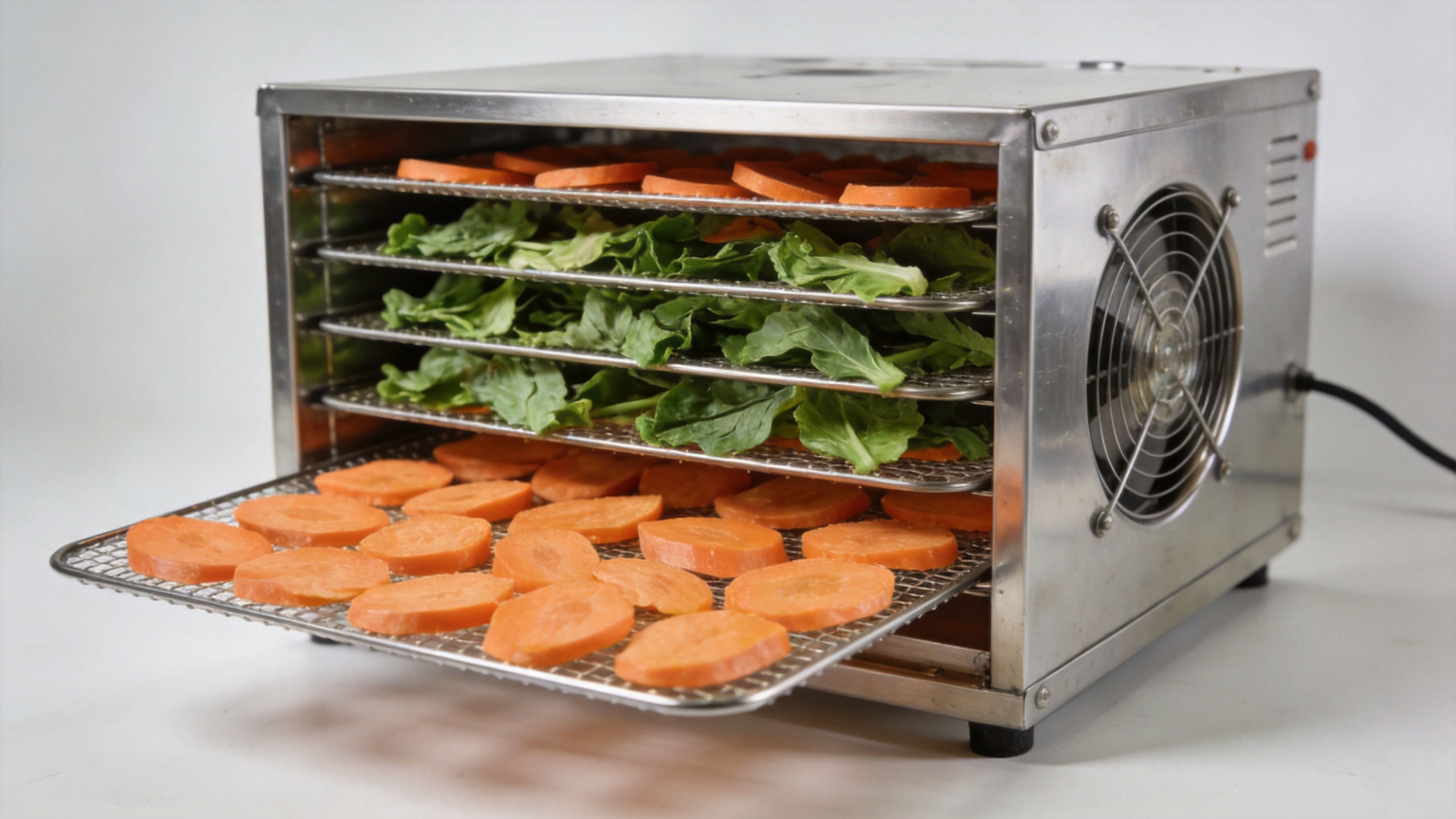
A vegetable dryer machine uses controlled heat and moving air to carry water away from prepared produce. In a typical hot-air system, the product is washed, cut or sliced, drained, spread in a thin layer, and exposed to airflow at a managed temperature. The air provides heat for evaporation; ventilation removes humid air so moisture can continue moving from the centre of the vegetable to its surface.
Drying is not simply “more heat equals faster output.” If the surface dries too aggressively, it can form a firmer layer that slows the escape of moisture inside. Public food-preservation guidance commonly uses about 140°F (60°C) as a starting point for many food-drying applications, while also stressing that the correct setting depends on the product and process. A commercial line should therefore validate its recipe with small batches rather than copy one temperature across every vegetable.
Start With the Vegetable Category
Leafy vegetables
Spinach, kale, herbs, cabbage leaves, and similar products have a high surface-area-to-mass ratio. They can lose water quickly, but uneven loading or excessive airflow may move light pieces around and create inconsistent drying. A vegetable dryer machine for leafy material should support gentle, even distribution and give operators a way to observe product movement during trial runs. Consistent leaf size and adequate draining before drying are often as important as the dryer itself.
Roots and dense vegetables
Carrots, potatoes, beetroot, taro, and similar roots are denser. They usually benefit from uniform slicing, and some recipes use blanching before drying to manage colour and enzyme activity. Because thicker pieces take longer for internal moisture to migrate, processors should evaluate slice thickness, bed depth, and residence time together. A dryer that appears fast on thin slices may not deliver the same result on thicker root products.
Slices, dices, and mixed ingredients
For onion flakes, pepper strips, mushroom slices, vegetable dices, and blended snack ingredients, dimensional consistency is the first control point. Mixed loads with different thicknesses can leave some pieces overdried while others remain too moist. When several products will share a line, plan for changeover cleaning and document a separate drying profile for each product family.
Match the Dryer Format to Your Production Flow
Batch tray systems can be useful when product types change frequently or when a processor is proving a new recipe. They allow hands-on checks of tray loading and finished texture. Continuous belt-style systems are often considered when the objective is steadier throughput and repeatable movement through a defined drying zone. The right choice depends on how much product arrives per shift, the available floor layout, the labour available for loading, and how often recipes change.
Do not compare machines by capacity alone. Ask whether the stated capacity refers to fresh input or finished dry output, what product it was based on, and which moisture target was used. A credible equipment discussion connects capacity to your actual vegetable, cut size, starting moisture, and planned operating hours.
Four Controls That Affect Drying Consistency
- Temperature control: Adjustable, stable heat lets the team test a product-specific recipe instead of relying on a fixed setting.
- Airflow distribution: Even air movement across the load helps prevent wet pockets and unnecessary rework.
- Loading depth: A deeper product bed can restrict air contact; a shallower, uniform layer is easier to dry consistently.
- Time and moisture verification: Record the residence time and verify finished moisture with a method appropriate for your quality plan.
These controls work as a system. Raising temperature cannot reliably compensate for poor slicing or uneven loading. A good commissioning process changes one variable at a time, records the result, and keeps the most suitable trial recipe as the baseline for future production.
Use a Vegetable Dryer Machine Trial Protocol
Before placing a production order, run a structured trial on the vegetable dryer machine with representative samples. Prepare at least three batches that reflect the smallest, average, and thickest pieces you expect in normal operation. Record fresh weight, tray or belt loading depth, temperature setting, airflow setting where available, drying time, and finished weight. The purpose is not to find one single fixed number in a single run; it is to identify a practical control window that operators can repeat.
For leafy vegetables, check whether fragile edges darken or whether light pieces shift as air moves through the chamber. For roots and slices, split several pieces at the end of the cycle to see whether the centre is drying at the same pace as the surface. A vegetable dryer machine should make these observations easier by allowing stable temperature control, accessible loading areas, and a clear routine for checking the product without disrupting every batch.
Document the outcome in a one-page product card for each recipe. Include the preparation method, cut size, loading weight, target drying time, acceptable finished appearance, and packaging handoff. This record gives purchasing, quality, and production teams a shared reference when the vegetable dryer machine is commissioned or when a new operator joins the line.
Plan Hygiene and Handling Before the Dryer
The dryer cannot correct poor preparation. Establish a flow that separates raw receiving, washing, cutting, draining, drying, cooling, and packing. Product should be as uniformly prepared as possible before it reaches the drying chamber. After drying, protect the product from ambient moisture during cooling and packing; otherwise, a well-run drying cycle can lose value before the product is sealed.
For export-oriented food processing projects, ask the supplier what documentation, operating guidance, spare-parts support, and pre-shipment testing information are available. Zhengzhou Hongle Machinery can provide remote video technical guidance, operating manuals, and spare-parts support for overseas customers, and its equipment is tested under load before shipment. These practical handover details can reduce uncertainty during installation and early production trials.
Build a Practical Cost and Capacity Comparison
Capacity planning should include more than the dryer’s rated output. Map the full workflow: washing, trimming, cutting, draining, loading, drying, cooling, and packing. A vegetable dryer machine can become a bottleneck when upstream preparation cannot feed it consistently, or when dried product waits too long before packaging. Estimate labour at each point, then compare that estimate with the number of operating hours and product changes planned for each shift.
Ask suppliers to explain the assumptions behind any capacity figure. Useful questions include the original vegetable used for the estimate, average cut size, loading method, moisture target, and whether the number refers to fresh input or finished product. With these assumptions on paper, different vegetable dryer machine proposals become easier to compare fairly.
A Simple Procurement Checklist
- List every vegetable, cut size, and target finished format you intend to dry.
- Define the fresh-input volume per shift and the finished-output target separately.
- Ask for a trial plan that states loading depth, temperature range, airflow approach, and expected residence time.
- Confirm cleaning access, changeover steps, power requirements, installation conditions, and operator training.
- Review after-sales support, manuals, available spare parts, and the scope of any factory test before shipment.
Where to Continue Your Equipment Review
If your project calls for an industrial drying solution, review the available Industrial Drying Vegetable Dryer Fruit Drier Machine Dehydrator Automatic alongside your own product trials and capacity plan. The most useful specification is the one that has been tested with your leafy vegetables, roots, or slices—not just a generic output figure.
A well-selected vegetable dryer machine gives the production team control over heat, airflow, loading, and time. Begin with a clear product list, validate one recipe at a time, and use the procurement checklist to turn a broad equipment search into a workable processing decision.