EN


Vegetable Dryer vs. Freeze Dryer: How to Choose a Food Drying Process
Choosing between a vegetable dryer and a freeze dryer is not simply a question of which machine removes more moisture. For a food processor, the better choice depends on the finished product you want to sell, the texture your customers expect, the capacity you need, and the operating cost your business can carry. A food dehydrator freeze dryer comparison is most useful when it starts with the product specification—not the machine brochure.
Hot-air drying and freeze drying both lower available moisture, but they do so through very different process routes. That difference affects product appearance, rehydration, packaging, throughput, and investment planning. This guide gives purchasing teams a practical way to decide which food drying process fits vegetables, fruit pieces, herbs, and similar ingredients.
Start With the Commercial Goal of Your Dried Product
Before comparing a food dehydrator freeze dryer setup, write down the job the finished ingredient must perform. Is it a durable vegetable ingredient for soup mixes, seasoning, pet food, or ready meals? Or is it a premium snack, instant meal component, or high-value ingredient where shape, color, and rapid rehydration support the selling price?
- Hot-air vegetable drying usually suits volume-oriented products where a compact format, stable shelf life, and reasonable processing cost matter most.
- Freeze drying is often considered when a porous structure, strong visual appeal, quick rehydration, and premium positioning are central to the product brief.
- A hybrid line can be worth evaluating when you need pre-treatment, partial moisture removal, or different routes for different SKUs.
Neither route removes the need for validation. Water activity, final moisture, product temperature, and packaging performance should be set as measurable release criteria. The FDA notes that available water affects food stability and that the final water-activity condition must be brought to a suitable level and maintained during storage.
How a Vegetable Dryer and a Freeze Dryer Work
Hot-air drying in a vegetable dryer
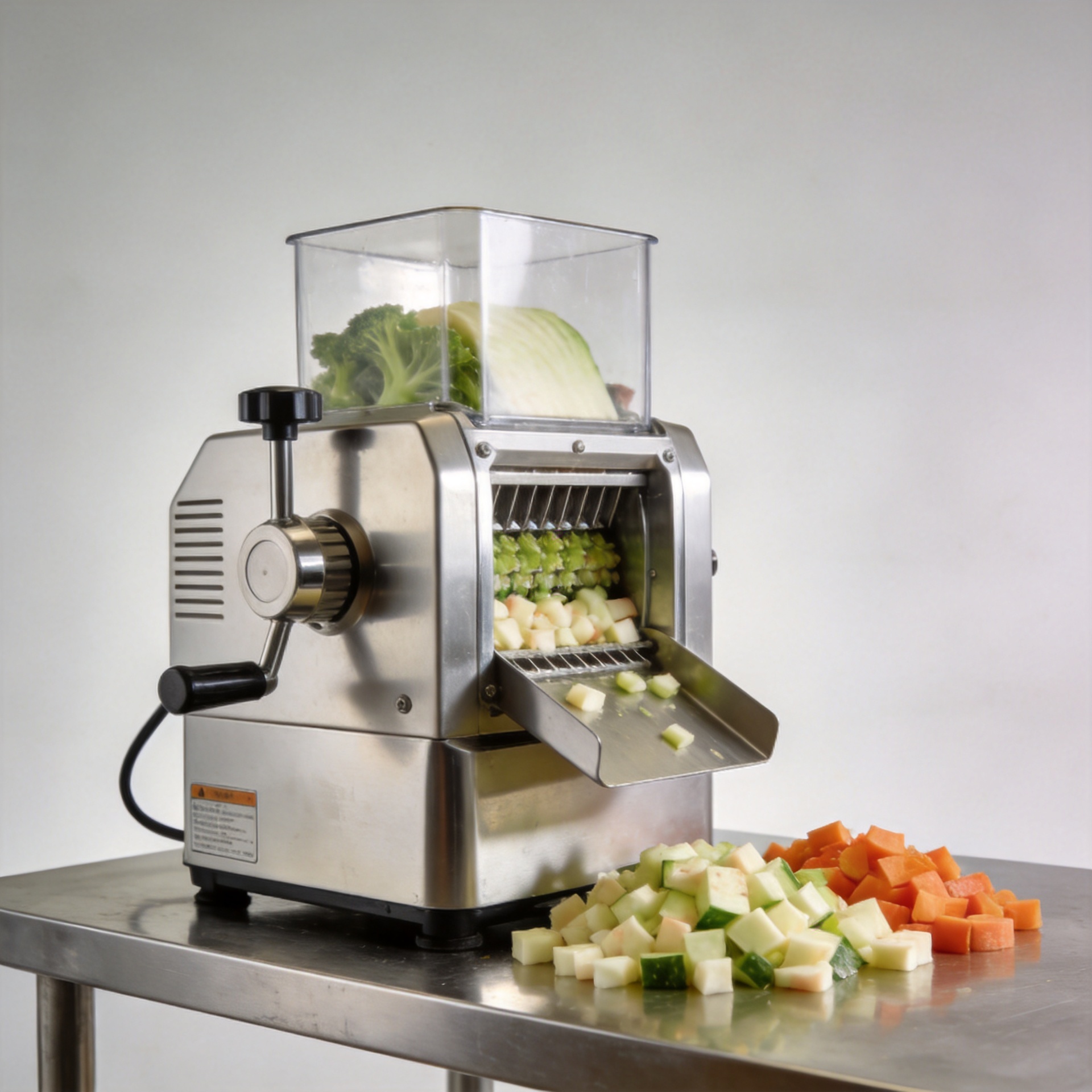
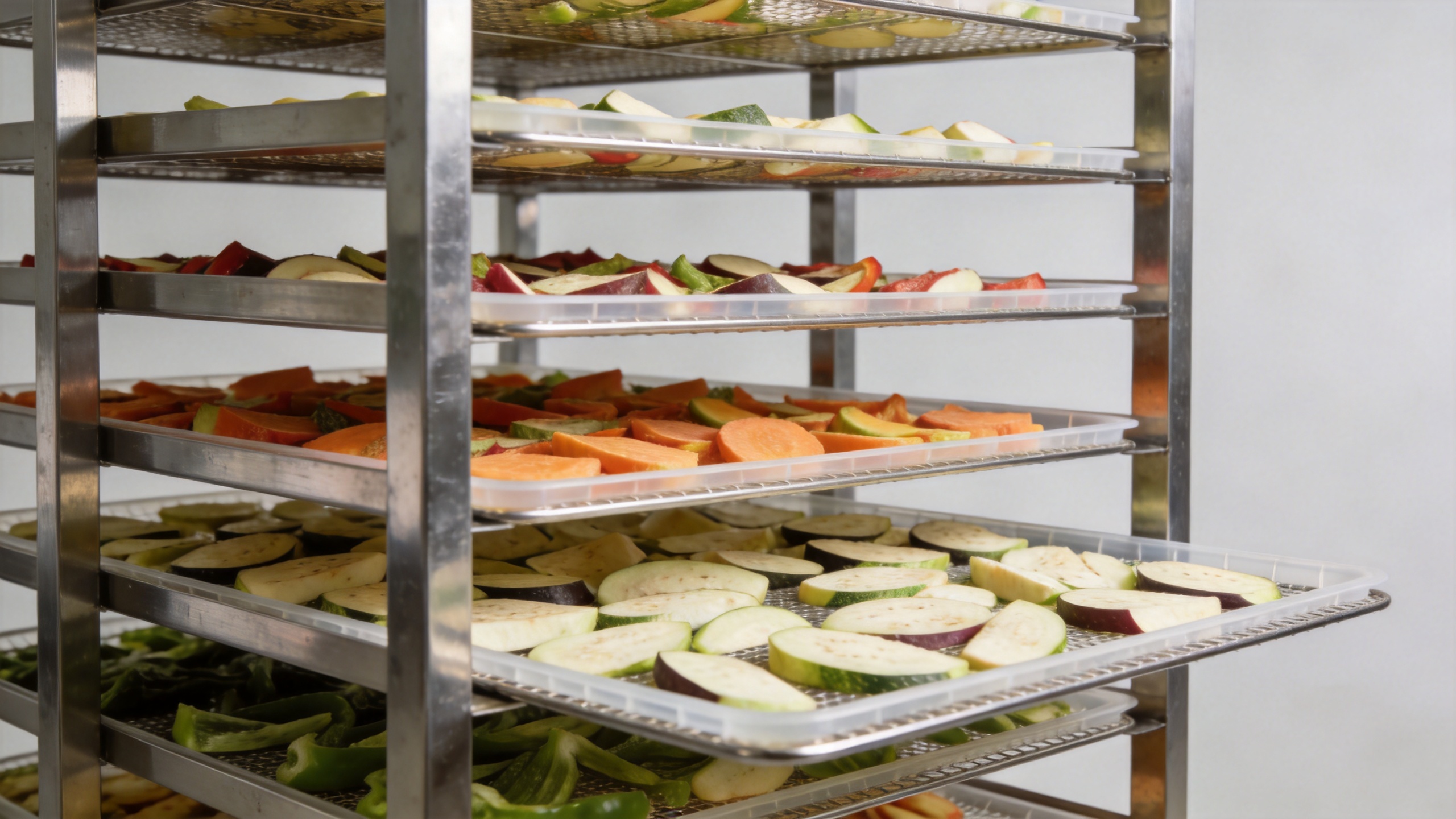
A vegetable dryer circulates controlled heated air across prepared material. Heat and airflow drive moisture from cut vegetables, while the exhaust system carries humid air away. For processors, the practical variables are loading depth, slice size, air distribution, temperature profile, residence time, and how evenly each tray or belt zone dries.
This route is familiar for onion, garlic, carrot, chili, leafy vegetables, and fruit slices. It is also the more direct option when production needs predictable continuous or batch operation. An onion dryer machine should be evaluated for airflow uniformity and sanitation access, because uneven slices or uneven airflow can produce a mix of over-dried and under-dried material.
Freeze drying under vacuum
Freeze drying first freezes the product, then removes ice by sublimation under vacuum. The process can better preserve an open, porous structure than conventional hot-air drying. That structure can support rapid rehydration and a lighter eating texture, but it comes with more process stages and a substantially different utilities profile.
Published review material commonly characterizes freeze drying as energy-intensive; one review result estimates that it can consume roughly four to ten times the energy of hot-air drying. Treat that range as an early feasibility signal, not a universal guarantee: product size, loading, refrigeration design, vacuum performance, and cycle recipe all change the result.
Compare Product Quality, Throughput, and Operating Economics
| Decision factor | Vegetable dryer / hot-air drying | Freeze dryer |
|---|---|---|
| Typical fit | Cost-conscious ingredients and high-volume dried vegetables | Premium ingredients, snacks, and products needing fast rehydration |
| Texture and structure | Usually denser and more shrunken | Usually more porous and shape-retaining |
| Process complexity | Temperature, airflow, residence time, and moisture control | Freezing, vacuum, shelf heating, condenser capacity, and cycle control |
| Capacity planning | Often easier to scale around material flow and dryer volume | Driven by batch shelf area, cycle duration, and condenser performance |
| Energy profile | Usually lower than freeze drying, though heat recovery and exhaust control still matter | Typically higher because freezing, vacuum, and condensation are integral to the process |
| Packaging focus | Protect from moisture pickup and product breakage | Protect porous product from moisture and physical crushing |
There is no universal winner in a food dehydrator freeze dryer decision. A lower-cost drying route can be commercially stronger when the customer accepts a dense ingredient and the factory needs higher output per investment dollar. A freeze dryer can be the better business case when product appearance and rehydration justify the added equipment, utilities, and cycle time.
Match the Process to the Vegetable and Its Intended Use
Product trials should use your actual cultivar, cut size, pre-treatment, and target pack format. Vegetables with high sugar, high fiber, or irregular pieces may respond very differently from a standard test sample. The key is to define a comparison protocol before asking suppliers for a final quotation.
- Choose representative raw material. Test seasonal variation, not only ideal material.
- Set a finished-product specification. Include moisture or water activity, particle integrity, color tolerance, rehydration behavior, and microbiological requirements.
- Measure yield. Compare raw input weight, finished weight, rejects, breakage, and packaging loss.
- Record utility demand. Track electricity, thermal energy, refrigeration, vacuum time, labor, and cleaning time per saleable kilogram.
- Run a storage check. Confirm that the selected package holds the validated endpoint through your intended shelf-life conditions.
For an onion line, for example, the question is not only whether the onion dryer machine reaches the desired endpoint. It is whether it does so consistently across batches while preserving the particle form and aroma profile required for the target application.
What to Ask When Comparing Industrial Equipment
For consideration-stage procurement, move past headline capacity. Ask each supplier to state assumptions: raw-moisture range, cut dimensions, loading density, target endpoint, ambient conditions, and operating hours. Capacity claims without those assumptions are difficult to compare.
- How is airflow or vacuum distribution verified across the usable loading area?
- Which operating variables are logged, alarmed, and retained for batch review?
- What are the cleaning access points and food-contact material details?
- What utilities and installation conditions are required for the quoted throughput?
- Can the supplier support trials using your vegetable, recipe, and packaging target?
- What parts, remote guidance, and operator documentation are available after commissioning?
For processors building a hot-air route, Hongle Machinery offers an industrial vegetable dryer and fruit dehydrator machine as a product category to review alongside your own capacity and process requirements. Confirm the actual configuration and trial results before treating any equipment as a final fit.
Use a Food Dehydrator Freeze Dryer Decision Worksheet
A food dehydrator freeze dryer evaluation becomes clearer when the purchase team scores both routes against the same commercial brief. Give each criterion a weight based on its effect on customer acceptance and margin: product appearance, rehydration, capacity, energy availability, labor, package cost, maintenance access, and expected selling price. Then compare trial results rather than relying on a single demonstration batch.
For many processors, the food dehydrator freeze dryer question also determines the upstream preparation line. Uniform washing, sorting, cutting, blanching where appropriate, and draining reduce variation before either process begins. Better preparation does not turn one technology into the other, but it makes dryer performance and finished-product consistency easier to control.
When the target is minced or sliced onion, involve production and quality teams early. An onion dryer machine trial should assess not only final moisture but also color, aroma retention, fines, discharge behavior, and how quickly the product gains moisture after packing. Those observations help specify the dryer, the cooling step, and the barrier level of the package.
When the target is a crisp premium vegetable inclusion, a food dehydrator freeze dryer comparison should include breakage in transit and consumer rehydration or eating texture. Freeze-dried material may command a better price, yet the commercial advantage can disappear if fragile product needs expensive packaging or suffers high handling losses.
A Practical Selection Rule for Food Processors
Choose a vegetable dryer when your business case prioritizes scalable throughput, stable dried ingredients, and controlled operating cost. Choose freeze drying when the product needs a premium porous structure, strong visual retention, or fast rehydration that customers will pay for. If you are unsure, run a side-by-side trial and calculate saleable yield, utilities, packaging, and expected selling price—not just moisture removal speed.
The most dependable food dehydrator freeze dryer choice is the one that meets a validated final-product specification at a cost structure your market can support. With clear trials and comparable supplier assumptions, the decision becomes a manufacturing calculation rather than a guess.