EN


Vegetable Slicer vs. Dicer: How to Choose the Right Cutting Function
For a food-preparation line, choosing a vegetable slicer is not simply a question of buying a machine with more blades. The cutting function determines the appearance of the finished product, how it cooks or packs, and how easily the line can keep a repeatable rhythm. A slicer makes controlled flat cuts; a dicer turns prepared produce into cubes or near-cubes. The right choice begins with the product specification, then works backward through raw-material condition, required throughput, and sanitation routine.
From a commercial purchasing perspective, the most useful comparison is not “which machine is better?” It is “which cutting result removes the next production bottleneck?” This guide compares the two functions for processors, central kitchens, and food businesses preparing potatoes, onions, carrots, cucumbers, fruit, and similar ingredients.
Start With the Finished Shape, Not the Machine Name
A vegetable slicer produces slices, rounds, strips, or other profile-led cuts depending on the cutting head. It is a practical fit when surface area, visual layering, or a consistent thickness matters. Potato chips, cucumber rounds, carrot coins, cabbage shreds, and sandwich or pizza toppings are common examples. The main decision is usually thickness: a thin slice behaves differently in frying, drying, marinating, and packing than a thicker slice.
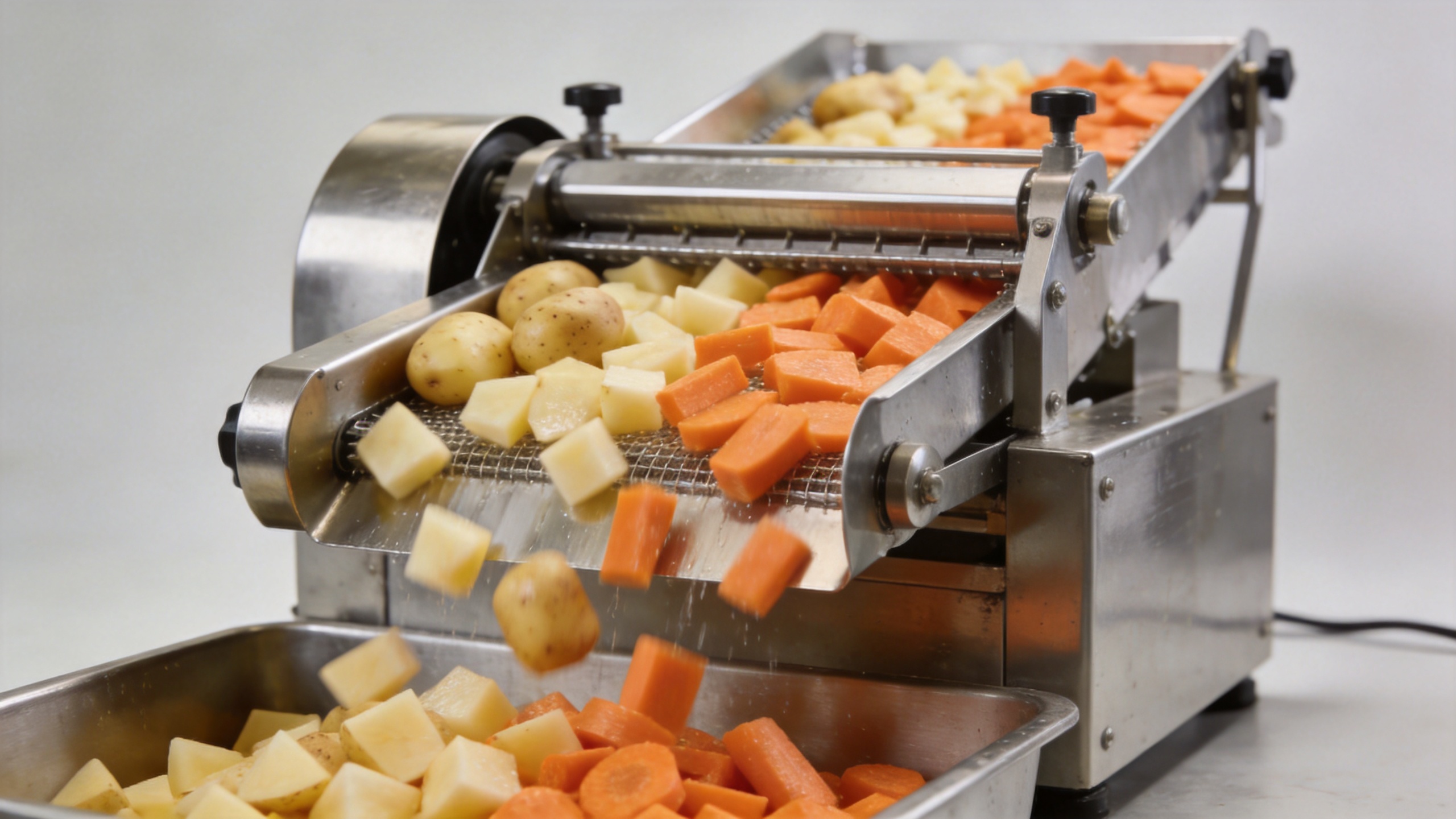
A dicer is designed for portions where cube geometry matters. It is often selected for soup mixes, frozen vegetable blends, salsa ingredients, filling preparation, and ready-meal components. Uniform dice can help improve portion appearance and cooking consistency, but it also asks more of the raw material: overly soft, irregular, or poorly pre-cut produce may not pass cleanly through the cutting set.
| Question | Choose slicing when… | Choose dicing when… |
|---|---|---|
| Finished product | Thickness and surface profile are critical | Cube size and portion consistency are critical |
| Typical use | Chips, rounds, shreds, toppings | Mixes, fillings, soups, frozen or prepared meals |
| Raw material tolerance | Shape variation can be more forgiving | More uniform feed preparation is usually needed |
| Changeover focus | Slice thickness or profile | Grid size and pre-cut sequence |
Match the Function to Raw-Material Behavior
The same ingredient can favor different functions at different stages. Firm potatoes and carrots can support either slicing or dicing, provided the product is cleaned and sized for the feed opening. Leafy vegetables may be better suited to slicing or shredding because a clean cube is not the priority. Onions, peppers, and fruit need an evaluation of firmness, moisture, and how much deformation is acceptable in the final pack.
Before selecting a vegetable slicer, run representative samples—not just ideal pieces. Include the largest and smallest expected produce, a realistic maturity range, and material after washing. Look for fractured edges, crushed tissue, inconsistent thickness, or product loss around the blades. For a dicing function, also check whether the ingredient needs a first cut before it reaches the dicing grid. This small process detail can affect labor, yield, and line layout.
Use Cutting Size as a Production Specification
Size is a commercial specification, not a cosmetic detail. For example, public commercial-cutting guidance commonly uses fine grids such as 3 × 3 mm for small onion pieces, garnishes, or compact mixes, while 6 × 6 mm is a more broadly useful dice for many vegetable applications. These examples are a starting point only: the correct size depends on the recipe, cooking time, packaging style, and customer expectation.
Ask the production team to define an acceptable size range and an acceptable trim-loss level. Then test whether one cutting head can cover most planned SKUs. A machine with several theoretical functions is valuable only if blade changes are practical, parts are available, and operators can repeat the setup. If the business alternates between slices for dehydrating and cubes for prepared foods, a modular cutter may reduce duplicated equipment—provided the actual changeover fits the production schedule.
Compare Throughput With the Whole Line
Do not choose capacity from a brochure alone. Published commercial dicing examples may list roughly 300–800 kg/h, but real output changes with produce type, cut size, feeding method, operator pace, and upstream preparation. A cutter that exceeds the washer, inspection table, or packaging line will not create useful output; it may simply create accumulation and more handling.
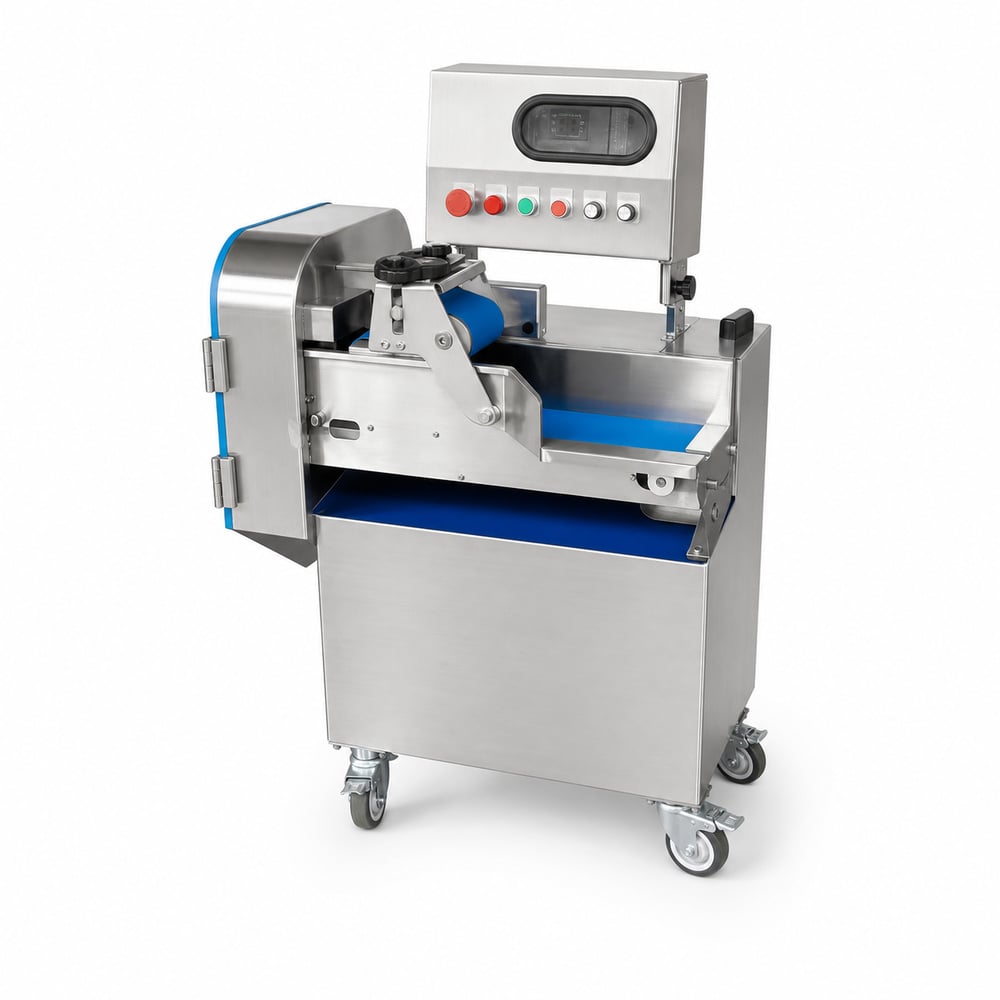
Build a short line-balance worksheet: kilograms per hour required, average piece size, preparation steps, target cut, expected yield, cleaning time, and changeovers per shift. When reviewing a commercial cutter option, such as the Commercial Industrial Electric Vegetable Cutter Dicing Machine for Potato Fruit & Green Onion, confirm the available cutting function against those samples and workflow needs rather than assuming a product title establishes every performance detail.
Put Hygiene and Changeover Into the Purchase Decision
For both slicing and dicing, the blade area and food-contact path deserve the same attention as output. Review how readily operators can access, remove, clean, inspect, and reassemble cutting components. Food-contact material suitability, safe guards, and a documented cleaning routine are essential questions. A quick changeover is useful only if the sanitation check is equally reliable.
- Can the required cut be demonstrated with your own material?
- Are the cutting heads, grids, and wear parts identified clearly?
- How long does cleaning and reassembly take between products?
- Does the feed opening suit your real pre-cut size?
- What output range is achieved in a line trial, not just a nominal rating?
Vegetable Slicer Evaluation Checklist for Commercial Buyers
Use this vegetable slicer checklist during a supplier discussion. A vegetable slicer should be assessed with the actual ingredient, not a generic sample. Ask the vegetable slicer supplier to show the target thickness. Check whether the vegetable slicer handles the largest expected piece. Confirm that the vegetable slicer can be cleaned without leaving hidden food-contact areas.
For every vegetable slicer trial, record incoming weight, usable output, trim, and time. Compare one vegetable slicer setup with the current manual step. If the vegetable slicer feeds into a washer or packer, measure the handoff rather than the cutter alone. A vegetable slicer that creates clean pieces but interrupts the next station is not yet the right line choice.
Questions to Ask Before Ordering
- Which cutting head is supplied with the vegetable slicer?
- What thickness range can the vegetable slicer demonstrate on our produce?
- Which blade parts wear first on this vegetable slicer?
- How is the vegetable slicer protected during loading and cleaning?
- How long does a trained operator need to change a vegetable slicer cutting set?
- Can the vegetable slicer support both the planned daily volume and realistic sanitation windows?
Use the same discipline when comparing a vegetable slicer against a dicing configuration. The vegetable slicer may be the stronger choice for rounds, shreds, and thickness-controlled products. The vegetable slicer may also simplify a line where operators need quick profile changes. But when cube uniformity drives the recipe, test a dicer beside the vegetable slicer and compare yield, deformation, and cleaning time.
A final vegetable slicer decision should state the raw material, desired cut, output target, cleaning process, and spare-part plan. This turns a vegetable slicer purchase from a catalogue comparison into a documented production decision. With that record, the vegetable slicer function can be matched to the real product workflow instead of an assumed application.
A Simple Selection Path
- Define the finished shape and tolerance first.
- List every raw material and its condition after washing.
- Choose slicing for thickness-led products; choose dicing for cube-led portions.
- Test the target cut on representative produce.
- Check throughput, yield, cleaning, and changeover across the complete workflow.
The right vegetable slicer choice is the one that consistently delivers the cut your downstream process needs. If flat, even pieces support your recipe or packaging, prioritize slicing control. If uniform cubes improve mix consistency and portion presentation, prioritize a dicing setup. A focused product trial makes that decision far more dependable than comparing machine labels alone.