EN


What Should Buyers Ask a Fruit Dryer Machine Supplier Before Ordering?
Choosing a dryer for fruits is not simply a matter of comparing a quoted price, tray count, or stated output. For a commercial processor, the machine becomes part of a production system that must handle a specific fruit, a target moisture level, an available utility supply, and an operator team. Before placing an order, buyers should turn the supplier conversation into a written procurement checklist.
A good supplier should be able to explain what the proposed dryer for fruits can do under your conditions, what it cannot do, and which information still needs to be confirmed by a trial. That distinction matters. A capacity figure without fruit type, loading method, slice thickness, starting moisture, and end-moisture target is not yet a production commitment.
1. What Fruit and Final Product Has the Machine Been Sized For?
Start with the product, not the equipment model. Ask the supplier which fruits have been considered in the quotation and whether the machine is intended for slices, cubes, halves, purée sheets, or another format. Mango, banana, apple, pineapple, berry, and citrus products can behave differently in a drying chamber because their sugar content, initial moisture, thickness, and surface area differ.
Ask for a simple process sheet that states the expected incoming preparation, loading method, drying stages, estimated cycle time, and the expected condition of the finished product. If you plan to make more than one product, ask how recipe changes are handled and which items require a separate trial.
- Which fruit varieties and cut sizes were used to estimate performance?
- What incoming moisture and final moisture target does the supplier assume?
- Does the quote cover washing, slicing, blanching, cooling, or only drying?
- Can the supplier provide a test plan using your raw material or representative samples?
2. How Is Real Capacity Calculated?
For a dryer for fruits, “capacity” can mean fresh-fruit input per batch, finished dried-product output, tray loading, or hourly throughput. These are not interchangeable. Request the calculation behind the stated figure and ask the supplier to show the assumptions in writing.
Compare at least four items: fresh material per batch, usable loading area or tray count, average cycle duration, and expected finished output. Then ask what happens when fruit thickness changes, ambient humidity rises, or a batch is loaded less evenly than in a demonstration. This helps the buyer distinguish an ideal demonstration rate from a practical planning rate.
| Capacity question | Why it matters | Evidence to request |
|---|---|---|
| Fresh input per batch | Sets receiving and preparation needs | Loading diagram and sample batch record |
| Finished output per batch | Supports yield and packaging calculations | Assumptions for starting and final moisture |
| Cycle time | Determines daily scheduling | Stage-by-stage drying program |
| Usable tray area | Prevents overloading expectations | Tray dimensions, spacing, and loading guidance |
3. Which Heating, Airflow, and Control Features Are Included?
Drying quality depends on more than heat. Ask how air is distributed, whether the airflow direction can be adjusted or reversed, and how the supplier reduces uneven drying between trays or zones. A supplier should also explain the heating method, installed power, fuel or electrical requirements, exhaust arrangement, and insulation approach.
Request the actual temperature operating range, sensor locations, control accuracy or control logic, timer functions, alarm conditions, and data-recording options. Search results often highlight adjustable temperature and timer controls, but consumer-style feature lists are not enough for an industrial purchase. What matters is whether the control approach suits your fruit process and gives operators repeatable instructions.
Ask for the electrical drawing and a list of utility requirements before confirming the order. If your local voltage, frequency, gas supply, steam source, or ventilation conditions differ from the supplier’s standard, have the supplier identify any changes in writing.
4. What Makes the Food-Contact Design Easy to Clean?
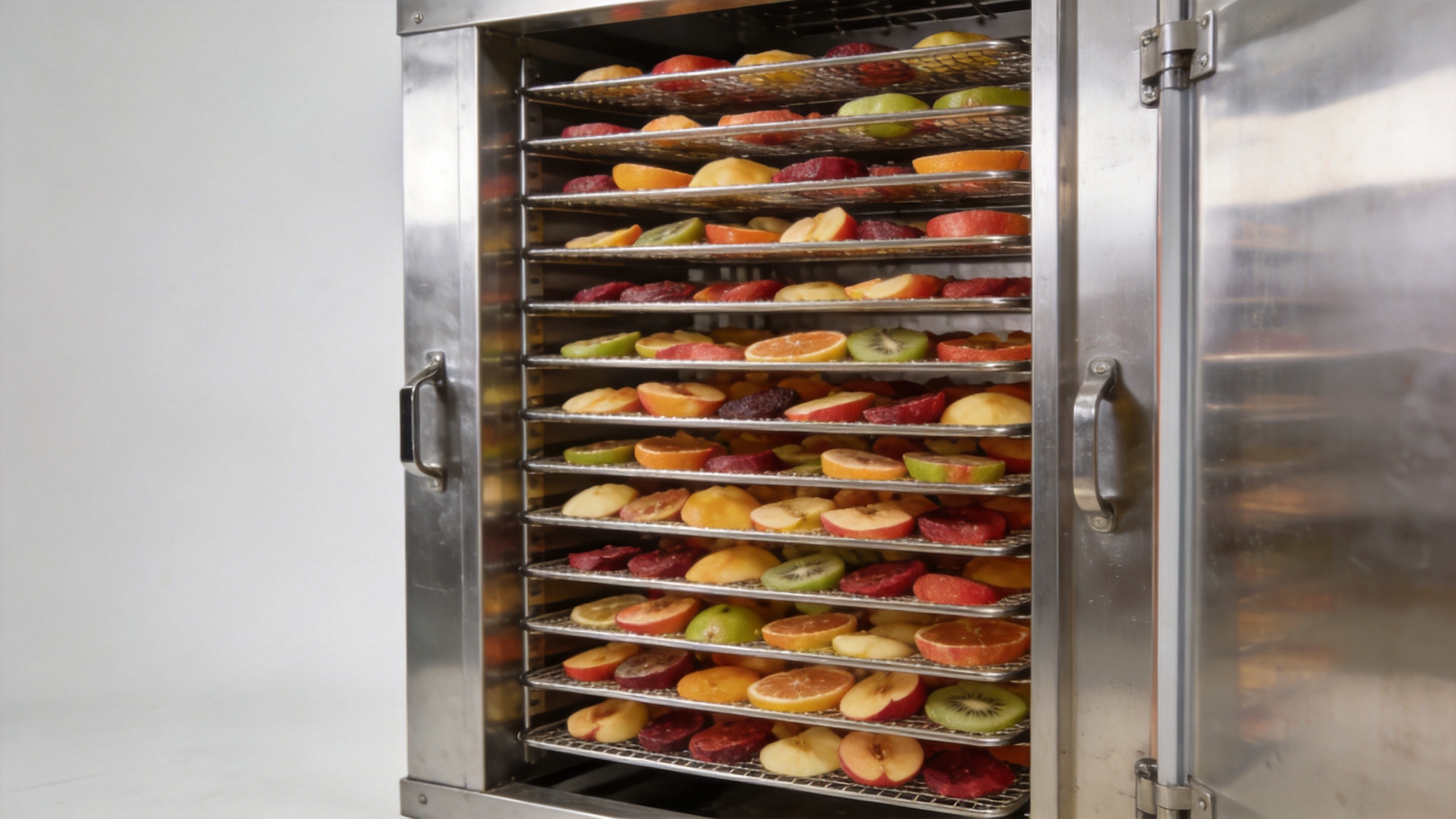
Hygiene should be a purchasing question, not an afterthought. Food-contact surfaces should be cleanable and appropriate for the operating environment. Ask which materials are used for trays, racks, chamber interiors, seals, fasteners, and drainage areas. Request material specifications where they are relevant to your food-safety program.
Then focus on access: Can an operator reach the corners, fan area, drains, and tray supports for cleaning and inspection? Are there areas where fruit pieces, syrup, or dust can accumulate? Ask the supplier to provide a cleaning procedure, recommended cleaning agents, a maintenance schedule, and photos or a video showing access points.
- Which components contact food, and what material specifications apply?
- How are trays, filters, ducts, and chamber surfaces cleaned?
- What parts are removable without special tools?
- Which daily, weekly, and preventive-maintenance tasks are expected?
5. What Will Be Delivered, Installed, and Accepted?
Many first-time buyers spend most of their time negotiating machine price; later they discover that installation scope, commissioning support, and acceptance criteria determine the real project risk. Ask for a complete scope list: machine body, trays, controls, electrical cabinet, spare parts, installation guidance, commissioning, training, packing, and export documents.
Set acceptance criteria before shipment. These should cover the fruit product to be tested, measurement method, trial conditions, safety checks, and the documents to be handed over. Do not accept a vague promise that the dryer for fruits will “work well.” Define what successful commissioning means for your line.
For buyers evaluating an industrial drying vegetable dryer fruit drier machine dehydrator automatic, it is sensible to request the same written scope and acceptance documents rather than infer specifications from the product name alone.
6. What After-Sales Support Is Available in Your Market?
For overseas projects, after-sales support is part of the machine specification. Ask who will provide remote commissioning help, how quickly technical questions are normally handled, which manuals are included, and whether electrical diagrams and recommended spare-parts lists are supplied. Confirm the warranty terms, exclusions, and the process for ordering wear parts.
Zhengzhou HongLe Machinery Equipment Co., Ltd. describes remote video technical guidance, operating manuals, and spare-parts support for overseas customers. Treat that as a discussion point to verify in your contract: ask which documents, response channels, and spare-parts packages apply to your exact order.
7. A Short Supplier-Question Checklist Before You Pay a Deposit
- Provide the process assumptions used to size this dryer for fruits.
- Show the capacity calculation in fresh input, finished output, and cycle time.
- List heating method, airflow design, utilities, and control functions.
- Provide food-contact materials, cleaning access details, and maintenance tasks.
- Confirm the complete supply scope and any buyer-side responsibilities.
- Define a written factory test, commissioning plan, and acceptance criteria.
- List manuals, drawings, training, warranty, and recommended spare parts.
- State lead time, packing method, shipping terms, and document package.
Quote Comparison Worksheet
Use the same wording when you ask each supplier about the dryer for fruits. A written answer makes the dryer for fruits easier to compare across quotations.
| Ask the supplier | Record in the quote |
|---|---|
| What fruit process is this dryer for fruits designed for? | Fruit, cut size, loading method |
| What fresh input, finished output, and cycle time apply to this dryer for fruits? | Batch calculation |
| Which heating method, airflow design, and controls are supplied with this dryer for fruits? | Utilities and control sheet |
| Which food-contact materials and cleaning steps apply to this dryer for fruits? | Material list and cleaning SOP |
| How is this dryer for fruits installed, commissioned, and accepted? | Service scope and test protocol |
| Which manuals, spares, warranty, and support accompany this dryer for fruits? | Document and service list |
| What lead time, packing, and buyer-side responsibilities apply to this dryer for fruits? | Delivery matrix |
Make the Supplier’s Answers Comparable
The most useful question is one that produces a comparable answer. Send the same fruit details, production target, utilities, layout constraints, and desired finished-product specification to each supplier. Ask each one to return the same checklist with supporting documents. This approach makes it easier to compare a dryer for fruits on process fit, hygiene, operating practicality, and lifecycle support—not just on the first quotation.
When the answers are complete, you can make a more informed decision: select the equipment only after its capacity assumptions, controls, cleaning design, delivery scope, and service commitments match the production plan you actually intend to run.