EN


Coconut Peeler Machine: How to Evaluate Processing Capacity
A coconut peeler machine can look productive in a short demonstration yet deliver a very different result over a full shift. For processors comparing fruit and vegetable peeling equipment, the useful question is not simply “How many coconuts per hour?” It is how many saleable, correctly peeled coconuts the line can produce after allowing for loading, size variation, trimming, cleaning, and stops. This guide gives buyers a practical way to evaluate that number before committing to equipment.
Start by Defining What the Coconut Peeler Machine Is Expected to Do
“Peeling” is used loosely in the market. Depending on the product and process, it may refer to removing the fibrous husk, paring an outer skin, trimming a shaped young coconut, or preparing fruit for a later cutting stage. A capacity claim is only comparable when the scope of work is identical. Before asking for a quote, write down the incoming coconut condition, average size range, moisture condition, desired finished appearance, and whether manual trimming remains after the machine.
This distinction matters because a machine handling pre-sorted, similarly sized coconuts can run more smoothly than one receiving mixed lots. Research and field-oriented performance reports also point to coconut size, operating speed, and blade settings as variables that influence time, force, and efficiency. In other words, a published or advertised figure is a test point—not a universal production promise.
Separate Rated Capacity From Net Shift Output
A supplier may state capacity in pieces per hour, kilograms per hour, or a range. Ask which number is being quoted. Rated capacity is often the theoretical throughput achieved under favorable, continuous feeding conditions. Net shift output is the amount of acceptable product produced after normal interruptions. For planning, net output is the more useful number.
Use a simple working calculation:
Net saleable output per hour = tested feed rate × operating availability × acceptable-output rate.
For example, if a trial shows 300 coconuts per hour, the line is available for 85% of the hour after loading and routine adjustments, and 92% meet the agreed finish standard, the planning number is about 235 acceptable coconuts per hour. The percentages are not fixed assumptions; they should be replaced with figures from a trial using the buyer’s own raw material and quality criteria.
Measure the Capacity Inputs That Change Most in Real Production
1. Coconut size distribution
Do not send a supplier only an average diameter. Provide a representative spread: small, typical, and large pieces, along with the share of each group. Mixed sizes can affect gripping, blade contact, cycle time, and the amount of correction work. A coconut peeler machine should be assessed on the mix the factory actually receives, not only on the easiest sample.
2. Feeding and discharge
Many capacity gaps occur before or after the peeling action. Count the time needed to orient each coconut, load it safely, remove it, inspect it, and transfer it to the next station. If one operator must also collect peel waste or clear occasional jams, this labor must be part of the evaluation. A higher-speed core machine does not automatically raise line output if feeding remains manual and slow.
3. Finish standard and reject definition
Agree on what counts as acceptable: remaining husk, cut depth, surface damage, shape consistency, and rework allowance. A trial that counts every discharged coconut can overstate usable throughput. Record first-pass acceptance, rework quantity, and scrap separately so that teams can compare machines on the same basis.
4. Cleaning and changeover time
For food-processing equipment, routine cleaning is part of capacity. Ask which parts contact the fruit, how tools are used for access, what cleaning steps are required, and how long a trained operator needs to restart. If multiple coconut sizes or products are planned, include blade adjustment and setup time in the shift calculation.
Ask for a Capacity Test Plan, Not Only a Specification Sheet
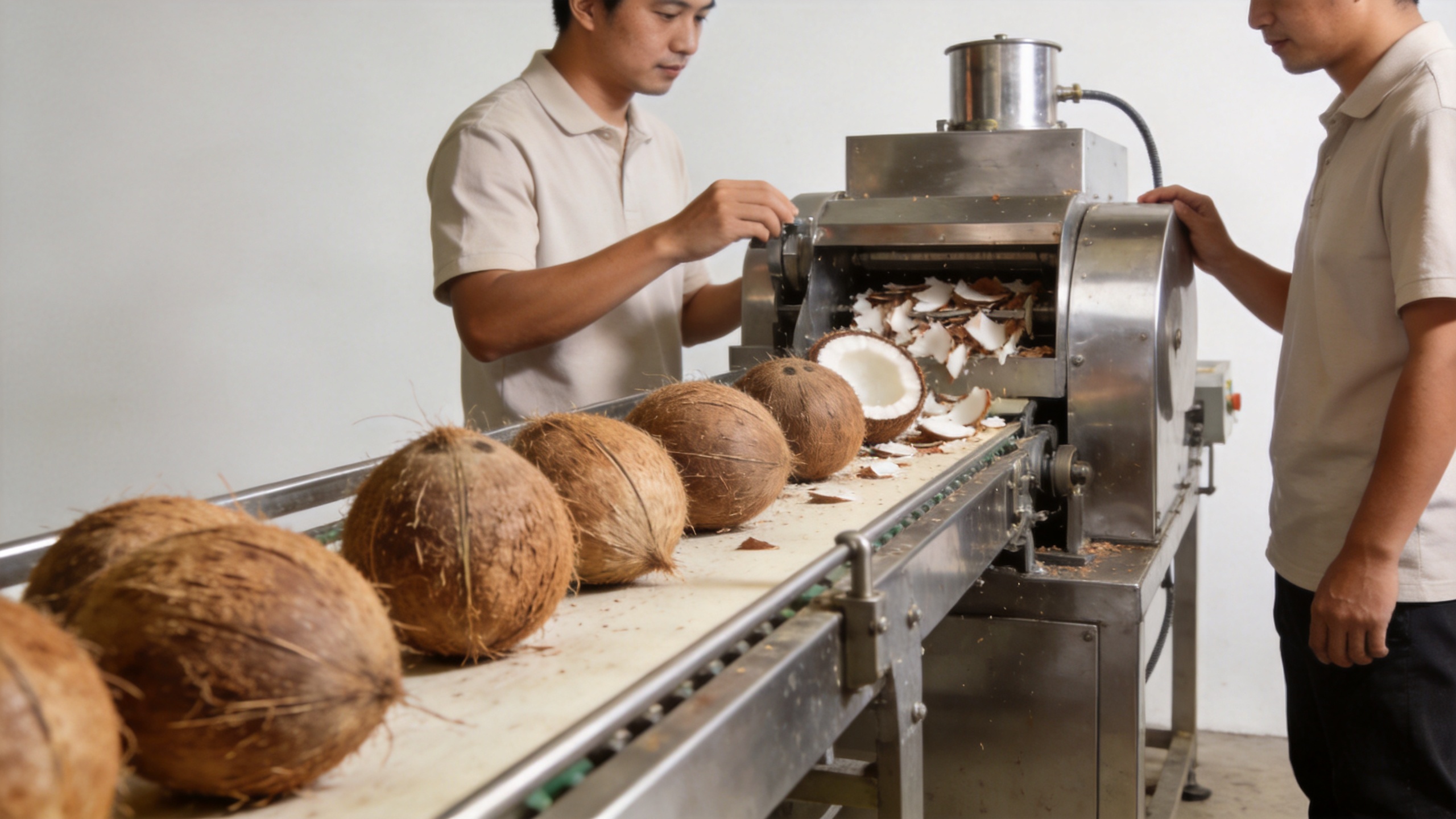
A good comparison trial has a fixed sample size, a documented raw-material profile, and a clear definition of acceptable product. Request a timed run long enough to include normal handling rather than a short highlight clip. During the test, log total input, completed output, acceptable output, rework, stops, stop reasons, labor used, and power information if that affects the project.
Useful questions include:
- What coconut type and size range was used to establish the stated capacity?
- Does the number include trimming or only the main peeling operation?
- How many operators are required for continuous production?
- What adjustment is needed when the size mix changes?
- What are the common stop causes, and how are they cleared safely?
- How is acceptable peeling quality defined during acceptance testing?
Search and research results show widely different reported outputs across dehusking and peeling designs, from piece-rate claims to kilogram-based trials. That variation is exactly why the conditions behind the figure deserve more attention than the figure alone.
Compare Machine Options With a Line-Level Scorecard
| Evaluation item | What to record | Why it matters |
|---|---|---|
| Tested throughput | Input and completed pieces per hour | Establishes the starting rate |
| First-pass acceptance | Acceptable pieces ÷ completed pieces | Prevents rework from being hidden |
| Availability | Running time ÷ planned time | Captures loading, clearing, and minor stops |
| Labor per shift | Operators for feed, inspection, and discharge | Shows the real operating requirement |
| Cleaning time | Minutes per shift or changeover | Supports realistic scheduling |
| Downstream fit | Transfer, trimming, packing, or waste handling capacity | Prevents the next station becoming the bottleneck |
For a comparison-stage purchase, this scorecard is more dependable than ranking machines by maximum stated capacity. It also makes it easier to see whether a semi-automatic option with stable quality is a better fit than a faster model that creates extra manual work.
Coconut Peeler Machine Capacity Trial Worksheet
Use the following worksheet during a supplier test. The repeated checkpoints keep the coconut peeler machine comparison consistent across candidates.
- Coconut peeler machine sample lot: record piece count, size range, and condition.
- Coconut peeler machine feed rate: record actual pieces loaded each minute.
- Coconut peeler machine cycle rate: record completed pieces each minute.
- Coconut peeler machine acceptance rate: record pieces meeting the agreed finish.
- Coconut peeler machine rework rate: record pieces requiring manual correction.
- Coconut peeler machine reject rate: record damaged or unusable pieces.
- Coconut peeler machine stop time: record every adjustment and clearance.
- Coconut peeler machine cleaning time: record routine sanitation and restart time.
- Coconut peeler machine labor count: record operators at feeding, inspection, and discharge.
- Coconut peeler machine waste handling: record whether peel removal slows the run.
- Coconut peeler machine setting changes: record blade or guide adjustments by size group.
- Coconut peeler machine energy reading: record it when utility planning is important.
- Coconut peeler machine safety checks: confirm guards and stop access before each run.
- Coconut peeler machine maintenance observations: note wear, loosening, and cleaning access.
- Coconut peeler machine downstream transfer: verify the next station accepts the actual rate.
- Coconut peeler machine shift plan: apply availability and quality allowances to the trial rate.
- Coconut peeler machine acceptance record: attach the agreed test conditions to the purchase file.
With the same worksheet, a coconut peeler machine can be assessed on repeatable operating evidence rather than a headline output figure. The worksheet also helps a coconut peeler machine supplier and buyer agree on the conditions for a fair capacity comparison.
Evaluate Cleaning, Safety, and Support Alongside Throughput
Capacity must be repeatable, not just achievable once. Inspect the guards, emergency-stop access, waste-removal arrangement, and access to areas that need sanitation. Ask the supplier to explain the recommended maintenance routine, wear-part checks, and troubleshooting path. These details determine whether the coconut peeler machine can hold its expected output after installation.
Buyers who also process garlic or ginger may wish to review this commercial garlic and ginger peeling machine as a separate product reference. Its suitability for coconut processing should be confirmed through material-specific testing; different crops and peeling tasks should not be treated as interchangeable.
Turn Trial Results Into a Purchase Decision
Before finalizing a coconut peeler machine, convert the trial result into a conservative shift plan. Add the expected raw-material mix, staffing level, sanitation breaks, quality target, and the capacity of the next process. Then ask the supplier to confirm the test conditions in the technical discussion or acceptance criteria.
The most suitable choice is not necessarily the machine with the biggest headline number. It is the option that produces the required finish at a verifiable, repeatable rate with manageable cleaning, labor, and downtime. A disciplined test plan gives procurement teams a stronger basis for comparing fruit and vegetable peeling equipment and building a line that can meet daily production targets.