EN


Food Dryer Capacity Planning for Small and Medium Processing Plants
Choosing a food dryer for a processing plant is less about finding the largest catalog number and more about matching the machine to a real production rhythm. For a small or medium operation, the practical questions are straightforward: how much wet material arrives per shift, how much water must be removed, how many hours are genuinely available for drying, and where will product wait before and after the dryer? A capacity plan built around those questions is more reliable than one based only on tray count or a headline output figure.
As a B2B buyer, start with the process rather than the machine. A food dryer removes moisture to support preservation, but the final target is product-specific. Final moisture and water activity requirements, slice thickness, loading depth, airflow, and cleaning time all change the throughput a plant can sustain. That is why an equipment quotation should be the end of the sizing exercise, not the beginning.
Start With Water Removal, Not Just Wet Feed
The most useful way to plan a food dryer is to convert incoming product into a water-removal requirement. Record the wet feed per batch or per day, the starting moisture level supplied by your quality or process team, and the intended finished-product specification. The difference between incoming mass and final dry mass is mostly water that the system must move out.
For example, a plant processing sliced fruit should not assume that two tonnes of wet fruit means a two-tonne drying task. The usable dry solids remain in the product, while moisture is removed over a controlled time period. The calculation is therefore a planning tool: it helps procurement teams compare dryer options by kilograms of water removed per hour and by actual usable load, rather than by an isolated nominal capacity.
There is an important boundary here. The same food dryer can produce different hourly outputs when raw-material moisture, cut size, sugar content, loading density, or target finish changes. Treat supplier capacity data as a condition-based reference and ask which product, starting moisture, final moisture, belt or tray loading, and drying time were used to establish it.
Convert Production Demand Into an Operating-Hour Requirement
Once the water-removal requirement is clear, map it to the hours your plant can actually operate. A small facility may have an eight-hour production shift, but that does not mean eight hours of net drying time. Receiving, washing, slicing, blanching where applicable, loading, unloading, product cooling, sanitation, and changeovers all consume time.
A practical planning sequence is:
- Set the average daily wet-feed target and identify peak-season volume separately.
- Define the product format: whole, diced, sliced, shredded, or granular material.
- Specify the required final condition with the relevant food-safety and product-quality team.
- Estimate net operating hours after planned loading, unloading, cleaning, and changeover time.
- Divide the required water removal by net operating hours, then compare that requirement with validated machine test conditions.
This sequence makes hidden constraints visible. If upstream washing and slicing can feed the dryer continuously for only five hours, specifying a unit around a theoretical twenty-four-hour cycle will not solve the bottleneck. Conversely, a system that is too small can force extra shifts, rushed sanitation, or unplanned raw-material holding time.
Choose the Dryer Format Around Product Flow
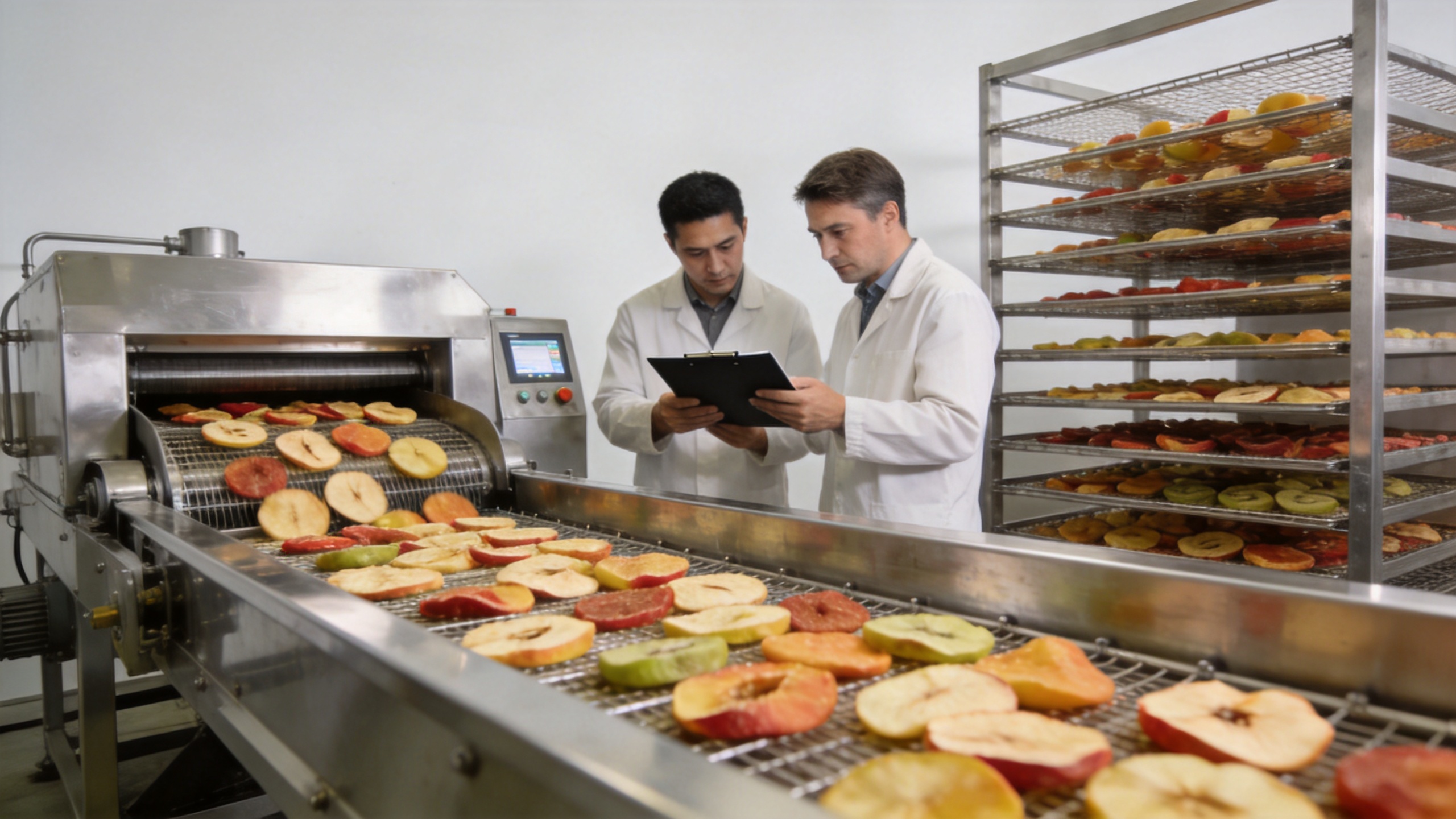
Capacity planning should also reflect how product moves through the plant. Batch-style cabinet or tray systems can suit varied product programs and modest runs because operators can change recipes and load sizes with flexibility. Continuous belt-style drying may be more appropriate when the product format is stable and a predictable flow from preparation to packing is required. Neither format is automatically better; the right choice depends on the mix, labor model, cleaning schedule, and expansion plan.
For small and medium processors, a common mistake is to compare only the purchase price of a food dryer. A lower initial cost may be attractive, but loading labor, energy availability, spare-parts planning, cleaning access, and downtime response also influence total ownership cost. If the product range changes frequently, the time needed to clean and validate a new batch can be as important as the drying chamber’s stated volume.
Automation involves a similar trade-off. Greater automation can improve repeatability and reduce handling, yet it may require more capable controls support and more disciplined maintenance. A plant without dedicated maintenance resources may be better served by a configuration that operators can inspect, clean, and troubleshoot consistently.
Build in a Realistic Capacity Allowance
Planning for growth is sensible, but buying the largest food dryer available is not necessarily the economical answer. An oversized system can increase capital cost, utility demand, and the difficulty of maintaining stable drying conditions at low load. Instead, document the expected demand range for the next planning period and decide whether growth will be handled through longer operating hours, a second shift, modular additions, or a larger initial system.
Ask suppliers to discuss performance at your likely minimum, normal, and peak loads. Also ask how the dryer responds to seasonal raw-material variation. Fruit and vegetables can differ from lot to lot, so a robust plan needs room for adjustments to temperature, airflow, residence time, and loading density without treating every variation as a machine fault.
Check the Interfaces Before You Place an Order
A food dryer is part of a line, not a stand-alone purchase. Before final selection, review:
- Upstream preparation: washing, cutting, dewatering, and feed consistency.
- Utilities: available electrical capacity, heat source, ventilation, drainage, and any required compressed air.
- Space and access: installation footprint, loading paths, maintenance clearance, and cleaning access.
- Downstream handling: cooling, inspection, weighing, packaging, and moisture-protection steps.
- Acceptance testing: product, load, run duration, measurements, and pass criteria to document before delivery.
These checks prevent an expensive mismatch in which the dryer can technically run but the overall line cannot sustain its intended output. It is also wise to agree on a test plan that reflects representative product rather than a short, ideal-condition demonstration.
Food Dryer Capacity Questions to Put in Every Quote Request
A disciplined quote request makes food dryer comparisons easier. For each food dryer proposal, ask the supplier to state wet-feed rate, water-removal rate, product moisture assumptions, and net operating hours. Ask how the food dryer was loaded during testing and whether the food dryer capacity changes for different slice sizes. Ask which utilities the food dryer needs at normal load and what cleaning time the food dryer requires between products.
Also request a layout showing how the food dryer connects to preparation and packing. Confirm whether the food dryer can maintain the intended product flow at peak season, whether the food dryer supports your planned batch size, and whether food dryer controls allow repeatable recipes. A food dryer quotation is more useful when its stated output is tied to a defined product and test method.
| Capacity question | Why it matters |
|---|---|
| What water-removal rate is the food dryer rated for? | It links food dryer sizing to real moisture load. |
| What product and loading condition was used for the food dryer test? | It shows whether the food dryer result is comparable to your material. |
| How much non-drying time does the food dryer cycle include? | It avoids overstating food dryer shift output. |
| What utilities and ventilation does the food dryer require? | It checks whether the food dryer fits the site. |
| How is food dryer cleaning handled? | It protects food dryer availability and product changeover time. |
| Can the food dryer be expanded or paired with a second unit? | It helps food dryer planning reflect growth without oversizing today. |
A Procurement Checklist for a Food Dryer
When comparing proposals, give every supplier the same input sheet: product type, wet-feed range, initial and target moisture, target daily output, operating hours, available utilities, preferred degree of automation, installation constraints, and expected growth path. Request a clear statement of the conditions behind the proposed capacity and a description of what is included for controls, training, documentation, and spare parts.
For plants evaluating a machine for fruit and vegetable dehydration, the Industrial Drying Vegetable Dryer Fruit Drier Machine Dehydrator Automatic can be reviewed as part of that comparison process. Confirm the final configuration against your own product trials, site utilities, and acceptance criteria rather than assuming a generic capacity applies to every material.
Make Capacity a Verified Decision
The right food dryer capacity is the one that fits verified water-removal demand, real operating hours, and the pace of the whole production line. Start with product data, calculate the workload, allow for non-productive time, and compare proposals under equivalent conditions. This gives a small or medium processing plant a more defensible investment decision and a clearer path to stable dried-product quality.