EN


How to Choose a Commercial Food Dehydrator by Capacity and Tray Area
Choosing a food dehydrator machine for a business starts with production planning, not a tray-count headline. A small processor, co-packer, farm brand, or ingredient supplier needs to know how much wet product enters each batch, how thinly it can be spread, how long it takes to dry, and how often the operator can load and unload. Those answers determine the useful size of a commercial food dehydrator machine.
For a buyer comparing equipment, capacity and tray area are connected but not interchangeable. A cabinet with more trays may have less usable area than another cabinet with fewer, larger trays. More importantly, a food dehydrator machine only delivers its planned output when airflow, loading density, temperature control, sanitation access, and the daily work schedule are considered together.
Start with the daily production target
Begin by defining a production target in kilograms or pounds of fresh material per day, then list the products separately. Sliced apple, mango, herbs, jerky, mushrooms, and vegetable flakes do not load or dry in the same way. A food dehydrator machine selected for thin fruit slices may be poorly sized for thicker vegetable pieces or sticky products that need more tray space and more frequent handling.
Use this practical planning sequence:
- Estimate fresh product to be processed per day and per shift.
- Decide the realistic batch window, including loading, drying, cooling, unloading, and cleaning.
- Run a representative test batch to establish a safe loading depth and single-layer coverage.
- Calculate the tray area needed for that loading pattern, then add room for seasonal peaks and normal operating variation.
This sequence prevents a common mistake: sizing a food dehydrator machine from nominal tray count alone. Actual throughput comes from usable square area multiplied by acceptable loading density and the number of completed batches, not from a catalogue number by itself.
Convert tray dimensions into usable drying area
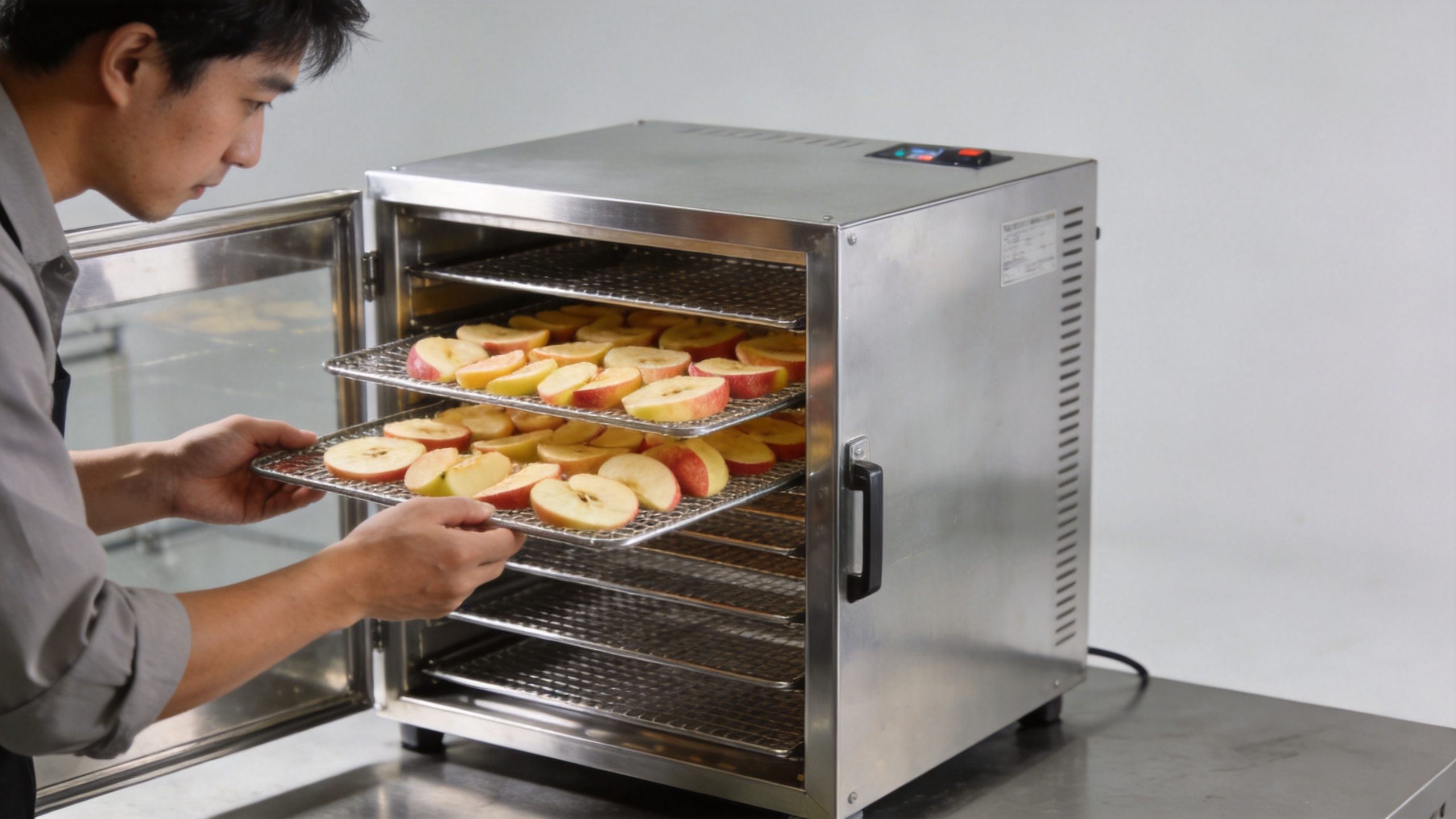
Ask each supplier for tray length, tray width, number of trays, internal clearance, and the recommended loading method for your product. The basic calculation is simple: tray area equals length times width, and total area equals one tray area times the number of usable trays. But the result is a planning starting point rather than a production guarantee.
For example, commercial guides show tray formats ranging roughly from 12 by 12 inches to 18 by 26 inches. Larger trays can reduce handling steps, while smaller trays can make delicate or mixed-product batches easier to organize. Your food dehydrator machine should allow airflow around the product and give staff enough access to load and remove trays without damaging the material.
| Question | Why it matters |
|---|---|
| What is the net tray area? | It gives a comparable baseline across different cabinet sizes. |
| How much edge area is usable? | Product placed too close to walls or airflow paths may dry differently. |
| What layer depth is recommended? | It determines real loading density and affects drying time. |
| Can trays be rearranged safely? | It helps manage products that dry unevenly during a batch. |
Check airflow before accepting a capacity claim
A commercial food dehydrator machine removes moisture with controlled heat and moving air. If trays are overloaded, airflow paths narrow and the centre of a load can dry more slowly than the edges. That can extend the batch, increase labour, and reduce the useful capacity you expected from the cabinet.
Discuss the airflow direction with the supplier: horizontal, vertical, or a managed circulation pattern. Then ask how the design handles full loads, partial loads, different product thicknesses, and trays near doors or corners. A well-matched food dehydrator machine should support repeatable operation rather than forcing the operator to guess where the wettest trays will be.
Temperature range and recovery also deserve attention. A new load introduces cool, wet material, so a process with frequent loading needs equipment that can return to the planned conditions without excessive swings. The correct setting still depends on the food, moisture target, and local processing requirements; it should be validated with your own product trial.
Match the machine to batch rhythm and labor
Capacity has a human side. If one large batch takes most of a day, a high-tray-count food dehydrator machine may be right for a centralized operation. If the business dries several products in smaller runs, two smaller cabinets may offer more flexibility and reduce the cost of a delayed batch. Consider whether employees can load trays at the intended frequency, where cooling takes place, and how finished product moves to packaging.
Also check cleaning access, tray material, drainage, door clearance, electrical supply, ventilation, and the floor space needed for staging racks. These items do not change the tray-area formula, but they strongly influence whether a food dehydrator machine can deliver reliable daily output.
Use a supplier comparison sheet
For a consideration-stage purchase, compare each food dehydrator machine using the same inputs: net tray area, recommended loading density for your product, expected batch duration, power requirements, airflow arrangement, cleaning method, spare parts support, and expansion options. Request a trial based on your raw material whenever possible. The trial should record fresh weight, loaded area, drying time, finished yield, and any tray-to-tray variation.
Hongle Machinery can discuss a capacity-led configuration for food processing projects and provide information on an Industrial Drying Vegetable Dryer Fruit Drier Machine Dehydrator Automatic. Treat the product discussion as the next step after confirming your material, batch target, utilities, and validation plan.
Final buying checklist
- Confirm fresh input per batch and per day.
- Calculate net tray area, not only tray quantity.
- Validate loading density with your actual food product.
- Review airflow, temperature control, cleaning, and access.
- Allow capacity for peak demand, maintenance, and future growth.
The most suitable food dehydrator machine is the one that turns a realistic loading plan into repeatable finished output. By tying capacity to tray area, airflow, product thickness, and daily workflow, buyers can compare commercial options with fewer assumptions and make a more defensible investment decision.