EN


How to Compare Food Freeze Dryer Machine Capacity and Cost
Choosing a food freeze dryer machine is less about finding the largest stated batch number and more about matching a system to the output, product quality, utilities, and labor model of your factory. For a B2B buyer, two machines with similar tray counts can produce very different real-world results. The reason is simple: freeze-drying capacity is governed by water removal and cycle time, not by cabinet size alone.
This comparison framework helps food processors evaluate a food freeze dryer machine for fruit, vegetables, prepared foods, ingredients, and other value-added products. It focuses on the questions that matter before requesting a quotation: how much sellable product is needed per day, what constrains each batch, and what costs remain after the equipment is installed.
Start With Required Daily Output, Not a Supplier’s Headline Capacity
Ask first: how many kilograms of finished freeze-dried product must leave the line each day or week? Then work backward. A practical planning equation is:
Required wet load per day = required finished output ÷ expected finished-product yield.
For example, a fruit with high initial moisture may yield only a small fraction of its fresh weight after freeze-drying. That means a target of 100 kg of finished product cannot be compared directly with a machine described as “100 kg per batch” unless the supplier states whether that figure is fresh loading weight, ice-removal capacity, or finished output. Request all three definitions in writing.
Next, divide the required wet load by the planned number of completed cycles. A full cycle includes loading, freezing, primary drying, secondary drying, defrosting, unloading, and preparation for the next batch. Food freeze-drying can take roughly 24 to 48 hours depending on the product and process conditions, so an optimistic one-batch-per-day assumption can distort an investment decision. Pilot tests with the actual recipe, cut size, tray depth, and packaging target are more valuable than a generic capacity chart.
Compare the Four Capacity Limits Together
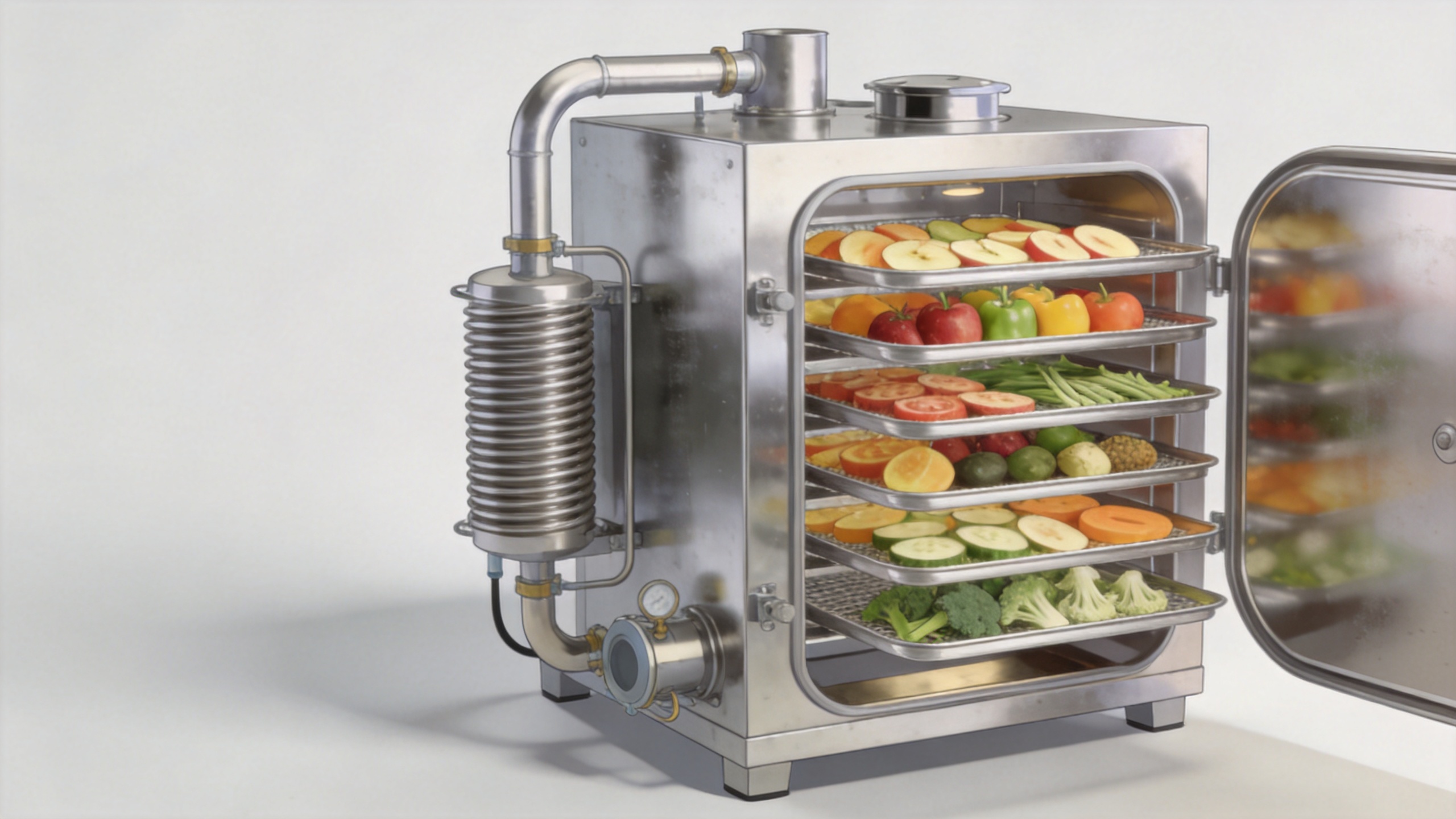
A food freeze dryer machine should be evaluated as a balanced system. The following limits should be reviewed together:
| Capacity factor | What to request | Why it changes output |
|---|---|---|
| Shelf area and tray loading | Usable shelf area, tray dimensions, loading depth, recommended kg/m² | Too much product depth slows vapor flow and can extend the cycle. |
| Condenser ice capacity | Maximum ice capture per batch and capture rate | The condenser must handle the water removed from the food without becoming the bottleneck. |
| Refrigeration and heating performance | Shelf cooling/heating range, pull-down performance, temperature uniformity | These determine how consistently the product freezes and receives drying energy. |
| Vacuum system | Pump type, control method, vacuum stability, maintenance needs | Stable vacuum supports controlled sublimation and repeatable drying. |
Freeze-drying removes frozen water by sublimation under vacuum. Shelf temperature, chamber pressure, and condenser performance therefore work as a system. A larger cabinet is not automatically more productive if its condenser, vacuum capacity, or heat-transfer control does not support the intended wet load.
Use Cycle Time and Utilization to Convert Batch Size Into Daily Capacity
When comparing proposals, calculate a conservative daily output rather than accepting “kg/batch.” Use:
Daily wet throughput = verified wet load per batch × completed batches per day × planned utilization.
Planned utilization should allow for sanitation, defrosting, routine maintenance, changeovers, operator availability, and product variation. A line that looks attractive at 100% utilization may be less economical than a slightly larger system that runs predictably with operating margin. Ask the supplier to identify which part of the cycle is based on measured product data and which part is an estimate.
Also compare products separately. Sliced strawberries, diced vegetables, soup ingredients, meat pieces, and liquid formulations may have different freezing behavior, water loads, and acceptable product temperatures. Do not size a food freeze dryer machine using the easiest product in your portfolio if the difficult product will determine production scheduling.
Compare Cost as Total Cost of Ownership
Purchase price is only one line in the business case. A useful comparison separates capital cost from operating cost and risk cost.
- Capital cost: machine, trays, vacuum equipment, installation, electrical work, cooling-water or chilled-water infrastructure, and commissioning.
- Energy cost: refrigeration, shelf heating, vacuum pumping, defrosting, and any upstream pre-freezing load.
- Labor cost: product preparation, loading, unloading, cleaning, inspection, and packaging.
- Maintenance cost: vacuum-pump service, seals, valves, sensors, refrigeration maintenance, and spare parts.
- Quality and downtime cost: failed batches, uneven moisture, delayed deliveries, cleaning delays, and lost production during repairs.
Request a utilities schedule for each proposal: connected electrical load, expected operating power by phase, cooling demand, compressed-air requirements if applicable, and pump consumables. Compare the same production scenario across suppliers. A lower-priced food freeze dryer machine can cost more over time if it needs longer cycles, more labor, or frequent service.
Check Food-Production Fit Before You Compare Features
Before ranking controls or automation options, confirm that the machine fits your food-production workflow. Review food-contact materials, cleanability, drain design, tray handling, access around the chamber, control-record needs, and the space needed for pre-freezing and packaging. A well-designed process also needs a clear plan for incoming raw-material temperature, uniform cutting, tray loading, post-drying moisture verification, and moisture-barrier packaging.
For buyers adding a broader drying line, an industrial vegetable and fruit dryer machine can be reviewed alongside freeze-drying equipment for products where a conventional drying route may better match the target texture, cost, and volume.
A Procurement Checklist for a Food Freeze Dryer Machine
- Provide the supplier with product type, initial moisture, cut size, target final moisture, and daily finished-output target.
- Ask for a capacity statement that separates fresh load, ice-removal capacity, and finished output.
- Request a representative cycle profile, including loading, drying, defrosting, and turnaround time.
- Compare usable shelf area, condenser capacity, refrigeration capability, and vacuum specifications as one system.
- Calculate utilities, labor, maintenance, and downtime exposure over the expected operating life.
- Run or review a pilot test before finalizing the production capacity commitment.
Make the Final Decision on Verified Output and Risk
The most suitable food freeze dryer machine is not necessarily the one with the highest stated batch capacity or the lowest quotation. It is the one that can repeatedly achieve your required finished output at acceptable product quality, cycle time, utility use, and operating risk. Build the comparison around verified product trials and total cost of ownership. That approach gives procurement teams a clearer basis for choosing capacity today while leaving room for future growth.